


 Italiano
 Français
 Deutsch
 Español
 Português
 Svenska
 Suomi
Suomi
The Real Environmental Cost of Meat
Data and Alternatives
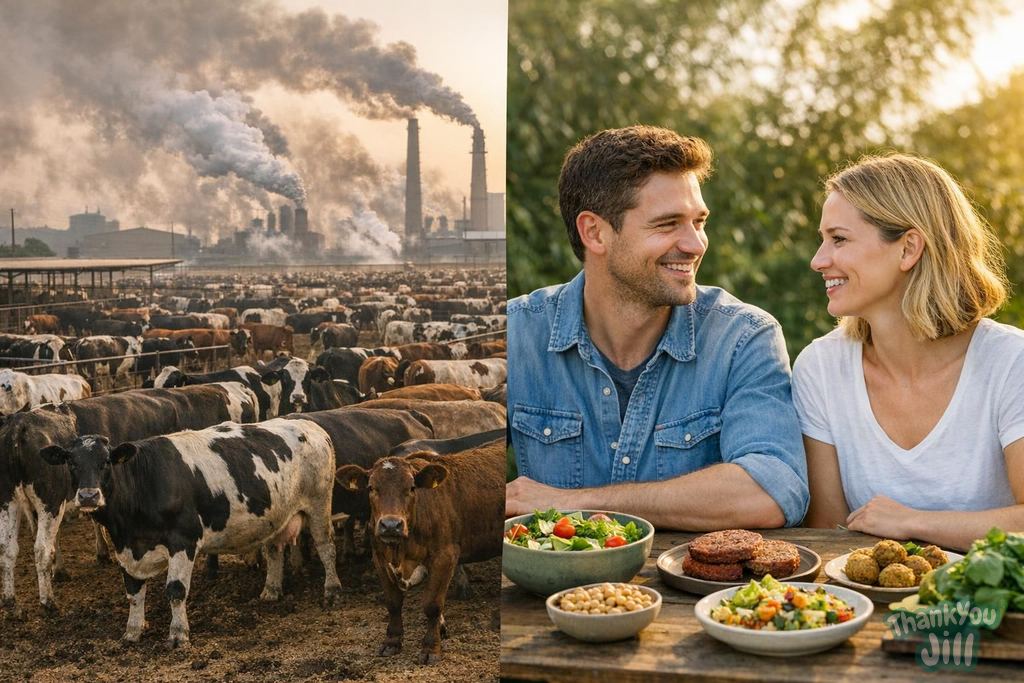
When you drive to work, you know you're contributing to CO2 emissions. But when you put a kilogram of beef in your shopping cart, you rarely think about the fact that purchase has a climate impact comparable to—or exceeding—hours of driving. The global food system is responsible for roughly 26% of total greenhouse gas emissions. Of these, livestock farming accounts for 14.5% of the global total (FAO, 2013). That's more than all transportation combined—planes, ships, cars, and trucks together.
Beef: The Emissions Champion
Producing 1 kg of beef protein requires an average of 50 kg of CO2 equivalent. The comparison with other foods is striking: 1 kg of lentil protein emits 0.9 kg of CO2eq. Chicken: 5.7 kg. Pork: 7.6 kg. Tofu: 1.6 kg. Beef doesn't just emit significantly more than tofu—it emits roughly 55 times more. The main culprit is methane produced by enteric fermentation in cattle (the digestive process in ruminants releases methane through belching) and nitrous oxide from manure. Both are far more potent greenhouse gases than CO2 (methane is 25 times more potent, nitrous oxide 298 times more potent over a 100-year period).
Land Use: The Other Major Crisis
Seventy-seven percent of global agricultural land is used for livestock farming (pasture and feed crops), yet it produces only 18% of global calories and 37% of protein. The remaining 23% of agricultural land (crops grown directly for human consumption) produces 82% of calories and 63% of protein. The inefficiency is staggering: producing 1 calorie of animal protein requires an average of 10 calories of plant-based input (animal feed).
Amazon deforestation is driven 70–80% by cattle ranching expansion and soy cultivation for animal feed. Terrestrial biodiversity is declining at an accelerating rate, with agricultural expansion for livestock as the primary driver.
Water Consumption: A Silent Crisis
The water footprint of meat is enormous. Producing 1 kg of beef requires roughly 15,400 liters of water (global average). Chicken: 4,325 liters. Lentils: 1,000 liters. Avocado: 320 liters (high but incomparable to beef). In regions already facing water stress, intensive livestock farming puts local water reserves under severe pressure.
Not All Meat Is Equal: Differences Between Systems
Beef from pasture grazing on permanent natural grasslands has a carbon footprint far more variable than the average cited above. In some well-managed extensive grazing systems, pastures sequester enough carbon in the soil to partially offset emissions. Carbon sequestration through managed rotational grazing is real but controversial—the extent of the effect is heavily debated in the literature. In any case, beef from extensive pasture systems has significantly lower impact than beef from intensive feedlot operations with imported feed.
Chicken and pork, while having much higher per-capita emissions than plant-based proteins, have significantly lower impact than beef. Not all meats carry equal weight: reducing beef has far greater impact than reducing chicken.
The Planetary Health Diet: A Concrete Path Forward
The EAT-Lancet Commission translated science into practical recommendations: maximum 100g of red meat per week, maximum 200g of fish, maximum 200g of poultry, with protein primarily from legumes, nuts, and seeds. This framework reduces food-related emissions by 49–54% compared to the average Western diet. It's not veganism—it's a realistic, evidence-based adjustment.
Emerging Protein Alternatives
Traditional plant-based proteins (legumes, soy, nuts): already available, affordable, with excellent nutritional profiles. Cultivated meat: still limited production scale and high costs, but with potential for 90% emissions reduction compared to conventional meat. Insect protein: extremely efficient in feed conversion, already commercialized in Europe (cricket flour, mealworms). Precision fermentation: proteins produced by microorganisms with minimal carbon footprint.

Every time you choose legumes instead of a steak, you save the equivalent of dozens of kilometers of driving in emissions. You don't need to become vegan—you just need to shift the balance. Less beef, more lentils: a small choice with outsized impact.
Calculate Your Food Footprint
Free online tools like "My Climate" or "Shrink That Footprint" let you calculate your diet's carbon footprint. Enter what you typically eat in a week and get a concrete number in kg of CO2eq. Then experiment: what happens if you cut beef from 3 times a week to once? How much does the number drop? Seeing the concrete data is far more motivating than any climate change article.
Meatless Monday: A Concrete First Step
The Meatless Monday movement proposes eliminating meat on Mondays. It's a minimal change requiring zero permanent sacrifice. If all Italians did this, the annual emissions reduction would be equivalent to removing millions of cars from the road. Start on Monday. Then add Wednesday. Gradual changes stick better than radical ones.
Concrete Substitutions for Your Favorite Meat Dishes
Bolognese sauce: replace 50% of the ground meat with finely cooked red lentils. The flavor is nearly indistinguishable, the texture similar, the protein equivalent. Burgers: use patties that are 50% meat and 50% black beans or chickpeas—more tender, more flavorful, less expensive. Tacos and fajitas: black beans are the original Mexican filling, predating Spanish colonial beef. These tweaks reduce the meat's impact in dishes you love without eliminating it entirely.
Choose the Right Cut to Reduce Waste
When buying meat, prioritize less desirable cuts (the ones nobody wants): shoulder, osso buco, tail, jowl, offal. They're cheaper, require slow cooking that develops extraordinary flavors, and make use of animal parts that might otherwise go to waste. Offal has a much lower per-kilogram footprint than filet. Cooking the whole animal, nose to tail, is the most respectful and sustainable practice.
Frequently Asked Questions
What is the environmental impact of beef production compared to other protein sources?
Producing 1 kg of beef protein emits roughly 50 kg of CO2 equivalent, far more than chicken, pork, tofu, or legumes. Beef is the largest emissions contributor among meats, primarily due to methane produced by cattle digestion.
How does intensive livestock farming affect deforestation and biodiversity?
Cattle ranching expansion and soy cultivation for animal feed drive 70–80% of Amazon deforestation, causing rapid terrestrial biodiversity decline through conversion of natural habitats into agricultural land.
When should you choose pasture-raised beef over intensively farmed beef?
Beef from extensive pasture grazing can have a lower carbon footprint thanks to soil carbon sequestration, while intensive feedlot operations with imported feed have much higher environmental impact. However, the effectiveness of rotational grazing remains debated.
What are some practical alternatives to reduce environmental impact without eliminating meat entirely?
Reducing beef consumption and partially replacing it with legumes like lentils or beans in your favorite dishes, adopting Meatless Monday, and choosing less premium cuts to avoid waste are effective strategies for lowering environmental impact while maintaining flavor.

Latest News




Comments
No comments yet. Be the first!
Leave a comment