


 Italiano
 Français
 Deutsch
 Español
 Português
 Svenska
 Suomi
Suomi
Intensive Agriculture
Hidden Costs for the Environment
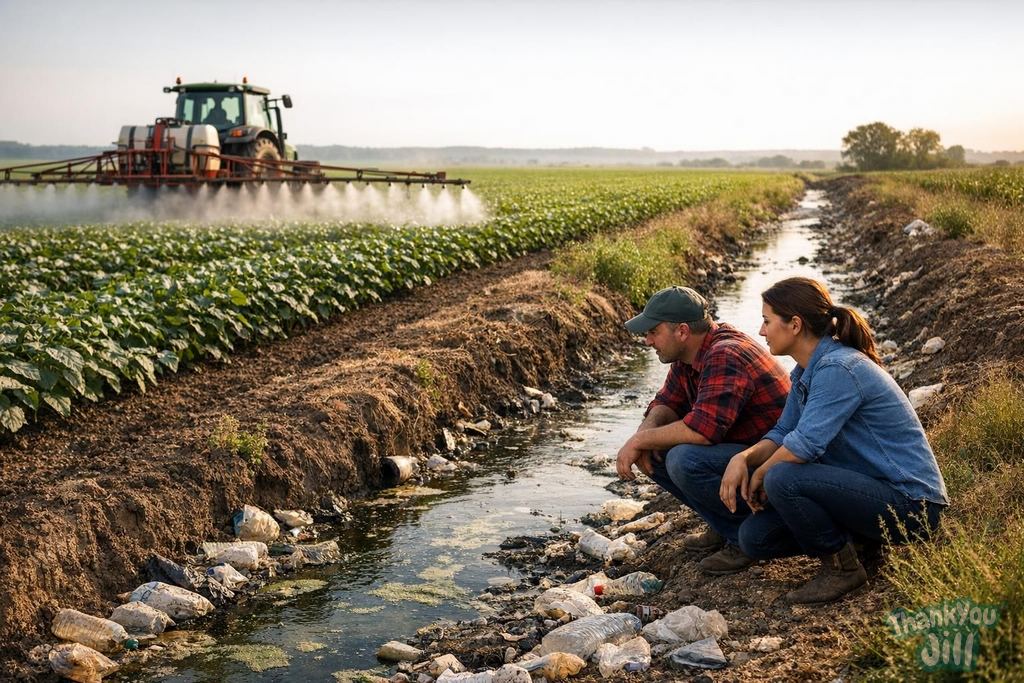
The Green Revolution of the 1960s and 1970s increased global agricultural yields extraordinarily, feeding billions of people who would otherwise have starved. Yet this success came at a massive environmental cost, now visible in soil degradation, groundwater contamination, the collapse of pollinator populations, antibiotic resistance, and the loss of agricultural biodiversity. Understanding these mechanisms isn't an exercise in nostalgia—it's grasping the challenges our food system must face in the coming decades.
Soil Degradation: The Legacy of Chemical Agriculture
Agricultural soil is an extraordinarily complex ecosystem: a single teaspoon of healthy soil contains more living organisms than there are people on Earth. Intensive agriculture degrades soil through: repeated deep plowing (destroys soil structure and releases organic carbon into the atmosphere), use of synthetic nitrogen fertilizers (inhibit soil microorganisms that naturally produce humus), pesticides and herbicides (kill beneficial microorganisms, mycorrhizal fungi, and soil invertebrates), continuous monoculture (depletes specific nutrients and favors specialized pests). The FAO estimates that 33% of the world's agricultural soils are moderately or severely degraded. At this rate, productive agricultural soils could shrink significantly in coming decades, precisely when global food demand is rising.
Pesticides and Pollinators: The Bee Crisis
Bees and other pollinating insects are responsible for pollinating roughly 75% of the world's flowering plants and 35% of global food production (fruits, vegetables, nuts). Wild bee and honeybee populations have collapsed dramatically in recent decades: losses of 30-50% of colonies in the USA and Europe are common. The main causes: neonicotinoid insecticides (imidacloprid, clothianidin, thiamethoxam), used as a preventive treatment on billions of seeds of corn, sunflower, and rapeseed, directly kill bees and impair their spatial orientation. Habitat loss (wildflowers along hedgerows and field margins, eliminated to maximize cultivated area). Pathogens (Varroa destructor, Nosema). The pollinator crisis isn't just an ecological problem—it's a direct threat to global food production.
Synthetic Nitrogen Fertilizers and the Broken Nitrogen Cycle
Synthetic nitrogen fertilizers (produced by the Haber-Bosch process, which fixes atmospheric nitrogen—a process consuming 2% of global energy) enabled enormous increases in agricultural yields. But 50-70% of nitrogen applied to fields isn't absorbed by crops: it leaches into groundwater and rivers (eutrophication), evaporates into the atmosphere as nitrous oxide N2O (a greenhouse gas with 298 times the climate-warming power of CO2), or converts to ammonia (air pollution). Marine "dead zones" (where oxygen is too low to support life) are created by excess nitrogen reaching the sea through rivers. Reducing nitrogen loss in agriculture is one of the most critical technical and agronomic challenges of the coming decades.
Antibiotic Resistance: The Livestock Problem
73% of all antibiotics consumed globally are used in animal farming, primarily preventively (not to treat sick animals, but to prevent disease in overcrowded conditions) and as growth promoters (banned in the EU since 2006, still used in many other countries). This massive and often inappropriate use of antibiotics in animals accelerates the development of bacterial resistance (AMR: Antimicrobial Resistance), which then transfers to humans through the food chain, the environment, and direct contact with animals. The WHO identifies antibiotic resistance as one of the ten greatest global threats to public health. Antibiotic-resistant bacteria already cause 700,000 deaths annually worldwide—a number that could rise to 10 million by 2050 without drastic action.

Intensive agriculture has fed the world. Now it risks making it impossible to feed in the future. This isn't romantic criticism—it's an assessment of the externalities the system has ignored for 70 years. Degrading soil, disappearing bees, antibiotics that no longer work: these are the bills that arrive late, but they always arrive.
How Your Food Choices Influence Intensive Agriculture
Consumer choices drive the production system through the market. Actions with the greatest impact: reduce consumption of meat from intensive farming (the sector with the highest antibiotic use and soil impact), prefer organic products for categories with heavy pesticide use (the EWG's "Dirty Dozen" lists the 12 conventional products with the highest pesticide residues each year: strawberries, spinach, peaches, apples, grapes, bell peppers, cherries, blueberries, green beans, pears, celery, kale), support producers using regenerative techniques (crop rotation, cover crops, reduced plowing), choose products with Demeter (biodynamic) or certified organic certification as a signal of different soil management.
Precision Agriculture: Technology Serving Sustainability
Precision agriculture uses sensors, GPS, drones, and artificial intelligence to optimize water, fertilizer, and pesticide use by applying them only where and when needed, rather than uniformly across the entire field. Documented results: 20-40% reduction in fertilizer use, 20-50% reduction in pesticide use, 20-40% reduction in water consumption. This isn't a return to the past—it's advanced technology in service of reducing environmental impact. The European Union is funding this transition through the new CAP ("Farm to Fork" strategy), which aims to reduce pesticide use by 50% and fertilizer use by 20% by 2030.
Concrete Alternatives to Intensive Agriculture
Alternatives to conventional intensive agriculture aren't a single thing—they're a spectrum of approaches with varying degrees of change. Certified organic: elimination of synthetic chemical pesticides and synthetic nitrogen fertilizers, but not necessarily soil regeneration. Biodynamic (Demeter): organic plus soil management as a living ecosystem, complex rotations, biodynamic preparations. Regenerative agriculture: the most comprehensive approach, discussed in the next article. Low-input integrated: progressive reduction of pesticides and fertilizers while maintaining high yields through integrated pest management (IPM). Permaculture: systematic design of agroecosystems that mimic natural ecosystems.
Frequently Asked Questions
What are the main environmental impacts of intensive agriculture on soil?
Intensive agriculture degrades soil through repeated deep plowing, use of synthetic nitrogen fertilizers that inhibit beneficial microorganisms, pesticides that kill useful organisms, and monocultures that deplete nutrients, causing loss of fertility and increased erosion.
How do neonicotinoid pesticides affect bee and pollinator populations?
Neonicotinoid pesticides, used as a seed treatment on many crops, directly kill bees and impair their orientation, contributing to the drastic decline of wild and honeybee colonies, threatening global food production.
Why does intensive use of synthetic nitrogen fertilizers represent an environmental problem?
50-70% of applied nitrogen isn't absorbed by crops and ends up in groundwater or the atmosphere, causing eutrophication, marine dead zones, and greenhouse gas emissions like nitrous oxide, with serious consequences for ecosystems and climate.
How can precision agriculture reduce environmental impact compared to traditional intensive agriculture?
Precision agriculture uses technologies like sensors and drones to apply water, fertilizers, and pesticides only where necessary, reducing their use by 20-50% and decreasing environmental impact without compromising agricultural yields.
Latest News




Comments
No comments yet. Be the first!
Leave a comment