


 Italiano
 Français
 Deutsch
 Español
 Português
 Svenska
 Suomi
Suomi
Heirloom Seeds
Recovering traditional varieties
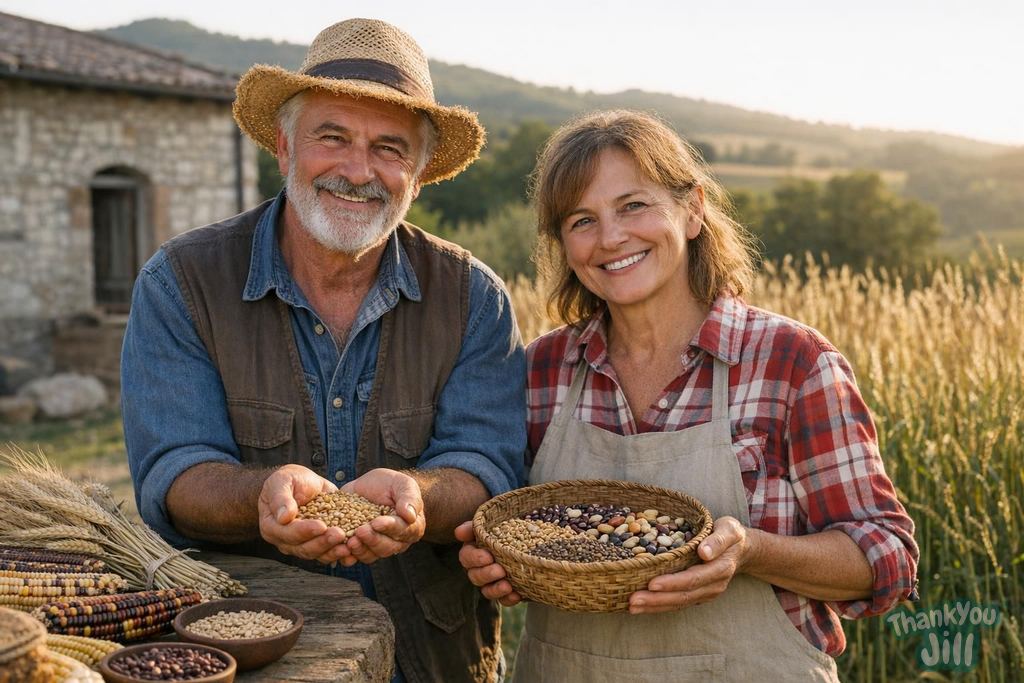
Human agricultural civilization has selected, saved, and exchanged seeds for 10,000 years. Through this extraordinarily long process, thousands of local varieties emerged, each adapted to specific climates, soils, cuisines, and tastes. The twentieth century interrupted this millennia-old tradition: hybrid F1 commercial varieties optimized for industrial yield replaced most local ones. An F1 hybrid seed produces uniform, productive plants, but the seeds you'd harvest from them don't faithfully replicate the parent plant (they segregate, producing non-uniform plants). This forces farmers to buy new seed every year instead of saving it—a system highly convenient for seed sellers, far less so for growers.
Open-pollinated seeds vs. F1 hybrid seeds: the fundamental difference
Open-pollinated varieties (OPV): pollinated naturally (by wind, insects) and produce offspring faithful to the parent plant. Seeds can be saved and replanted year after year, with the variety remaining stable over time. Traditional Italian varieties (the Genovese ribbed tomato, Montefeltro spelt, Lamon bean) are all open-pollinated. F1 hybrid seeds: created by crossing two distinct pure lines in a controlled way. Every F1 seed is genetically identical to the others. High yield, uniformity, often resistance to specific diseases. But seeds from the fruit aren't reproducible with fidelity: the variety "belongs" to whoever created it. Patented seeds: some F1 hybrid seeds are protected by patent. It's illegal to reproduce them without a license. This system of intellectual property on seeds sits at the center of an important ethical and political debate over the appropriation of humanity's shared biological resources.
How to collect seeds from your garden: a practical guide
Tomatoes: choose the most beautiful and flavorful fruits from vigorous plants. Extract the pulp with seeds into a glass of water, let it ferment for 2-3 days (fermentation removes the gelatinous coating that inhibits germination). Rinse, dry on paper towels for 1-2 weeks. Store in a paper envelope with the variety name and year. Beans and legumes: the simplest method. Leave a few pods on the plant until completely mature (they become dry and shriveled). Harvest, dry further in a dry place for 2-3 weeks, shell. Store in a glass jar. Cherry tomatoes, peppers, eggplants: like tomatoes. Lettuce: let it bolt and produce seeds (small, light, white). Harvest when seeds are dry by shaking the seed heads over a sheet of paper. Sift. Squash and zucchini: collect seeds from the mature fruit (squash completely orange/yellow, zucchini grown into an enormous yellowed squash). Rinse, dry.
Seed storage: optimal conditions
Seeds lose viability over time at varying rates: some last only a few years (onion, parsnip, leek: 1-2 years), others for decades (tomato, pepper: 4-6 years, legumes: 3-5 years, cucumber: 5-8 years, tomato: up to 10 years under optimal conditions). The three enemies of stored seeds are: moisture (causes mold and premature germination), heat (accelerates enzymatic breakdown), light (photodegradation). Optimal storage: paper envelopes labeled (variety name, harvest year) inside airtight glass jars, in the refrigerator (0-5°C) or in a cool, dry place (basement, under stairs). Add a silica gel packet for moisture control in the jar. Viability test: before planting old seeds, do a germination test: place 10 seeds on damp paper in a warm plastic bag (25°C). Count germinated seeds after 7-10 days. If fewer than 50% germinate, viability is too low: use more seeds to compensate or skip that variety.
The seed exchange network: how to participate
Seed-saving culture is inseparable from seed-exchange culture: farmers have always exchanged seeds with neighbors and friends, spreading the best varieties. Today, organized networks facilitate this exchange. Rete Semi Rurali (seminaturali.it): Italy's main network of traditional seed keepers. Organizes exchanges, fairs (Biodiversamente, Terra Futura), and local seed banks. Seed Libraries: seed libraries where you "borrow" seeds with the obligation to return them at season's end. They exist in some Italian public libraries (Turin, Milan, Bologna). Online exchange: semintesta.it, biforcuto.com, dedicated Facebook and Telegram groups. Slow Food Farmers Markets: many producers bring traditional variety seeds to markets for exchange or sale.

Saving a seed is an act of faith in the future: this seed can produce plants in 5, 10, 50 years. The hands of farmers who for 10,000 years selected, exchanged, and preserved seeds have reached yours. The ribbed tomato you grow today is the same one your grandmother grew. Don't let it disappear.
How to participate in a local seed bank
Local seed banks function like libraries: you borrow seeds at the start of the season, with the commitment to return double the seeds at season's end (from your best fruits). To participate: search online for "seed bank" + your city or region name. Or contact Rete Semi Rurali (seminaturali.it), AIAB (aiab.it), or Slow Food Italia (slowfood.it) to find active local groups. Some Italian municipal libraries have launched seed libraries: ask at yours. If no initiative exists in your area: starting one, even informally with a few neighbors and friends, is simpler than it seems and has enormous impact on the continuity of local varieties.
The easiest traditional Italian varieties to grow and save seeds from
For those starting seed saving: Genovese ribbed tomato (easy, abundant seeds, high germination), Lamon bean (very simple: let it dry on the plant), Genovese basil DOP (let one branch flower, collect black seeds when dry), Chioggia sea squash (large seeds, easy to collect and store), wide-ribbed chard (biennial: flowers and produces abundant seeds in the second year). Start with just one variety your first year: learn to collect and store correctly, then gradually expand your collection.
Seed saving as a political act
Preserving traditional seeds is also a political act: it maintains biodiversity outside the exclusive control of major seed companies (the top 4 control over 60% of the global seed market). The FAO Convention on international treaties on plant genetic resources (IT PGRFA) recognizes farmers' right to save, use, exchange, and sell preserved seeds: a right that many national regulations limit in various ways. The legal and cultural battle to keep seeds as humanity's common heritage is one of the most important food sovereignty struggles of the twenty-first century.
Frequently asked questions
What's the main difference between F1 hybrid seeds and open-pollinated varieties (OPV)?
F1 hybrid seeds guarantee uniformity and high yield but don't produce seeds faithful to the parent plant, forcing annual purchases. OPV seeds are naturally pollinated and allow you to save and replant seeds while keeping the variety stable over time.
How do you properly store heirloom seeds to maintain their viability?
Seeds should be stored in labeled paper envelopes inside airtight glass jars, in a cool, dry place or refrigerator at 0-5°C, with a silica gel packet to absorb moisture, avoiding heat, light, and humidity that reduce viability.
How can you tell if saved seeds are still viable before planting them?
You can do a germination test by placing 10 seeds on damp paper at 25°C in a plastic bag. After 7-10 days, count how many germinate: if fewer than 50%, viability is low and it's better to use more seeds or choose another variety.
When is it worth participating in a seed bank or heirloom seed exchange network?
It's worthwhile to participate to access local traditional varieties, preserve biodiversity, learn seed-saving techniques, and contribute to the spread of open-pollinated seeds by returning quality seeds at season's end to ensure variety continuity.
Latest News

Comments
No comments yet. Be the first!
Leave a comment