

 English
 Italiano
 Français
 Deutsch
 Español
 Português
 Svenska
 Suomi
Suomi
The Ten Largest Trees in the World
Size, stories, and secrets of trees that defy imagination
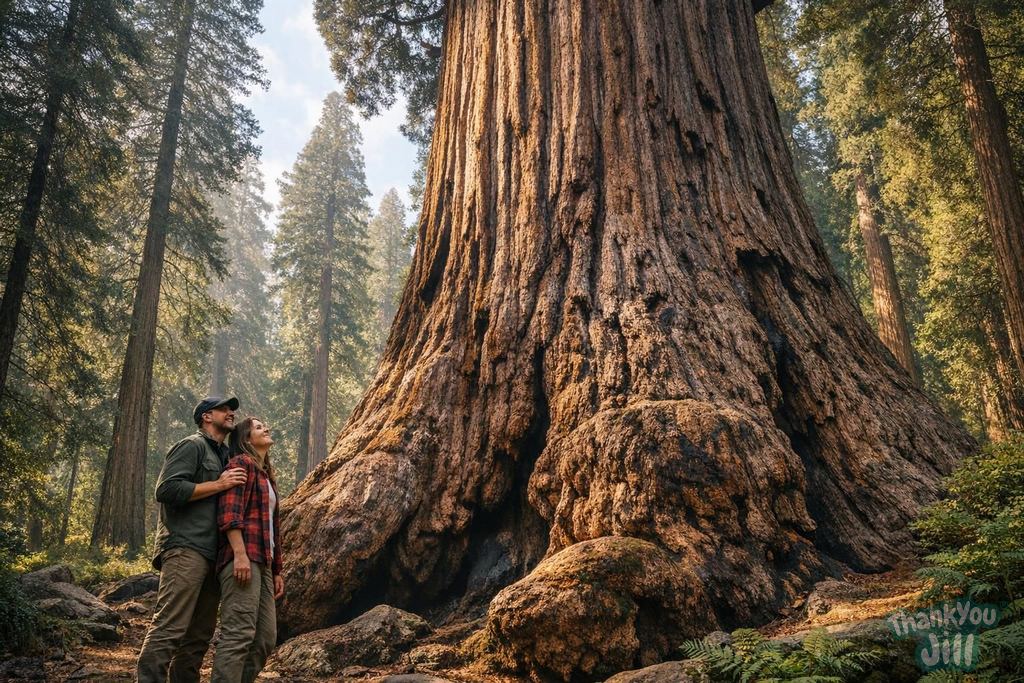
When we talk about the largest tree in the world, we need to be clear about what we're measuring. Height? Wood volume? Total mass? Trunk width? Each criterion points to a different champion — and they're all extraordinary. Here's a journey through Earth's vegetable giants.
General Sherman: The Largest by Volume
The title of largest tree by wood volume belongs to General Sherman, a giant sequoia (Sequoiadendron giganteum) living in Sequoia National Park in California. Its numbers defy imagination: height 83.8 meters (roughly 25 stories), base circumference 31.3 meters, maximum base diameter 11.1 meters, estimated wood volume 1,487 cubic meters, estimated age 2,200–2,700 years, approximate trunk weight 1,385 tons. To put it in perspective: it takes about 16 people with outstretched arms to embrace General Sherman's trunk. Its largest branch alone has a diameter of more than 2 meters — wider than the trunk of many common adult trees. General Sherman is alive, healthy, and still growing: it adds roughly 40 kg of wood each year — more than many normal trees produce in their entire lifetime.
Hyperion: The Tallest in the World
The record for maximum height belongs to Hyperion, a coast redwood (Sequoia sempervirens) discovered in 2006 in Redwood National Park, California. Its measured height is 115.92 meters — equivalent to a 38–40 story building. Hyperion's exact location is kept secret by Park authorities to protect the tree and the delicate surrounding ecosystem from excessive visitor traffic. Coast redwoods (Sequoia sempervirens) differ from giant sequoias (Sequoiadendron): they have narrower trunks but reach greater heights, generally live shorter lives (500–800 years for most, though some specimens exceed 2,000 years), and grow exclusively along the coastal strip of California and Oregon, wrapped in Pacific fog.
Enormous Branches and Impossible Canopies
The sacred banyan of Calcutta (Ficus benghalensis) in the Acharya Jagadish Chandra Bose Indian Botanic Garden has the widest canopy in the world: it spreads across approximately 19,000 square meters — nearly two football fields. It achieves this through its aerial roots: branches that descend toward the ground, touch earth, and become new trunks that support the upper branches. This banyan has more than 3,600 secondary "root trunks" supporting its canopy. From the outside it looks like a small forest — and technically it's a single organism. The Glencoe Baobab in South Africa (unfortunately partially collapsed in 2009 and completely in 2017) had a trunk 15.9 meters in diameter — the largest ever recorded for a single non-clonal tree.
Europe's Giants: Lesser Known but Extraordinary
Europe — and Italy — are also home to trees of exceptional size. The Chestnut of the Hundred Horses on Mount Etna (Catania): historically estimated trunk circumference up to 57 meters (today the original part is partially separated into multiple sections due to natural vegetative division). It's the tree with the largest trunk circumference ever documented in Europe, with an estimated age between 2,000 and 4,000 years. The Pietrasecca beech (Abruzzo): one of Italy's largest beeches, with over 5 meters of circumference. The Tortorici chestnut (Messina): 22-meter circumference, estimated age 4,000 years. The monumental oaks of Foresta Umbra (Gargano): some with canopies extending 25–30 meters in diameter.
Why Are the World's Largest Trees Almost All in the Same Zones?
It's no coincidence that height and volume records concentrate along the North Pacific coast (California, Oregon, Washington). That region has ideal conditions for growing the world's largest trees: abundant precipitation (1,500–3,000 mm annually), constant fog providing moisture even in summer, mild winters without severe frost, deep fertile soils, and historically no large-scale destructive fires. The Italian Mediterranean, with its dry summers, winter frosts, and millennia of human forest use, cannot produce trees of the same scale — but it has something California doesn't: olive trees with 3,000 years of history lived alongside humanity, monumental beeches in Apennine national parks, centuries-old oaks in Gargano forests.

General Sherman has been alive for 2,500 years. It has watched civilizations rise and fall. It doesn't know we measure and photograph it. It grows, and that's all. Perhaps that's the secret of greatness: not knowing it.
How to Visit the World's Giants and Italy's Treasures: Practical Guides
- General Sherman (California, USA): Sequoia National Park, accessible by car from Los Angeles in about 5 hours. The trail to General Sherman is short (400 meters, with moderate slope) and suitable for all ages. The Park is open year-round, but winter access may be limited by snow. Combine it with a visit to the adjacent King's Canyon National Park.
- Chestnut of the Hundred Horses (Sicily, Italy): in the municipality of Sant'Alfio (Catania), on the slopes of Mount Etna. Accessible year-round, free entry to the area where it grows. Can be combined with a visit to Etna and the chestnut and beech forests of the park. It's one of Italy's most extraordinary natural sites, yet far too little known.
- Foresta Umbra (Gargano, Puglia): one of Italy's most beautiful broadleaf forests, with monumental beeches and oaks. Accessible from Vieste or Peschici, with marked trails. The State Forestry Corps organizes guided tours in certain seasons.
- How to measure a large tree near you: to measure circumference, use a tailor's measuring tape (or rope) at 1.30 meters from the ground. To estimate height, use the "pencil method": hold a pencil vertically at arm's length, moving forward or backward until the pencil's height visually matches the tree's height. Then measure the distance you've traveled: that distance equals the tree's height.
- With children: the hug challenge: how many people does it take to wrap around the trunk? Line up children with outstretched arms and count how many it takes to go around. An average beech requires 2 children; a century-old oak 4–5; a monumental chestnut many more. It's a physical activity that makes the scale of trees immediately comprehensible.
- Record the largest trees in your area: it's likely your municipality has at least one monumental tree in the national register. Search www.politicheagricole.it for the "monumental trees" section and find the tree monuments nearest you. Visiting them is one of those gestures that makes you appreciate local natural heritage in a completely new way.
The giants of the plant world remind us that life can reach dimensions and durations that defy every human category. A tree 2,500 years old has traversed the entire span of modern human history without moving a centimeter. Yet it has changed everything around it, every day, silently. There's something profoundly humbling and magnificent in that.
Frequently Asked Questions
What's the difference between the tallest tree and the one with the most wood volume?
The tallest tree is Hyperion, a coast redwood standing 115.92 meters tall, while General Sherman, a giant sequoia, holds the record for wood volume at 1,487 cubic meters. Height and volume measure different characteristics, so the records belong to different specimens.
How do you correctly measure the circumference of a giant tree?
Circumference is measured using a tailor's measuring tape or rope at 1.30 meters from the ground — chest height. This is the standard measurement for comparing the width of monumental tree trunks.
Why are the world's largest trees found mainly on the North Pacific coast?
This zone offers ideal conditions: abundant precipitation, constant fog that maintains moisture, mild winters without severe frost, deep fertile soils, and historically no large-scale destructive fires, all favoring the growth of giant trees like redwoods.
How can I tell if a monumental tree near me is officially registered?
You can consult national registers of monumental trees, often available online through institutional sites dedicated to agriculture or the environment. These lists indicate protected trees and those of historical or natural interest in your area.
Latest News




Comments
No comments yet. Be the first!
Leave a comment