


 Italiano
 Français
 Deutsch
 Español
 Português
 Svenska
 Suomi
Suomi
The Planet's Strangest Trees
Impossible shapes, evolutionary strategies, and botanical wonders
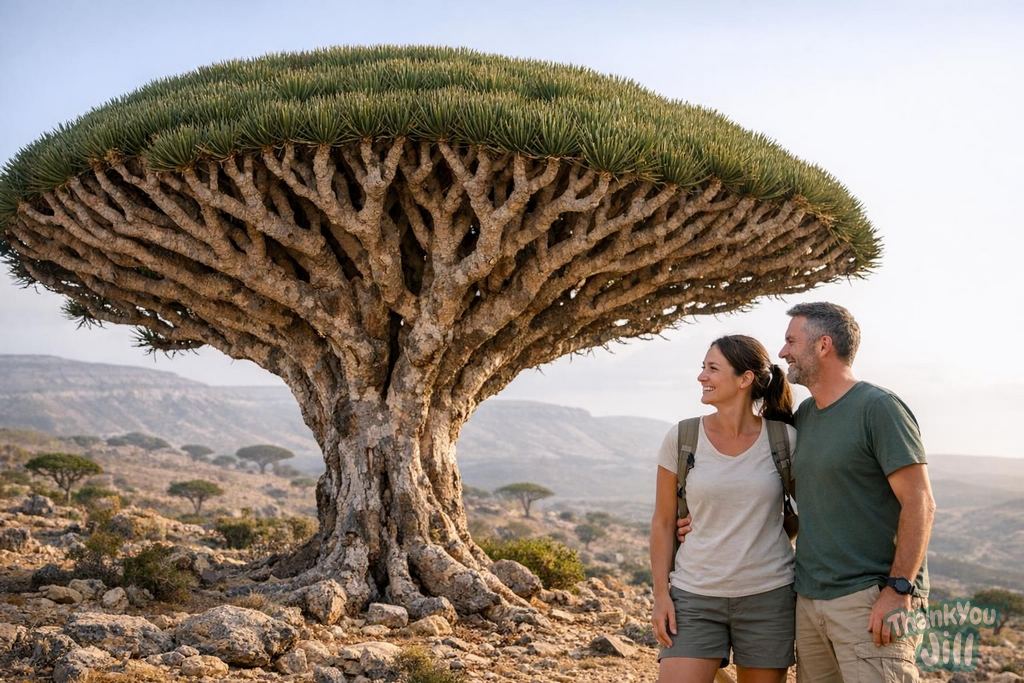
If you think all trees are the same — trunk, branches, leaves — you're missing the best part of botany. The plant world has produced shapes so strange, so improbable, so far outside any conventional framework that they seem straight out of a science fiction novel. Yet they exist, they grow, and there's precise evolutionary logic behind every one of their oddities.
The dragon's blood tree: an umbrella from another planet
The Dracaena cinnabari, the dragon's blood tree of Socotra Island (Yemen), is probably the most alien-looking tree on Earth. Its canopy is flat like an inverted umbrella, dense and compact, supported by a trunk that bifurcates repeatedly in geometric fashion. Seen from above it looks like a giant gray-green broccoli; seen from below, it looks like the sky of another planet. The umbrella's function: on Socotra rainfall is scarce and concentrated in just a few months. The flat canopy collects fog and condenses it into droplets that fall along the branches down to the trunk and roots — a passive and extraordinarily efficient water-harvesting system. The red sap (the "dragon's blood") is a dense resin used for millennia as a dye, violin varnish, and medicine. Socotra has about 700 endemic plant species (found nowhere else) — an evolutionarily isolated island that has developed a flora unmatched for strangeness and beauty.
The baobab with an impossible shape
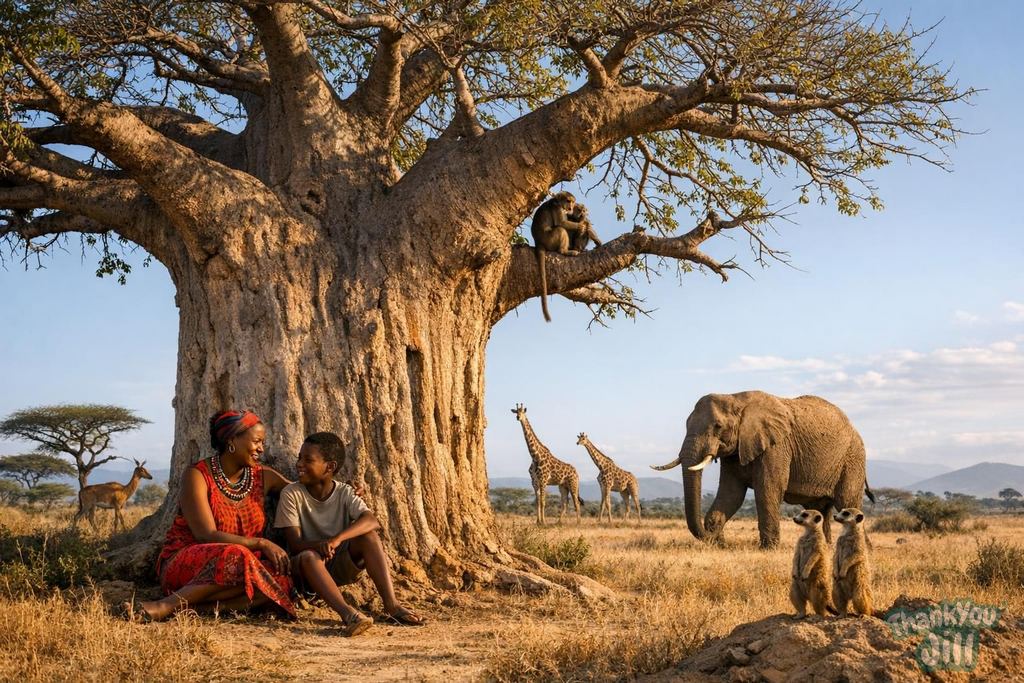
The baobab (Adansonia spp.) looks like a tree planted upside down, with its roots in the air. In reality, the immense and tapered trunk, grayish and almost bark-free in its smooth appearance, is a water reservoir: it can hold up to 120,000 liters of water in its spongy fibers. Leaves appear only for a few months during the rainy season; for the rest of the year the tree is bare, and the twisted branches high above actually look like roots reaching for air. There are 8 different species: 6 endemic to Madagascar, one from continental Africa (A. digitata), and one from Australia (A. gregorii). Some African baobabs are so large that bars, prisons, dormitories, and shepherd shelters have been carved inside them. The Sunland baobab in South Africa (before its partial collapse in 2016) contained a licensed bar capable of accommodating about fifteen patrons inside the trunk.
The traveler's tree: a giant fan
The Ravenala madagascariensis, called the traveler's tree, is not technically a tree but an arborescent herbaceous plant related to the banana. It grows always in a perfect two-dimensional plane — all leaves develop on the same axis, creating an enormous green fan that can reach 15 meters in height. The name "traveler's tree" comes from the legend that lost travelers could find water in the bases of the leaf stalks (where rainwater accumulates). Each plant is always oriented the same way relative to the cardinal directions: east-west axis — a light-response mechanism that made this plant a living compass for Madagascar's navigators.
The tree that walks
The Socratea exorrhiza palm of the Amazon is known as the "walking palm." It grows on a network of stilt roots that extends 1 to 2 meters above the ground. According to a (debated) theory popularized by naturalist Nalini Nadkarni, the palm can slowly "move" toward light by developing new roots in the favorable direction and letting those on the opposite side die. The hypothesized speed is a few centimeters per year — not exactly a sprint, but enough to change position over the course of years. Scientific evidence for this "movement" is still debated, but the stilt roots themselves are real and serve mainly to stabilize the palm in the muddy and unstable soils of the Amazon rainforest.
Hura crepitans: the forest's gun
The Hura crepitans (sandbox tree or dynamite tree) is a tropical American tree that has developed one of nature's most spectacular seed-dispersal mechanisms. Mature fruits literally explode with a sound like a gunshot, launching seeds up to 45 meters away at speeds of about 70 km/h. The explosion is caused by mechanical tension that accumulates in the fruit's shell as it dries in the sun: when the pressure exceeds the limit, the shell cracks with a bang and launches seeds in all directions. The wood is toxic and the bark is covered with conical spines: it's not a tree to hug.

Nature has no design department. It has billions of years of trial and error. And some of the solutions it has found are so strange, so improbable, so magnificently functional that no human engineer would ever have imagined them.
How to explore the world of bizarre trees: practical ideas
- Visit a botanical garden: Italian botanical gardens — the Palermo Botanical Garden, the one in Padua (Europe's oldest, UNESCO-listed), those in Florence, Rome, and Naples — host trees from around the world including bizarre and rare species. They're extraordinary places for anyone wanting to see the diversity of the plant world without getting on a plane. Many Italian botanical gardens have free or discounted admission.
- Look for twisted trees in your area: even in Italy there are trees with surprising shapes. The centuries-old olive trees of Salento, with their hollow and twisted trunks like sculptures, have nothing to envy from the dragon's blood tree in terms of visual strangeness. Hundred-year-old oaks on wind-battered slopes develop asymmetrical and tormented forms of great beauty.
- With children — build a "crazy trees book": challenge kids to find online photos of the world's 10 most bizarre trees. Then have them draw each one and write a sentence explaining why it's strange. The dragon's blood tree, the baobab, the traveler's tree, the walking palm: each drawing becomes a page in a personal book about the diversity of the plant world.
- Film seed explosions in your garden: even without reaching Hura crepitans, many common plants have seed-launching mechanisms: the cyclamen wraps the fruit stalk in a spiral, then releases it with a snap; the violet projects seeds up to a meter away; the geranium has spring-loaded launching mechanisms. Film these launches in slow motion with your phone (many modern smartphones have slow-motion modes at 240 fps): the result is fascinating.
- Look for the "tormented pine" in the mountains: dwarf pines and larches on Italian alpine ridges develop forms of extraordinary expressiveness from wind, snow, and cold. Some shapes resemble abstract sculptures. Photographing them in winter, with snow, is one of the most rewarding photographic exercises in Italian mountains.
The world of bizarre trees is a formidable antidote to the idea that nature is predictable. Every time you think you've figured out how a tree works, nature brings you the baobab, the dragon's blood tree, the walking palm. And it reminds you that 500 million years of evolution have produced solutions that none of us would ever have imagined.
Frequently Asked Questions
What is the evolutionary function of the flat canopy of Dracaena cinnabari, the dragon's blood tree?
The flat canopy of Dracaena cinnabari collects fog and condenses it into water droplets that fall along the branches down to the roots, allowing the tree to survive in environments with scarce rainfall concentrated in just a few months.
How does the baobab store large quantities of water and why does it lose its leaves?
The baobab has a spongy trunk that can hold up to 120,000 liters of water, used during the dry season. To reduce water loss, it sheds its leaves during the arid season, keeping only the twisted branches visible.
What is the seed-dispersal mechanism of Hura crepitans?
Hura crepitans produces fruits that explode with a sound like a gunshot, launching seeds up to 45 meters at about 70 km/h. The explosion is caused by mechanical tension accumulated in the fruit's shell that suddenly cracks.
How would the Socratea exorrhiza palm, called the 'walking palm,' slowly move?
According to one theory, the palm develops new stilt roots toward the light and lets those on the opposite side die, moving a few centimeters per year. This movement is still debated, but the roots serve to stabilize the tree in muddy soils.
Latest News



Comments
No comments yet. Be the first!
Leave a comment