


 Italiano
 Français
 Deutsch
 Español
 Português
 Svenska
 Suomi
Suomi
The Thrush
The Forest's Musician and Essential Seed Disperser
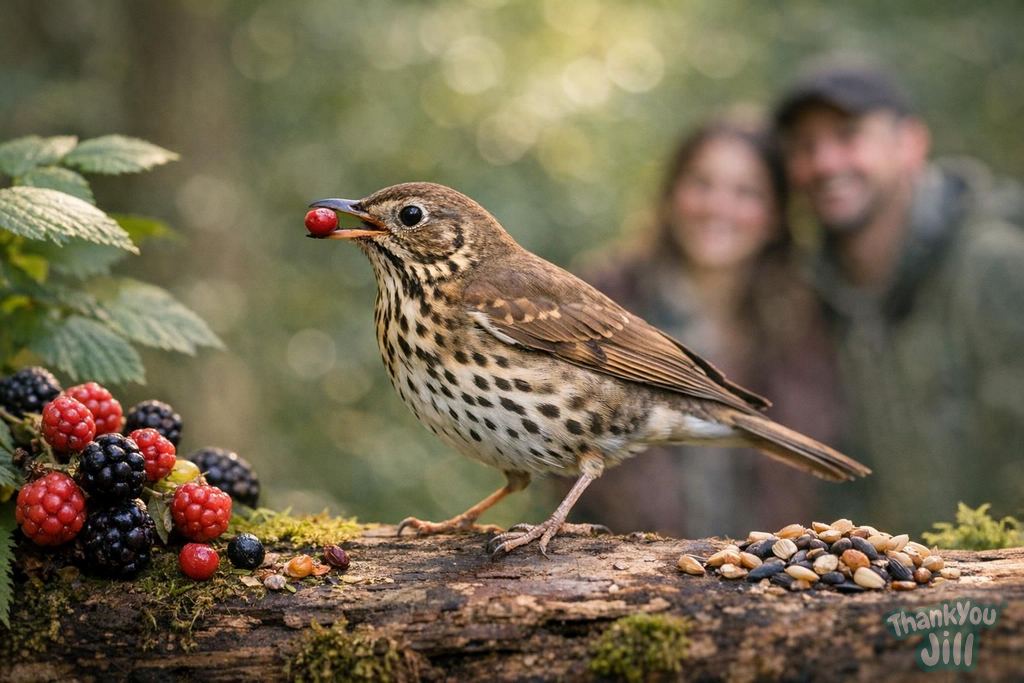
There are March mornings when you open your window and hear a song that sounds like it came straight from an orchestral composition: notes repeated twice, then three times, then changed, then recombined in ever-different ways. It's the song thrush. And even if you don't realize it yet, that song has been shaping the forest around you far longer than you've been alive.
nnItaly's Thrush Family
nnSix species of the genus Turdus live in or regularly pass through Italy. The song thrush (Turdus philomelos) is the most common: brown above, cream with dark spots below, roughly the size of a blackbird but with a shorter tail. The redwing (Turdus iliacus) is similar but with russet-red flanks and a prominent white eyebrow stripe—a migrant that passes through Italy in autumn and winter. The fieldfare (Turdus pilaris): large, with a grey head, brown back, and orange-spotted breast—it arrives from northern Europe in autumn in large, noisy flocks. The blackbird (Turdus merula): technically a thrush, the most common and most urban of them all—the male completely black with a yellow bill. The song thrush is the symbol of thrush song: European bird enthusiasts have ranked it first among the continent's most beautiful songs, alongside the nightingale.
nnThe Song Thrush's Song: An Improvisation Every Morning
nnThe song thrush is one of Europe's most extraordinary singers. Unlike the nightingale (which has a repertoire of roughly 200-300 different syllables) and the blackcap (which has a fixed repertoire per individual), the song thrush improvises: each musical phrase is repeated 2-4 times, then changed or replaced with a new one. A single male's repertoire can include 100-250 different phrases, some learned from other thrushes (imitative learning), others invented. Thrushes in urban areas incorporate anthropogenic sounds into their song—phones, doorbells, car alarms—mixing them with natural calls so seamlessly that you often don't notice their artificial origin. Morning song begins before dawn (often the first bird in the dawn chorus) and can continue for hours. In spring, a single male sings an average of 3-4 hours per day.
nnThe Thrush as Seed Disperser: A Crucial but Overlooked Role
nnThe song thrush's most important ecological role isn't its song: it's seed dispersal. Thrushes are partial frugivores—they feed heavily on berries and fleshy fruits from late summer through winter. Plant species that depend on thrush dispersal include: holly (Ilex aquifolium), mistletoe (Viscum album), rowan (Sorbus aucuparia), hawthorn (Crataegus monogyna), dogwood (Cornus sanguinea), oleaster (Elaeagnus angustifolia), wild rose, ivy, wild cherry, and blackthorn. For many of these species, the thrush is the primary or exclusive disperser. Seeds from berries pass intact through the digestive tract (digestion removes the pulp but doesn't damage the seed) and are deposited via droppings hundreds of meters or kilometers from their origin. Mistletoe, in particular, depends almost entirely on thrushes (especially the song thrush) for dispersal: the sticky seeds adhere to the bird's bill after it eats the white pulp, and are wiped onto a nearby branch—where they'll germinate and grow into a new parasitic plant. This mechanism is so specific that it gave the song thrush its scientific name philomelos ("lover of music"), but in many Germanic languages the bird's name derives directly from mistletoe: in German Misteldrossel literally means "mistletoe thrush."
nnMigration and the Importance of Forests
nnThe Italian song thrush is partially migratory: populations breeding in the Alps and northern Apennines migrate to the western Mediterranean (southern Italy, Spain, North Africa) in autumn, while part of the population remains wintering in milder areas. During migration, thrushes concentrate in berry-rich forests—rowans, hawthorns, hollies—which serve as essential refueling stations to complete their journey. The depletion of these arboreal "stepping stones" along migration routes is one of the main causes of thrush population decline across Europe.

Every March morning, the song thrush perches on the forest's highest branch and improvises. It has no audience. It has no composer. It has only its voice and the 200 themes it has learned and invented. And every morning they're different. This is the oldest music that exists.
How to attract thrushes to your garden and woodland
- Plant berry-bearing shrubs for migrating thrushes: hawthorn (Crataegus monogyna), dogwood (Cornus sanguinea), rowan (Sorbus aucuparia), wild rose, holly, and autumn olive are the most important species for thrushes in autumn and winter. Even a small corner of your garden with 3-4 of these shrubs can become a vital refueling stop for migrating thrushes.
- Leave berries on the branches: resist the urge to "tidy up" your garden by removing berry-laden branches in autumn. Those berries are fuel for migrating thrushes arriving from northern Europe. Every year, in November and December, flocks of fieldfares and redwings stop in gardens with rowans and hawthorns — an extraordinary display of backyard birdwatching.
- Install a thrush feeding station: thrushes won't come to hanging feeders. They prefer food on the ground or on low platforms. Place on your garden soil: halved apples, raisins softened in water, hawthorn berries, crushed eggshells (for calcium). In winter, when the ground is frozen and food is scarce, these supplies can be lifesaving.
- Don't use slug pellets containing metaldehyde: granular slug products containing metaldehyde are deadly to thrushes (and hedgehogs) that eat poisoned slugs. Use beer traps or ferric phosphate-based products instead (safe for vertebrates).
- Listen to the dawn chorus in spring: wake up an hour before sunrise in April and open your window. The first bird you'll hear, still in near-total darkness, will almost certainly be a song thrush. Then others will join in. By first light, it will be a full orchestra. The dawn chorus is one of nature's most beautiful acoustic phenomena — free to experience from any window near a garden or woodland.
- With children — record the birdsong: take children into the woodland early in the morning in spring and record 2-3 minutes of bird calls on your phone. Then at home, use BirdNET to identify each species in the recording. The song thrush will almost certainly be present. Listening to the recording and recognizing individual calls is an extraordinary exercise in active listening.
The song thrush carries holly berries to woodlands where they never grew. It carries rowan seeds to mountains where they never arrived. It brings its improvised music every March morning. Its presence is so constant and so rich that it takes a moment of attention to truly see it — but once you do, you never forget it.
Frequently asked questions
What is the main ecological role of the song thrush in the woodland?
The song thrush is a fundamental seed disperser for many tree species. It eats berries and fruits, and the seeds pass intact through its digestive system, later being deposited far away, promoting the regeneration and spread of plants.
How do you recognize a song thrush's call compared to other birds?
The song thrush's call is characterized by improvised musical phrases, repeated 2-4 times and then varied. It has a repertoire of 100-250 different phrases, often incorporates human-made sounds, and sings mainly at dawn for several hours.
When and why should you plant berry-bearing shrubs to attract thrushes to your garden?
You should plant berry-bearing shrubs like hawthorn, rowan, and holly in autumn and winter, as they are essential food sources for migrating thrushes that stop to refuel during migration, helping their survival and seed dispersal.
Why is it important to avoid using slug pellets with metaldehyde if you want to protect thrushes?
Slug pellets containing metaldehyde are deadly to thrushes that feed on poisoned slugs. Using safer alternatives like beer traps or ferric phosphate-based products protects thrushes and other vertebrates in your garden.
Latest News

Comments
No comments yet. Be the first!
Leave a comment