


 Italiano
 Français
 Deutsch
 Español
 Português
 Svenska
 Suomi
Suomi
Who Nests Where
A guide to birds that choose trees to build their nests
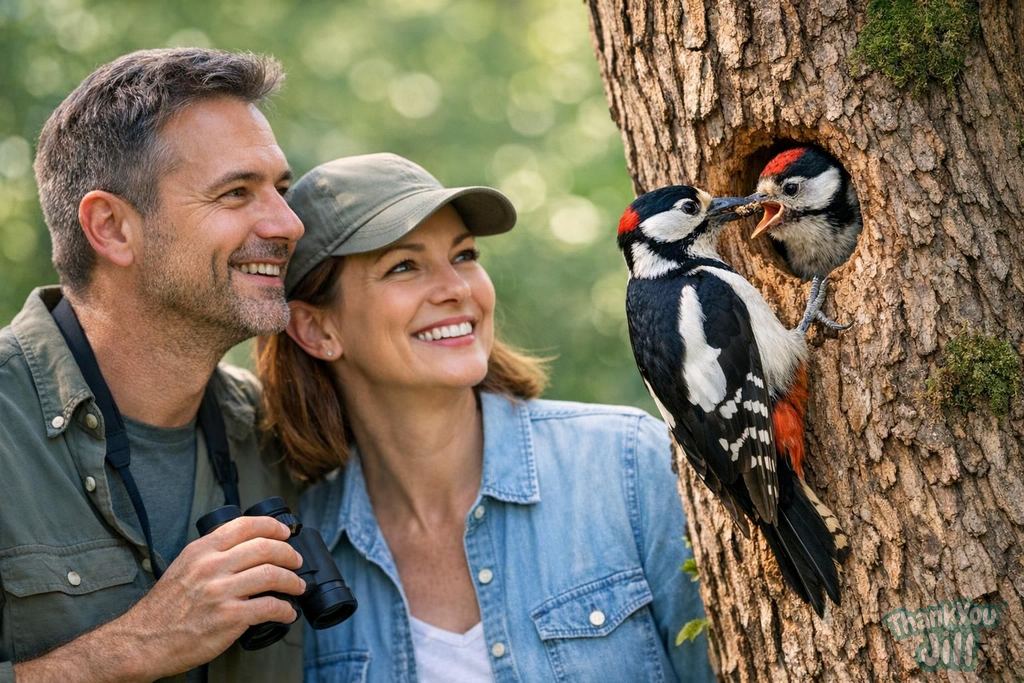
Every nest is a signature. If you know how to read the signatures, the forest becomes a register of presences: who passed through, who chose this branch, who built this particular home on that specific tree. It's an art that requires observation and curiosity — and it pays in continuous satisfaction for a lifetime.
Nests in tree cavities: the inhabitants of the holes
Birds that nest in tree cavities (cavity nesters or "hole-nesters") are among the most dependent on the presence of old trees with natural holes or woodpecker cavities. Great tit and blue tit (Parus major, Cyanistes caeruleus): the most common species in gardens and forests. They nest in small cavities (3-3.5 cm entrance hole for the great tit, 2.8 cm for the blue tit). They build a cup-shaped nest of moss, hair, and feathers. 1-2 broods of 8-12 eggs. Extremely easy to attract with nest boxes. Common redstart (Phoenicurus phoenicurus): an African migrant that nests in tree cavities, stone walls, and artificial boxes. The male has a brilliant orange breast and russet-red tail — one of the most beautiful birds in the Italian forest. Eurasian wryneck (Jynx torquilla): the "mimic" woodpecker that doesn't excavate but uses cavities abandoned by true woodpeckers. A summer migrant that feeds on ants. Its call (a series of very high notes repeated rapidly) is one of the most characteristic sounds of the forest in spring. Hoopoe (Upupa epops): unmistakable with its ochre and black fan-shaped crest. It nests in tree cavities and stone walls in open fields and forest margins. Tawny owl, barn owl, little owl: all already described in dedicated articles.
Open nests in the canopy: diverse architectures
Birds that nest openly in the canopy must build more elaborate structures that hide eggs from predators. Eurasian blackbird (Turdus merula): robust cup-shaped nest, built with grass, stems, and rootlets, often with mud in the internal structure (which solidifies it). Positioned 1-5 meters high in dense shrubs, conifers, ivy. Easily found in gardens. Eurasian blackcap (Sylvia atricapilla): light, almost translucent cup-shaped nest, built with dry grass and very fine rootlets, among understory shrubs 0.5-2 meters high. Golden oriole: the suspended cup between forked branches already described. Eurasian jay (Garrulus glandarius): large and robust nest of interwoven twigs, in high tree forks. Wood pigeon (Columba palumbus): very thin platform of twigs, so translucent that the eggs are visible from outside. One of the least elaborate constructions in the forest.
Colonial nests: safety in numbers
Some species nest in colonies concentrated on a few trees, exploiting collective defense against predators. Grey heron (Ardea cinerea): forms heronries of dozens or hundreds of nests on the same trees (poplars, planes, oaks along river edges). Heronries are visible and audible from far away — the hoarse cry of herons in flight is unmistakable. Cormorant: forms mixed colonies with herons. Black-headed gull: in some lowland areas they nest on trees along lake edges. Red-rumped swallow and barn swallow: not on trees but on human structures — mentioned for contrast with tree-nesting species.
The nesting calendar: when to find what
The nesting calendar in Italy: February-March: construction begins for tawny owls, barn owls, wood pigeons, and crows. April-May: peak nesting season for the majority of species (blackbird, blackcap, thrush, blue tit, redstart, golden oriole, jay). June: second brood of many species; nesting begins for the black redstart and some late-arriving migratory species. July-August: last brood of multi-brooding species. September: nests are abandoned and can be examined without disturbance.

Every nest is a home built without hands, without tools, in less than a week, using only what is found nearby. Every nest is a masterpiece of natural engineering that would be impossible to replicate with human technology at the same size and weight. Looking at an abandoned nest in autumn is looking into evolutionary biology itself.
How to observe and respect nests in the forest and garden
- Never disturb an occupied nest: Italian law (L.157/1992) prohibits disturbing birds during nesting season. Getting too close to a nest with eggs or chicks can cause the brood to be abandoned. If you find a nest, observe it from a distance (at least 5-10 meters) and never use flashlights or camera flashes.
- Study abandoned nests in autumn: from September to February, abandoned nests can be examined, photographed, and even collected for educational use (without disturbing any animals using them as winter shelter). Examine the structure: what materials? How are they woven? Is there mud inside (blackbird)? Is there down (blue tit)? Is it a cup (thrushes) or a platform (wood pigeon)?
- Install nest boxes of different types: to maximize the biodiversity of cavity-nesting birds in your garden, install boxes with holes of different sizes: 28 mm (blue tit), 32 mm (great tit), 35 mm (redstart), 45 mm (wryneck), 50 mm (hoopoe), 80-100 mm (tawny owl). Position them at different heights and orientations. Clean them every September-October.
- Build a nest box with children: building a handmade nest box is one of the most engaging environmental education projects for children aged 8-14. You need 4-5 rough wooden boards (untreated), nails or screws, a small saw. Many nature organizations (WWF, Legambiente) organize free nest box building workshops for families.
- Document presences with a notebook: note each year the nests you find in your garden or your reference forest: species, tree used, height, discovery date, outcome (complete clutch? abandonment?). After 5-10 years you have a valuable phenological document.
- Watch out for cats in spring: free-roaming domestic cats are the main predator of chicks and fledglings during the breeding season. It's estimated that in Europe domestic cats kill billions of birds annually. Keeping cats indoors during critical weeks (May-July) is one of the most effective actions to protect local bird biodiversity.
The forest and garden in spring are full of homes built in haste and silence. Learning to recognize who lives where transforms every walk into a neighborhood visit — where the neighbors have wings, sing at dawn, and leave traces in the nests you find in September. There's no better way to feel part of something larger.
Frequently Asked Questions
How can I identify which bird species built a cavity nest in trees?
To identify the species that built a cavity nest, observe the size of the entrance hole and the materials used. For example, the great tit uses holes of 3-3.5 cm and builds nests of moss and feathers, while the wryneck occupies abandoned cavities without excavating.
When is the best time to observe open nests in the tree canopy?
The peak nesting season for open nests in the canopy, such as those of blackbirds and blackcaps, is between April and May. During this period nests are active and more easily observable, while from September nests are abandoned and can be studied without disturbance.
What precautions should I take to protect nests and birds during nesting season?
It's essential not to disturb occupied nests, maintain a distance of at least 5-10 meters, and avoid using flashes or flashlights. Additionally, keeping domestic cats indoors from May to July reduces predation on chicks and protects local bird biodiversity.
How do I choose and position nest boxes to attract different cavity-nesting bird species?
To attract various species, install nest boxes with holes of different sizes (from 28 to 100 mm) and position them at different heights and orientations. Clean them every September-October to keep them suitable and encourage nesting of species like great tits, redstarts, and hoopoes.
Latest News




Comments
No comments yet. Be the first!
Leave a comment