


 Italiano
 Français
 Deutsch
 Español
 Português
 Svenska
 Suomi
Suomi
Migration and Trees
Why Migratory Birds Can't Survive Without Forests
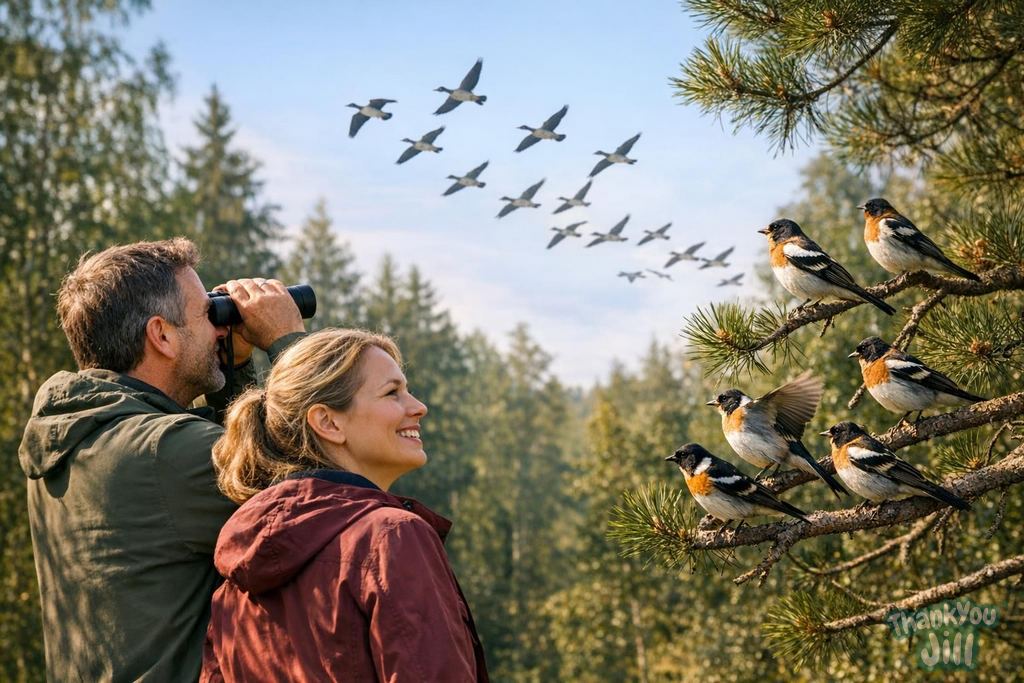
Every year, between August and November, Italy becomes a crossroads of the world. Millions of birds from across Europe and northern Asia traverse the peninsula heading toward Africa. And every year, between March and May, they return. This flow of life — invisible to most of us — depends critically on the presence of forests, trees, and green spaces along the route. Without these refueling stations, migration would not be possible.
Migration: Numbers That Boggle the Mind
Bird migration is one of the most extraordinary biological phenomena on Earth. Every year approximately 5 billion birds migrate from Europe to Africa and back. Italy is one of the most important transit points for this flow: its central position in the Mediterranean, the peninsula extending toward North Africa, and the presence of islands (Sicily, Sardinia, Pantelleria, Lampedusa) make it one of the principal "gateways" between Europe and Africa. Species that migrate through Italy include: insectivorous birds (black flycatcher, willow warbler, firecrest, reed warbler, lesser whitethroat, blackcap, black redstart, wryneck, swallow), fruit-eaters (thrushes in autumn), seed-eaters (finches, buntings, sparrows, hawfinches), and raptors (falcons, sparrowhawks, harriers, kites). Italy's most important migration passes are: the Strait of Messina (for raptors in autumn), the Bocca Trabaria Pass in the Apennines, the coasts of Puglia and Calabria, the Euganean Hills, and the Venetian Prealps.
Forests as Refueling Stations
Migration is a titanic energy undertaking. A 16-gram blackcap covers 500–1,000 km in a single night flight during migration, burning fat reserves that make up half its body weight. At dawn, when it lands exhausted in coastal or hilly areas, it needs to find abundant food in the shortest time possible to recharge before the next night flight. Forests and berry-bearing shrubs are the most important refueling stations. A single hawthorn laden with berries, a rowan, a mastic tree, an ivy — can feed dozens of migratory birds for hours. Riparian forests (along rivers) are particularly important: they offer shelter from wind, nearby water, and a variety of food (insects, berries, seeds) in a compact space. The stepping-stone theory describes this exactly: migrants don't make one continuous flight from Europe to Africa — they hop from one "stone" to another along the route. Every coastal forest, every Mediterranean scrub patch, every well-treed urban park can be a precious stone. Removing these "stones" — felling coastal forests for construction, eliminating hedgerows to mechanize fields, urbanizing coasts — is reducing the survival of billions of migratory birds.
Nocturnal Migrants and Light Pollution
The majority of migratory birds fly at night — when predators are less active, the air is more stable, and celestial reference points (stars, moon) are visible. This nocturnal flight is guided by a combination of magnetic navigation, stellar orientation, and visual memory of landscapes. Artificial lights — especially those intense and directed upward — disorient nocturnal migratory birds: they attract them like moths to lamps, causing collisions with buildings, towers, cables, or simply disorientating them and making them waste precious time and energy. It's estimated that in the USA, collisions with buildings kill between 100 million and 1 billion birds annually. In Europe, the numbers are in the tens of millions. The Lights Out movement (turn off lights during migration) is spreading in major cities: turning off the lights of tall buildings on nights of intense migration (August–October) significantly reduces collisions.
How to Know When Migration Passes Through
Migration is not random — it follows precise patterns linked to climate and season. In autumn, the most intense movements occur on the first nights after cold fronts pass (especially in September–October): northerly winds favor southward flight. The apps BirdCast (USA) and Trektellen (Europe) aggregate data from weather radars and ornithological observatories to show in real time the position and intensity of the migratory flow. With these apps, you can know early in the morning if a major migration passage occurred in your area the night before — and head out to the nearest forest or park to observe tired birds resting and refueling.

A 15-gram blackcap flies at night across the Sahara, descends into Sicily at dawn exhausted, and finds food in the mastic scrub. If that mastic isn't there, it won't make it. It's that simple and that serious. Every hedge we cut, every tree we fell along the coasts, is one fewer refueling station for billions of tiny migrants that depend on our choice to leave or not leave some green space.
How to Contribute to Migration: Concrete Actions
- Plant berry-bearing shrubs in coastal and hillside gardens: in migration transit zones (Liguria, Calabria, Sicily, Sardinia, Adriatic coasts), a garden with mastic, privet, wild olive, myrtle, ligustrum, ivy, and dog rose is a precious refueling station for autumn migrants. Even a single berry-bearing shrub on a balcony can be helpful in an otherwise food-barren urban landscape.
- Turn off lights on migration nights: if you live in a tall building or structure with lights shining upward, consider turning them off on September–October nights (and March–April for spring migration). Even reducing light intensity helps.
- Install anti-collision films on windows: large window panes and glass doors are invisible to birds in flight. Every year in Italy, tens of millions of birds (not just migrants: also resident species) die from window collisions. UV films that make glass visible to birds while remaining nearly transparent to the human eye are available and inexpensive.
- Observe migration live: bird-ringing stations (such as those on Ponza, Portofino, Ventotene, and WWF coastal reserves) often accept visitors during migration season. Ringing for scientific purposes (capture, measurement, marking with a numbered band, and immediate release) is the primary method for studying migration. Attending a ringing session is an unforgettable experience.
- With children — the migration map: download migration maps from BirdCast or Ornitho.it and show children where migratory birds are right now. Explain that those arrows on the map represent billions of tiny animals flying at night while you sleep. The visual concretization of the phenomenon has an extraordinary emotional and cognitive impact.
- Report collisions: if you find a bird dead or injured from window collision, report it to the WindowCollision.it portal or the CISO website (Italian Center for Ornithological Studies). Citizen reports help map critical collision hotspots in cities.
Bird migration is one of nature's grandest and most invisible spectacles. It passes over us every year, at night, in silence. We may not see it, but we can choose not to obstruct its path: by leaving some hedges, some berries, some shrubs along migration routes. It's a form of hospitality toward living beings that travel 10,000 km to cross our garden.
Frequently Asked Questions
Why do migratory birds depend on forests during their journey?
Migratory birds use forests and shrubs as essential refueling stations to recover energy. These environments offer abundant food, such as berries and insects, and shelter, allowing them to undertake long stretches of nocturnal flight more successfully.
How does light pollution affect nocturnal bird migration?
Intense artificial lights disorient nocturnal migratory birds, attracting them toward buildings and structures, causing collisions and energy loss. Turning off lights during migration nights can significantly reduce these incidents and improve bird survival.
What are practical ways to help migratory birds during their passage?
You can plant berry-bearing shrubs in gardens, turn off lights on migration nights, install anti-collision films on windows, and participate in or visit bird-ringing stations. These actions create safe habitats and reduce risks along migration routes.
How can I know when migration occurs in my area?
Migration follows precise seasonal and climatic patterns, with peaks after cold fronts in autumn. Apps like BirdCast and Trektellen provide real-time data on migratory flow, allowing you to observe birds during refueling stops.


Latest News



Comments
No comments yet. Be the first!
Leave a comment