

 English
 Italiano
 Français
 Deutsch
 Español
 Português
 Svenska
 Suomi
Suomi
The Squirrel
Acrobat of the branches and unwitting gardener of Italian forests
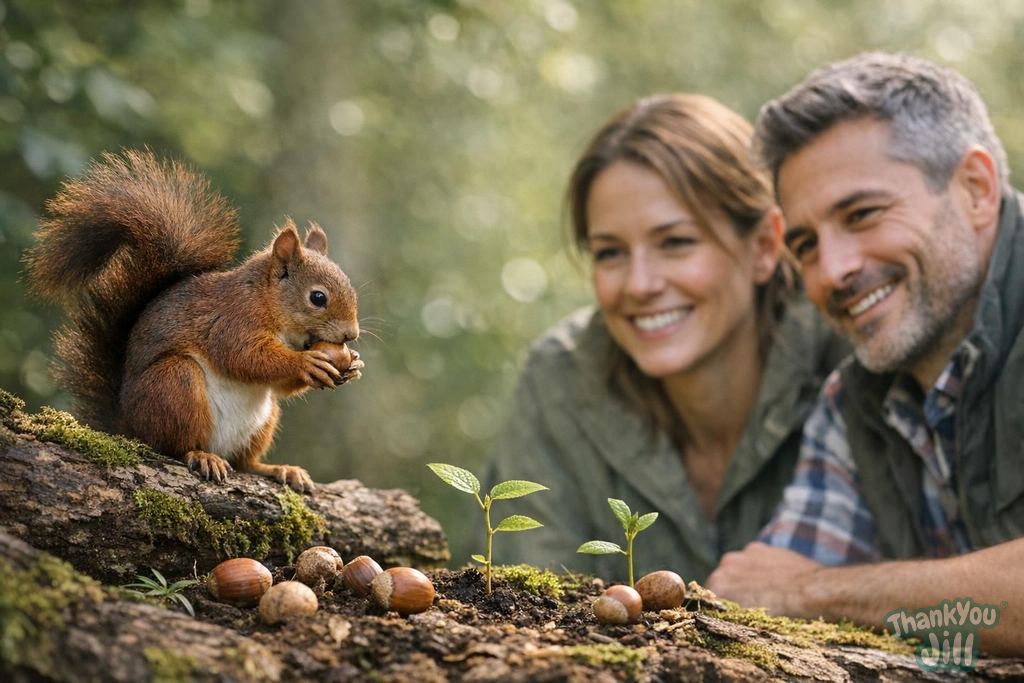
If the oak forest you walk through every Sunday exists, it's probably partly thanks to some squirrel that lived 50 or 100 years ago. It didn't know. It had no intention of planting trees. It was just stockpiling for winter. But it forgot half of them, and those forgotten acorns became oaks. Nature is full of these accidental masterpieces.
Who is the Italian red squirrel
The Eurasian red squirrel (Sciurus vulgaris) is the most well-known tree-dwelling rodent in Italy. Its coat varies greatly: bright red-orange in broadleaf forests, grey-brown in alpine conifer forests, sometimes almost black in alpine populations. The most recognizable feature is its long, bushy, curved tail — used as a counterweight during jumps (up to 4-5 meters between branches), as a rudder in flight, as a blanket during sleep in cold periods, and as a communication signal (the tail is flicked rapidly during territorial conflicts). Weighing just 250-350 grams, it can jump distances of 4-5 meters horizontally and descend head-first down vertical trunks at astonishing speed. The adaptation that makes this agility possible is its reversible hind legs: the squirrel can rotate its ankle joints 180 degrees, allowing it to cling to the trunk with claws pointing downward even during vertical descent.
The forgetful gardener: how the squirrel plants the forest
In autumn, the squirrel accumulates food stores for winter through a behavior called scatter hoarding: it hides food in hundreds of small separate caches — acorns, hazelnuts, beechnuts, pine nuts, dried mushrooms — burying them individually just a few centimeters deep in the soil. A single squirrel can make 3,000-10,000 caches in one autumn. It uses spatial memory to find the caches in winter: studies with radioactive tracers have shown that it recovers 70-85% of hidden stores. The remaining 15-30% is never recovered — through forgetfulness, the death of the individual, or snow displacement that alters spatial landmarks. These unrecovered seeds germinate in spring. For oaks (which produce heavy acorns with poor wind dispersal), squirrel scatter hoarding is one of the most important mechanisms of long-distance seed dispersal — acorns are buried up to 100-200 meters from the parent tree, allowing the species to colonize new areas. Without squirrels (and jays, which use the same strategy), oak forests would spread much more slowly.
The drey: home among the branches
The squirrel builds its nest — called a drey in English (a term also used in Italian) or more simply a "squirrel's nest" — in the forks of the highest branches of trees. It's a spherical structure made of twigs, leaves, bark, and moss, with a diameter of 30-40 cm, with one or two side entrances. The interior is lined with soft material: fur, feathers, dry grass, lichen. Each squirrel builds and maintains several dreys in its territory (usually 3-7): one main nest used for sleeping and raising young, and others as emergency shelters. The drey is visible year-round on oaks, pines, and beeches — especially in winter when leaves have fallen. Contrary to popular belief, the squirrel does not hibernate: it remains active throughout winter (though with reduced activity on the coldest days) and depends on hidden stores to survive.
The American gray squirrel: the invader threatening the red squirrel
In some areas of northern Italy (Piedmont, Lombardy), the eastern gray squirrel (Sciurus carolinensis) is present, accidentally introduced in the 1990s. It's larger, more adaptable, and more aggressive than the red squirrel, and competes for the same resources. But the most serious problem is that the American gray is a healthy carrier of the squirrelpox virus, which is lethal to the red squirrel: wherever the gray spreads, the red disappears within a few years. In Great Britain, the gray squirrel has already practically eliminated the red from 90% of the territory. In Italy, active control plans (trapping and euthanasia) are underway in Piedmont to slow the spread. The protection of the red squirrel is a conservation priority at the European level.

The squirrel forgets half the acorns it buries. For it, that's a failure. For the forest, it's the plan that works. Some of the greatest contributions to the lives of others come from those who didn't know they were giving something.
How to encourage and observe the red squirrel
- Install a squirrel-specific feeder: squirrel feeders (with a roof and front opening) should be positioned on a trunk or branch 2-4 meters high. Fill with whole hazelnuts in shell, acorns, unsalted walnuts, unsalted sunflower seeds. Squirrels are creatures of habit: once they find the feeder, they return every day at the same time. Don't use salted peanuts or human food: the squirrel won't refuse them but they're not good for it.
- Protect old trees with cavities: the squirrel uses tree cavities as secondary shelter and food storage. Old trees with holes are precious habitat.
- Observe the tail as a signal: the squirrel's tail is a rich body vocabulary. Tail straight and flicked rapidly = alert or threat. Tail low and still = relaxed. Tail curled over the back during rest = sleeping. Learning to read these signals makes every observation much richer.
- Report gray squirrel sightings: if you live in Piedmont or Lombardy and spot an American gray squirrel (gray with white belly, larger than the red, without ear tufts), report it to ISPRA (Institute for Environmental Protection and Research) or the regional Forestry Corps. Early reporting is essential to contain the spread.
- With children — the squirrel memory game: hide 20 small objects (buttons, pieces of wood) in an area of the garden and have the children find them after 10 minutes. Then explain that the squirrel does the same thing with 3,000 acorns in autumn and finds 85% of them. How many do you find in 10 minutes? The comparison with the animal's memory is lively and fun.
- Photograph the drey in winter: squirrel nests are visible on the bare branches of oaks and beeches from November to March. They're dark spheres of twigs, 30-40 cm in diameter, usually 5-10 meters high on forked branches. Photographing them — and then observing whether they're used in spring — is a nature documentation project accessible from any tree-filled park.
The red squirrel is one of the most beloved species in Italy — and one of the most threatened in the short term by invasive species. Getting to know it better is not just a pleasure: it's also the foundation for protecting it. A forest without red squirrels is a forest that has lost one of its most efficient gardeners, and doesn't know it yet.
Frequently Asked Questions
How does the squirrel contribute to forest regeneration?
The squirrel buries thousands of acorns every autumn for winter, but forgets 15-30% of these stores. The forgotten acorns germinate, planting new trees and promoting the spread of forests, especially oaks, at distances of up to 100-200 meters from the parent tree.
What are the main differences between the red squirrel and the American gray squirrel?
The American gray squirrel is larger, more adaptable, and more aggressive than the red squirrel. Additionally, it is a healthy carrier of the squirrelpox virus, which is lethal to the red squirrel, causing the decline of the latter in areas where the gray spreads.
How to recognize and interpret squirrel tail signals?
The squirrel's tail is an important communication tool: flicked rapidly it indicates alert or threat, low and still means relaxation, while curled over the back signals sleep. Observing these signals helps understand the animal's behavior.
What precautions should be taken to encourage the presence of red squirrels in a garden or park?
It is recommended to install specific feeders 2-4 meters high with hazelnuts, acorns, and unsalted seeds, protect old trees with cavities, avoid harmful human food, and report any sightings of gray squirrels to contain their spread.

Latest News



Comments
No comments yet. Be the first!
Leave a comment