


 Italiano
 Français
 Deutsch
 Español
 Português
 Svenska
 Suomi
Suomi
The Dormouse
Six months of sleep in the treetops and its secret life in Italian forests
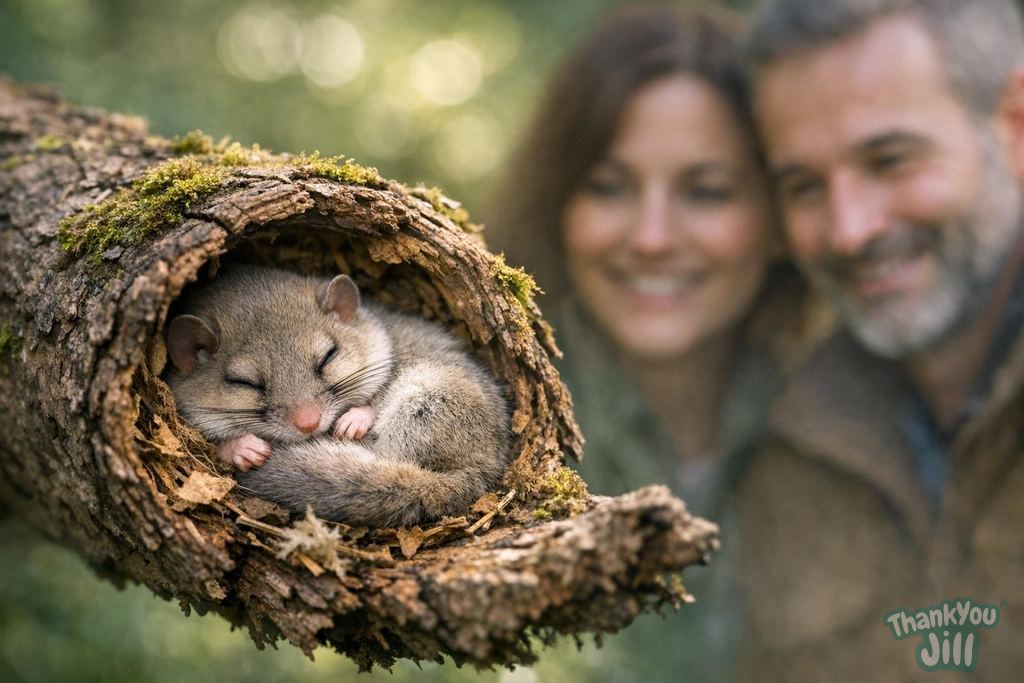
There comes a moment in autumn when the dormouse stops doing anything at all. It curls up in a tree cavity, drops its body temperature from 37°C to 2-4°C, reduces its heart rate from 300 to 4-6 beats per minute, slows its breathing to just a few breaths per hour, and vanishes for six months. It's not sleeping—it's hibernating. And when it wakes in April, the world around it has transformed completely. Yet the dormouse remains exactly as it was when it fell asleep.
Meet the dormouse
The dormouse (Glis glis) is the largest of Europe's hibernating rodents—a family that includes the hazel dormouse and the garden dormouse in Italy. It's about the size of a small squirrel (weighing 80-200 grams depending on the season), with a silvery-grey body, a thick, flat tail like a squirrel's (though shorter), and large black eyes ringed by dark circles. It inhabits the broadleaf forests of northern and central Italy, favoring beech, oak, and chestnut forests rich in fruit. It's completely arboreal: it climbs, leaps, and navigates branches with extraordinary agility, rarely descending to the ground. It's strictly nocturnal: by day it sleeps hidden in tree cavities or nests of dry leaves among the branches, becoming active only after sunset.
Hibernation: six months of apparent death
The dormouse's hibernation is among the longest and deepest of any European mammal. It begins between September and October (when nighttime temperatures drop consistently below 10°C) and ends between March and April. During these 6-7 months: body temperature plummets from 37°C to 2-4°C (nearly matching the surrounding environment); metabolism slows to just 2-5% of normal; heart rate drops from 300 bpm to 4-6 bpm; oxygen consumption decreases by 97%. The dormouse survives by slowly burning the body fat accumulated in the weeks before hibernation—by autumn it can weigh twice its spring weight, with 35-40% of its body mass as fat. Periodically, every 2-3 weeks, the dormouse briefly arouses (micro-awakening): it drinks if water is available, shifts position, then returns to hibernation. By the end of hibernation, it weighs half what it did in autumn. All that fat has been consumed to maintain minimal vital functions during the long winter sleep. The Romans knew the dormouse well and prized its fatty autumn meat: they raised them in gliraria (special enclosures) and consumed them as a delicacy—hence the Italian name, derived from the Latin glis.
The autumn diet: eating to sleep
In the weeks leading up to hibernation (August-October), the dormouse enters intense hyperphagia: it eats almost continuously, stuffing its stomach with energy-rich fruits. The diet during this period is dominated by acorns, beechnuts, hazelnuts, chestnuts, wild apples and pears, and mushrooms—anything that provides fats and carbohydrates quickly. During those same months, the dormouse is also the primary predator of nestlings for many bird species: in August, when nests contain the season's final broods, the dormouse systematically raids accessible nests—eggs and chicks are an excellent protein source for building fat reserves. This nocturnal behavior, invisible to most observers, is one of the least-known but most widespread causes of brood loss in Italian forests.
Reproduction: fast and concentrated
The dormouse has only 3-4 months of activity per year (April-September) to do everything: establish a territory, court, breed, raise young, and accumulate fat for hibernation. The breeding season is restricted to June-July. Gestation lasts about 30 days. A litter contains 4-6 young. The young develop rapidly—after 6-7 weeks they're already independent. In years of abundant fruiting (oak "mast years" or beech "mast years"), dormouse populations explode: food availability is so high that nearly all individuals breed successfully. In lean years, breeding can fail entirely.

The dormouse discovered that the best solution to winter isn't to fight it but to disappear. Six months of perfect absence, at two degrees body temperature, with a heart beating four times a minute. A survival strategy so radical it almost seems like a privilege.
How to spot a dormouse: where to look and how to recognize its presence
- Search for dormice at night in beech and chestnut forests: the best time to observe a dormouse is August–September, when it's in peak hyperphagia and spends the entire night feeding on branches. With a powerful headlamp, walk slowly through a broadleaf forest after sunset and shine your light into the fruit tree canopies. A dormouse's eyes reflect light in a very distinctive way: a reddish-orange glow, different from the green of insects and the yellow-green of felines.
- Recognize the signs of its presence: hazelnuts and acorns with a characteristic "cup-shaped" opening — the dormouse gnaws a precise circular hole at the top of the shell to extract the seed without fully cracking the fruit open (unlike squirrels, which split the shell completely in half). Finding dozens of hazelnuts with this circular hole beneath fruit trees is almost a certain signature of a dormouse.
- Install a dormouse box: dormouse boxes are similar in size to bird boxes but with the entrance hole facing the tree trunk (not outward), so the entrance sits in the gap between the box and trunk. Dimensions: 15×15×25 cm, with a 4–5 cm hole facing downward-inward. Dormice readily occupy them both for daytime sleep and winter hibernation.
- Don't disturb hibernating dormice: if you find a dormouse in hibernation (in a cavity, leaf pile, or nest box in autumn), don't touch it. Interrupting hibernation causes an enormous energy drain from accumulated reserves: a dormouse artificially awakened may not have enough fat stores to survive until spring. Gently close everything back up and leave it as it was.
- With children — the hibernation thermometer: take children outside on a cold autumn night (10–12°C) and have them measure the temperature with a thermometer. Then explain that the dormouse, right now, has the same body temperature as the air. If it were alive like us, it would already be dead. But it's not dead—it's simply waiting for spring with its entire body slowed to a minimum. It's one of the most fascinating concepts in biology, made immediate by the temperature they feel on their skin.
- Report sightings on Ornitho.it or iNaturalist: the dormouse is a monitored species because it's sensitive to climate change (hibernations are shortening due to warmer winters). Citizen reports contribute to distribution maps used by researchers.
The dormouse teaches us that there are life strategies completely different from our own. Six months of intense activity and three months of frantic accumulation, then six months of near-total absence. A biological rhythm that has worked for millions of years, and one that climate warming is beginning to put under pressure for the first time. Getting to know it is also a way of understanding what we risk losing.
Frequently asked questions
How does a dormouse survive during six months of hibernation?
The dormouse survives hibernation by drastically reducing its body temperature, heart rate, and metabolism, slowly burning the fat accumulated in autumn. It wakes only for brief micro-awakenings every 2–3 weeks to drink and change position.
What are the distinctive signs to recognize a dormouse's presence in forests?
A dormouse's presence is recognized by hazelnuts and acorns with a precise circular "cup-shaped" hole, created to extract the seed without completely breaking the shell, and by the reddish-orange glow of its reflective eyes at night.
When and how does a dormouse accumulate the fat needed for hibernation?
Between August and October, the dormouse enters hyperphagia, eating energy-rich fruits like acorns, hazelnuts, and chestnuts, as well as preying on eggs and nestlings, to double its weight and accumulate the fat necessary for hibernation.
Why is it important not to disturb a dormouse during hibernation?
Disturbing a hibernating dormouse causes an enormous energy expenditure, risking that it will exhaust its fat reserves and not survive until spring. It's essential to leave it undisturbed in its cavity or nest.
Latest News



Comments
No comments yet. Be the first!
Leave a comment