


 Italiano
 Français
 Deutsch
 Español
 Português
 Svenska
 Suomi
Suomi
The Badger
How it uses trees and the forest: the silent engineer of the woodland
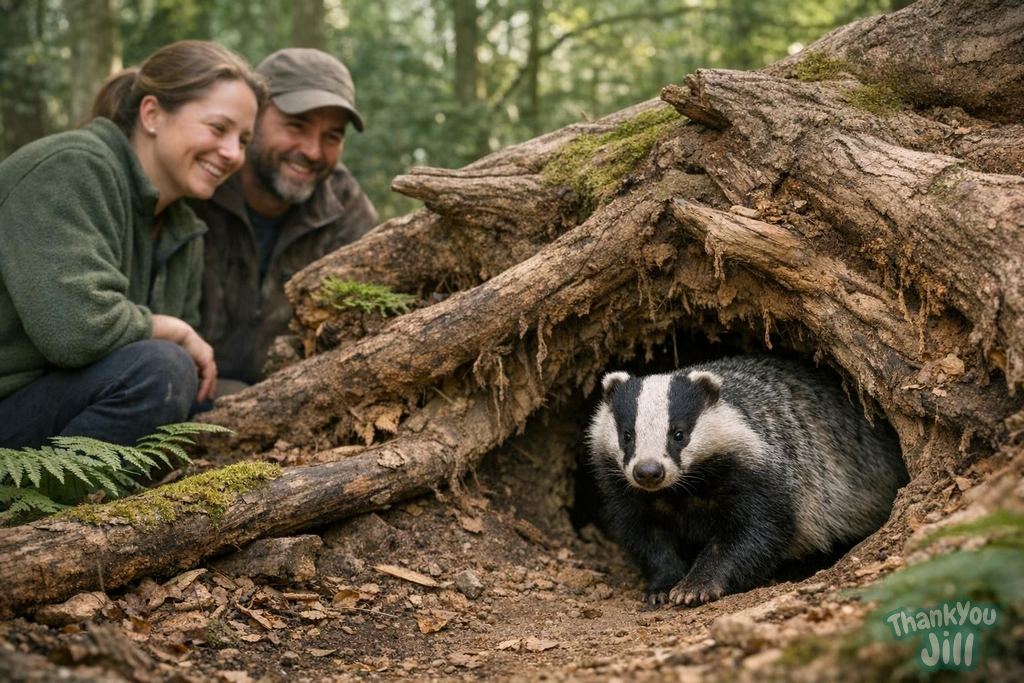
Few animals in the Italian forest are so little known yet so present. The badger lives in nearly all the hilly and mountain woodlands of the peninsula, but it's almost impossible to see — it's nocturnal, elusive, and moves with a caution you wouldn't expect from a 10-15 kg animal. Yet the signs of its presence are everywhere, if you know what to look for. And its work as an underground engineer is one of the most important contributions to the structure of the forest we inhabit.
Who is the badger
The European badger (Meles meles) is the largest terrestrial mustelid in Europe. It weighs between 8 and 18 kg (more in autumn when it accumulates fat for winter semi-hibernation), with a stocky, low-slung body, short and powerful legs, strong claws, and the characteristic white muzzle with two black longitudinal stripes covering the eyes. Despite its massive appearance, it's surprisingly agile — it can trot for hours during the night, covering up to 10-15 km. It has an extraordinary sense of smell (40 times more powerful than humans) and relatively poor eyesight. It's the animal with the most developed system of scent glands among European mustelids: it produces secretions from subcaudal glands that it uses to mark territory, mates, cubs, and burrow boundaries.
The sett: the multigenerational burrow beneath the roots
The most extraordinary characteristic of the badger is its burrow, called a sett in English. A sett is a system of underground galleries dug beneath tree roots and on steep slopes, with 5-30 entrances (but in some historic burrows even 50-100) and galleries extending for dozens of meters. The galleries are constantly enlarged and maintained by the badgers living there. The internal chambers are lined with dry grass, leaves, and ferns — the material is regularly renewed (the badger carries out the old and brings in the new in a systematic way). The most fascinating characteristic is the longevity of the sett: the same burrows are occupied by consecutive generations of badgers, for decades or even centuries. In Great Britain there are documented setts occupied for more than 100 years. The badgers living there belong to different generations but maintain their bond with the familiar territory through scent marking. This means a sett is not just a burrow: it's a living memory of the territory, a biological institution passed down from parents to children for centuries.
Trees and the badger: a structural relationship
Badgers choose sett locations with great care. They prefer to dig beneath the roots of large, stable trees — oaks, beeches, ash trees — because the roots reinforce the gallery walls, prevent ground collapse, and contribute to the structural framework of the sett. The presence of large trees above the sett is not coincidental: it's an architectural requirement. For this reason, protecting monumental trees in forests is indirectly also protecting the setts beneath them. Badgers also use trees as nocturnal orientation signals: they follow habitual paths through the forest that pass near certain recognizable trees. These paths, used for years, become visible in the forest as ground traces — small depressions in the soil about a foot wide, following the perimeter of roots and stumps.
The badger's diet: the eater of everything
The badger is one of the most versatile omnivores in the Italian forest. Its diet varies enormously with the seasons: in spring, earthworms (which it can ingest by the hundreds in a single night when the soil is damp), insect larvae, frogs. In summer, wild fruits (blackberries, cherries, plums, dogwood berries, cornelian cherries), mice, voles, hornets (it digs out their nests with its paws, protected from stings by its thick skin). In autumn, acorns, beechnuts, chestnuts — a hyperphagia of carbohydrates and fats that allows it to accumulate up to 30% of its body weight in fat for winter. A particular ability of the badger is its capacity to dig out and eat the buried nests of bumblebees and wasps: its thick skin and dense fur protect it sufficiently from stings.
Semi-hibernation and births
The badger does not fully hibernate: it enters a semi-hibernation (torpor) during the coldest periods (December-February), reducing activity without the profound metabolic reduction typical of dormice or hazel dormice. On mild winter nights it may venture out briefly. Like the pine marten, it uses embryonic diapause: mating in spring-summer, delayed embryonic implantation in January, birth of cubs (2-4) in February-March in the internal chamber of the sett.

The badger inhabits the same burrow that his great-grandparents inhabited, beneath the same oak roots. He doesn't know that those roots have been supporting his home since his ancestors were already old. He doesn't need to know. He only knows that it works, and it continues. There's something profoundly solid in this loyalty to place.
How to find and respect signs of badgers in the forest
- Look for the sett: badger burrows are typically found on wooded slopes with dry, stable soil, beneath large trees, often near a forest but also at the edge of a field. Recognize the sett by the large entrance holes (20-30 cm in diameter, oval-shaped), with a visible mound of fresh earth and excavated leaves outside. Near the entrances you often find latrines (small pits dug in the soil where the badger deposits feces — one of the few species that defecates in designated areas away from the burrow).
- Observe the tracks: badger prints are characteristic — 5 toes with long, robust claws, the heel wide. The gait is slow and waddling, almost as if walking with flat feet. In snow, badger tracks are unmistakable for their width and the impression of the entire sole of the foot.
- Never disturb an active sett: badger burrows are protected by Italian law (L.157/1992). Approaching within 50 meters of the sett during the breeding season (February-April) can cause cubs to be abandoned. If you find a sett, observe it from a distance and report it to forest rangers or local park authorities as a contribution to monitoring the species.
- Camera trap at the sett: positioning an infrared camera trap on the approach path to the sett (never on the entrance) is the least invasive way to document badgers. The ideal distance is 5-10 meters from the entrance, so that the infrared light doesn't disturb the animals as they exit.
- With children — the forest engineer: show children a sett (from a safe distance) and have them calculate the amount of earth excavated from the mound outside. A complex sett may have required the excavation of several tons of earth over the years. Explain that all of this was done with paws, at night, by animals weighing 10 kg. The comparison with a human construction site is immediate and always astonishes.
- Watch documentaries: the badger is one of the most filmed subjects in British nature documentary filmmaking (BBC Natural History Unit). Documentaries like "Badger Watch" show badger families exiting the sett in the evening with infrared cameras, revealing complex social behaviors of great beauty. Available on streaming platforms.
The badger is one of those animals that helps you understand how deeply the forest has a memory. Every sett with its oak roots above and galleries below is a structure that speaks of decades — sometimes of centuries. An animal that builds and maintains its own home for consecutive generations has something to teach us about the meaning of truly inhabiting a place.
Frequently Asked Questions
What is the role of tree roots in the construction and stability of the badger's sett?
The roots of large, stable trees such as oaks and beeches reinforce the walls of the sett's galleries, preventing ground collapse and ensuring the stability of the underground burrow, which can be inhabited for generations.
How can you recognize the presence of a badger in the forest without seeing it directly?
You can identify badgers by observing the large oval entrance holes of the sett, the mounds of fresh earth and excavated leaves, nearby latrines, and the characteristic 5-toed prints with long claws, especially visible in snow.
How does the badger's diet vary during the seasons and what are its particular feeding abilities?
The badger is omnivorous and adapts its diet seasonally: earthworms and insects in spring, fruits and small mammals in summer, acorns and chestnuts in autumn. It can dig out and eat bumblebee and wasp nests thanks to its thick skin that protects it from stings.
Why is it important not to disturb an active sett and how can you monitor badger presence in a non-invasive way?
Disturbing an active sett, especially during the breeding season, can cause cubs to be abandoned. Non-invasive monitoring is done with infrared camera traps positioned at a distance from the entrance, avoiding disturbance to the animals.
Latest News



Comments
No comments yet. Be the first!
Leave a comment