


 Italiano
 Français
 Deutsch
 Español
 Português
 Svenska
 Suomi
Suomi
Snails and Slugs
Silent inhabitants of logs, roots, and forest leaf litter
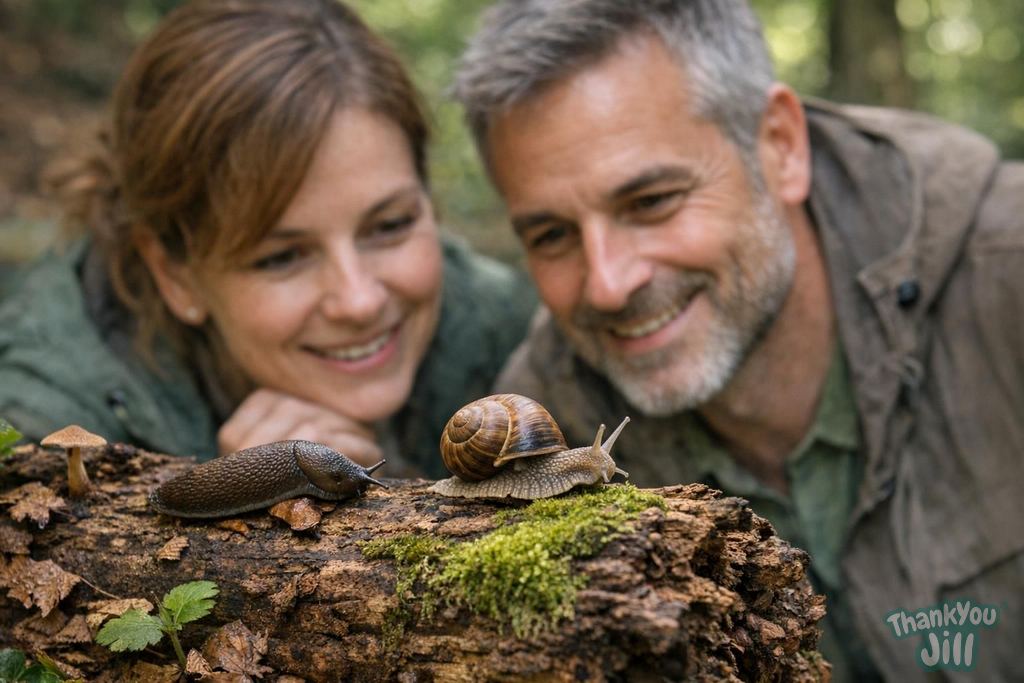
After a summer rain, the forest comes alive with presences we normally overlook entirely: on every wet log, on every fallen leaf, on protruding roots, hundreds of snails and slugs move slowly. They leave shiny trails on bark. They graze on fungal mycelium. They climb rough roots with a determination that seems unlikely for creatures so slow. And their silent work is fundamental to how the forest functions.
Snails and slugs: the difference
Common terminology often confuses the two categories. Snail refers to terrestrial gastropod mollusks with a shell — the spiral house carried on the back. Slug refers to terrestrial gastropods without a shell or with a vestigial internal shell. In both cases, the body consists of a muscular foot that moves along a film of mucus (the shiny trail). Mucus serves multiple functions: it lubricates movement, reduces dehydration, and contains antibacterial molecules. Slug slime is used in cosmetics for its hydrating and healing properties — this isn't a recent trend: it was already used in empirical pharmacology in the 18th century. About 300 snail species and 50 slug species live in Italy, ranging from microscopic rock-dwelling species to the large Helix pomatia (the vineyard snail or Burgundy snail) consumed in cuisine.
Ecological role: litter recyclers
Snails and slugs are among the forest's most important detritivores — organisms that feed on dead organic matter and recycle it into compounds available for plants. Their diet includes: fallen leaves in decomposition (the main source), fungi and mycelium (including both edible and toxic fungi — for most species), algae and lichens on tree bark, plant remains, and occasionally insect carrion. The radula — a ribbon-like toothed organ that functions as a scraper — allows the snail to scrape the surface of wood, leaves, and bark with great efficiency. Through digesting organic matter, snails produce nutrient-rich droppings that are immediately colonized by decomposing bacteria and fungi — accelerating the organic matter cycle in the forest soil.
Snail predators: the forest food chain
Snails are a fundamental food source for numerous forest and garden animals. The hedgehog is the best-known predator — it consumes snails and slugs of all sizes, opening them with robust mandibles. The badger eats snails, particularly in summer after rains. The song thrush has developed a specialized technique: it carries snails to a flat stone (its "anvil") and breaks them by repeatedly striking them. The presence of anvils surrounded by broken shells is one of the most recognizable signs of song thrush activity in the forest. The tawny owl hunts slugs at night. The smooth snake (Coronella austriaca) specializes in preying on small snails. The ground beetle (a predatory soil beetle) actively hunts slugs at night in the forest litter.
The water cycle in snail life
Snails are extremely sensitive to humidity. During the day, in dry seasons, they retreat into bark crevices, under fallen logs, into soil cavities — where humidity is maintained. During summer dormancy (estivation), the snail closes the shell opening with an operculum of dried mucus (the epiphragm) that reduces water loss. Some species can survive in this state for months. With the first rains of August-September they awaken quickly. Helix pomatia can also survive winter hibernation, sealed with a calcified epiphragm and hidden among tree roots or under litter. The resistance of these animals to dehydration is remarkable: some snail species from arid Mediterranean zones survive desiccated for years, reactivating with the first rain.

The snail carries its house on its back and moves incredibly slowly. Everyone knows these clichés. What people don't realize is that without snails and slugs, the forest wouldn't be able to recycle organic matter nearly as quickly. They're the silent sanitation workers of the understory, and they've been doing their job for 500 million years.
How to observe and protect snails and slugs in your area
- Search after rain: snails and slugs are much more visible in the hours following rain, when the soil is moist and they move actively. A walk in the forest in the early morning hours after a rainy night in summer is the best way to observe them on logs, roots, and leaves.
- Observe the radula with a magnifying glass: hold a magnifying glass close to a snail eating a leaf or fungus. You'll see the rhythmic movement of the radula — the toothed ribbon scraping the organic surface. It's one of the most fascinating feeding mechanisms to observe up close, accessible in any garden or forest.
- Look for the thrush's anvil: near forest trails, search for a flat stone surrounded by fragments of broken shells — typically white, cream-colored, or banded. It's the song thrush's anvil. Count the fragments: they tell you how many snails it has eaten in that spot. A single anvil can accumulate hundreds of shells in one season.
- Don't use slug pellets with metaldehyde in your garden: already mentioned for hedgehogs but applies to all: pellets with metaldehyde poison not only snails and slugs but also their predators like hedgehogs and birds, compromising the entire food chain that depends on snails. Use ferric phosphate, beer traps, or simply accept some plant damage as part of your garden's ecological balance.
- With children — the snail race: place 3-4 snails in the center of a circle drawn on asphalt with chalk. The first snail to exit the circle "wins." Then return them to where you found them. The game is the pretext: the real activity is observing the locomotion mechanism (the undulating contractions of the foot), the mucus trail, the antennae with eyes at the tips. After the race, every child already knows more than any zoology textbook teaches.
- Photograph empty shells: empty snail shells (from natural death or predation) are found abundantly in forest soil and under stumps. Collecting them, cleaning them, and photographing them reveals surprising diversity in shapes and colors. In Italy there are species with white, yellow, brown, banded, globular, elongated, and nearly flat shells. Each shape is an adaptation to microhabitat and predator pressure.
Snails and slugs are among the most overlooked animals in the forest — nobody photographs them, nobody studies them in school curricula, no documentary celebrates them. Yet they're everywhere, working tirelessly, and without them the forest would decompose much more slowly. Their silent work under fallen logs is one of the foundations on which the entire forest ecosystem stands. They deserve at least a glance.
Frequently Asked Questions
What is the main difference between slugs and snails?
The main difference is that snails have an external spiral shell carried on the back, while slugs lack one or have a vestigial internal shell. Both move on a muscular foot lubricated by mucus.
How does humidity affect snail behavior in the forest?
Snails are very sensitive to humidity and become active mainly after rains. During dry periods they take refuge in crevices or under logs, reducing water loss with a dried mucus operculum called an epiphragm, entering a state of dormancy.
Why is it important to avoid using slug pellets with metaldehyde in the garden?
Slug pellets with metaldehyde poison not only snails and slugs but also their predators like hedgehogs and birds, compromising the entire food chain. It's preferable to use ferric phosphate, beer traps, or accept some plant damage to maintain ecological balance.
How can you recognize the presence of song thrushes in the forest through snails?
The song thrush breaks snails on flat stones called anvils. The presence of broken shells around these stones is a distinctive sign of its predatory activity in the forest, and the number of fragments indicates how many snails it has consumed.
Latest News
Comments
No comments yet. Be the first!
Leave a comment