


 Italiano
 Français
 Deutsch
 Español
 Português
 Svenska
 Suomi
Suomi
Nocturnal Birds of Prey and Small Mammals
The night shift in the Italian forest: who hunts and who survives
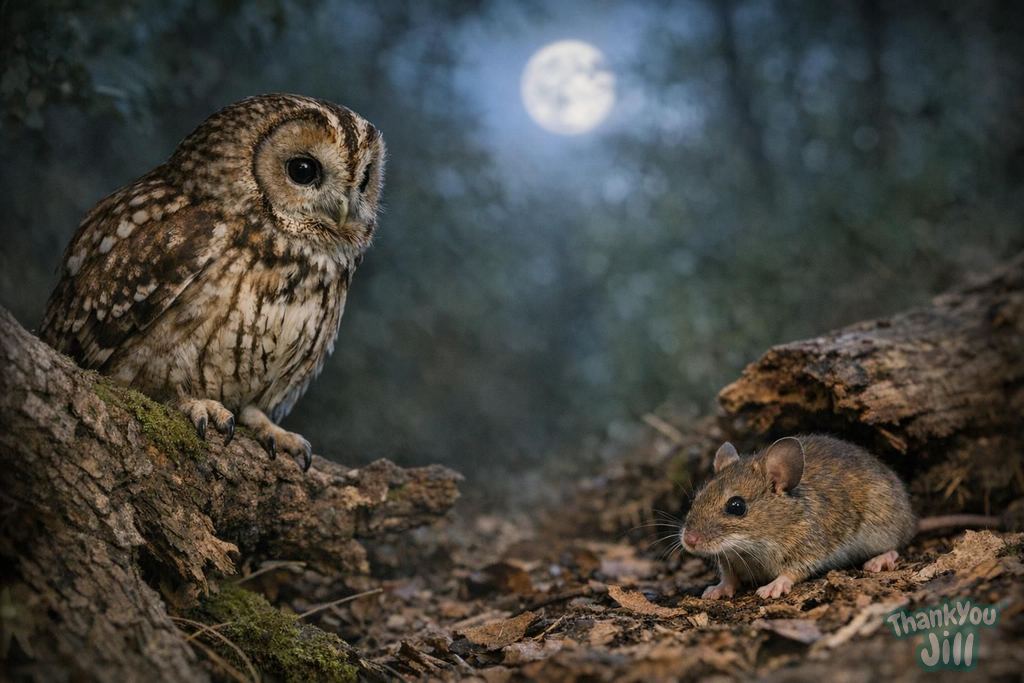
Every night, in any Italian forest, silent hunting takes place that almost no one witnesses. A tawny owl slips between tree trunks without making a sound, locates the rustle of a mouse in dry leaves 15 meters away, dives, and captures it. A scops owl tracks a moth with its eyes in the darkness. A barn owl sweeps over a stubble field like a white ghost. This is the other half of the forest's story — the one that happens while we sleep.
Italian nocturnal birds of prey: a diverse family
Italy is home to 9 species of nocturnal birds of prey (Strigiformes): Tawny Owl (Strix aluco): already described in a dedicated article. The most widespread and most powerful, a generalist predator. Little Owl (Athene noctua): also already described — the most common, the most adaptable, often partially diurnal. Scops Owl (Otus scops): the smallest (60-120 g), an African migrant present in Italy from April to September. Its rhythmic monosyllabic song is the quintessential summer nocturnal sound. It feeds almost exclusively on large insects (crickets, beetles, moths). Barn Owl (Tyto alba): the nocturnal bird of prey with the most extraordinary hearing performance — it can locate and capture prey in total darkness using hearing alone. White heart-shaped face, white-golden plumage. Prefers farmhouses, churches, barns, and hollow trees in agricultural landscapes. Eurasian Pygmy Owl (Glaucidium passerinum): Europe's smallest bird of prey (60-80 g), found in alpine coniferous forests. Partially diurnal. Long-eared Owl (Asio otus): the "owl" with distinctive ear tufts. A partial migrant, it lives at forest edges and in tree-lined hedgerows. Short-eared Owl (Asio flammeus): a migrant, it lives in open areas (marshes, meadows) rather than in forests. Eurasian Eagle-Owl (Bubo bubo): Europe's largest nocturnal bird of prey — wingspan up to 188 cm. It inhabits rocky areas and mountain forests. It is the nocturnal apex predator: it has no natural adult enemies and preys on anything it can overpower, including foxes, hares, and other birds of prey.
The evolutionary race between predators and prey
The evolutionary pressure of nocturnal birds of prey on small mammal populations has produced a series of anti-predator adaptations in forest rodents and mustelids. The wood mouse (Apodemus sylvaticus) has developed acute hearing in the frequency range used by birds of prey for echolocation and an immediate escape response (in less than 50 milliseconds) when it perceives the wind from the predator's wings. The vole uses underground tunnels that completely protect it from birds of prey. The shrew produces ultrasonic echolocation calls that allow it to navigate in total darkness. The dormouse and hazel dormouse live high in branches (out of reach of tawny owls that hunt mainly on the ground). The weasel — Europe's smallest mammal (2-3 g) — survives birds of prey thanks to its extremely small size (it's almost too small to be worth catching) and its activity at any hour of day or night, making it unpredictable. This evolutionary race between predators and prey is one of the most important drivers of evolution in the temperate forest — and it unfolds every night, in silence, in Italian woods.
The impact of tawny owls and barn owls on agriculture
Nocturnal birds of prey are among the most effective natural biological controllers of rodents in Italian agricultural areas. A pair of barn owls with a brood consumes approximately 3,000-5,000 rodents in a season — mainly field voles and common voles that damage cereals. This ecosystem service has direct economic value for agriculture. In some European countries (Switzerland, Netherlands, Great Britain), specific programs have been launched to encourage barn owl nesting in barns and farms with artificial nest boxes — with documented results in reducing rodent damage without the use of rodenticides. In Italy, these programs exist in experimental form in some areas of Emilia-Romagna and Tuscany.

The barn owl can catch a mouse in total darkness using hearing alone. Every night, over Italian fields, this silent white phantom does work that we couldn't do even in broad daylight. Its presence is a sign of landscape health — and its absence is a signal that something in the nocturnal ecosystem has broken.
How to encourage nocturnal birds of prey in agricultural and forest landscapes
- Install nest boxes for barn owls on farms: barn owl boxes (interior 30×30×30 cm, entrance hole 12×15 cm) should be positioned in barns, churches, farmhouses — 4-6 meters high, with free external access. The barn owl almost always occupies the boxes within 1-3 years if there are open fields with rodents in the area. The result is free, effective biological mouse control with no side effects.
- Don't use second-generation anticoagulant rodenticides: brodifacoum, bromadiolone, difenacoum — found in many rodent baits — kill nocturnal birds of prey through secondary poisoning. A barn owl that eats 10-15 mice poisoned by these products dies within days. In Italy, the use of these products outside buildings is legally regulated but often violated. Report improper use to your local health authority's veterinary service.
- Preserve trees with cavities: already mentioned many times, but it applies to nocturnal birds of prey too: tawny owls, little owls, and pygmy owls depend on tree cavities for nesting. Every old tree with holes that gets cut down is a lost nesting site.
- Watch the shift change at dusk: sit in a spot with an open view at the forest edge 30 minutes before sunset. Wait: you'll see diurnal birds of prey (buzzards, kestrels) return to their roosts while bats emerge and, shortly after sunset, the barn owl or tawny owl begins its first patrol flight. The shift change is precise and fascinating to observe.
- Learn the scops owl's song in summer: the monotonous tiu-tiu-tiu of the scops owl is the most common nocturnal sound in Italian countryside and hill areas from May to August. Learning it is very easy: once you hear it, you never forget it. Apps like Merlin Bird ID can identify it in seconds of recording.
- With children — a nocturnal sounds atlas: create a "nocturnal sounds atlas" of the forest near your home with children. Every identified nocturnal sound (tawny owl, scops owl, cricket, barn owl, bat) is added to the atlas with the name, a photo of the animal, and a description of the sound. After a summer of listening, the atlas is already a significant natural history document.
The night in the Italian forest is a symphony of invisible predations and improbable survivals. The tawny owl and the mouse, the barn owl and the vole, the scops owl and the moth: each predator-prey pair is the result of millions of years of coevolution, of challenge and response, of adaptation and counter-adaptation. Understanding this dynamic — even just by listening to it from outside, at the forest's edge at night — is to enter the natural history of Earth in the most direct way possible.
Frequently Asked Questions
What are the main survival strategies of small mammals against nocturnal birds of prey?
Small mammals adopt various adaptations such as acute hearing to perceive birds of prey, the use of underground tunnels, ultrasonic echolocation, and unpredictable activity patterns to avoid nocturnal predation.
How can you encourage the presence of barn owls in agricultural areas for natural rodent control?
You can install nest boxes in barns, farmhouses, or churches, positioned 4-6 meters high with free external access. This encourages nesting and helps naturally reduce the rodent population without the use of rodenticides.
Why is it important to avoid second-generation anticoagulant rodenticides near nocturnal birds of prey?
These rodenticides cause secondary poisoning in birds of prey that feed on contaminated rodents, often leading to their death. Avoiding them protects birds of prey and maintains the natural balance in rodent control.
What is the barn owl's role in the nocturnal ecosystem and how do you recognize its call?
The barn owl is an apex predator that catches rodents even in total darkness thanks to its exceptional hearing. Its call is a characteristic nocturnal sound, often described as a sharp and prolonged cry, typical of agricultural and rural areas.


Latest News




Comments
No comments yet. Be the first!
Leave a comment