


 Italiano
 Français
 Deutsch
 Español
 Português
 Svenska
 Suomi
Suomi
Trees and War
Forests as theater, victim, and symbol of humanity's conflicts
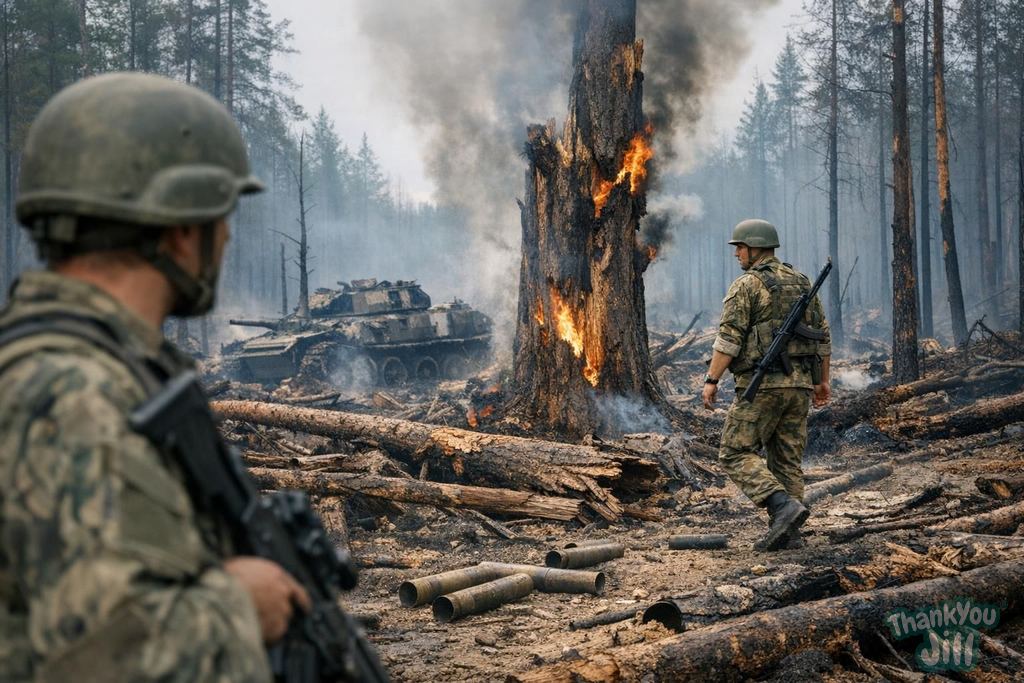
The forest has always been an ally of the weak. Partisans hid in forests. Germanic tribes stopped Roman legions in the Teutoburg Forest. Guerrillas still use forests as a shield today. But the forest has also always been a victim of conflict: burned to drive out the enemy, deforested to build weapons, poisoned with military herbicides. The history of war is also, in part, the history of what wars have done to forests.
The Teutoburg Forest: Where Forests Stopped Rome
In 9 AD, three Roman legions—the XVII, XVIII, and XIX—led by General Publius Quinctilius Varus were completely annihilated by the Germanic tribes of Arminius in the Teutoburg Forest (in present-day North Rhine-Westphalia, Germany). It was one of Rome's most devastating military defeats—approximately 20,000 soldiers killed in three days. Arminius's tactic was simple: lure the Romans into the dense forest, where their tactical formation (a legion in open field was nearly invincible) became useless, then attack with mobile guerrillas adapted to forest warfare. The forest was not merely the theater of battle: it was the Germans' primary weapon. The strategic effect was enormous: Augustus abandoned plans to expand the empire beyond the Rhine, establishing the limes as a permanent border. The German forest had redrawn the boundaries of the Western world.
The Forests of Italian Resistance
During World War II, the forests of the Apennines, the Alps, and the Karst plateau became the refuge, base camp, and often the battlefield of the Italian Resistance. Partisans lived in forests for months—building camouflaged shelters, hiding weapons in tree cavities, using forest paths for nighttime movements. The forests of Ossola, Cuneo, Casentino, the Orobian Alps, and the Trieste Karst still bear the marks of this presence today: carvings on bark, remnants of camps, memorial plaques beneath specific trees. For the partisans, the forest was more than just shelter—it was identity: being men of the forest was a cultural and political choice before it was a military one. Many stories of the Resistance are inseparable from the specific forest locations where they unfolded.
Agent Orange in Vietnam: The Forest as Target
The Vietnam War (1955-1975) produced one of the most severe episodes of intentional forest devastation in recent history. Agent Orange was a military herbicide (a mixture of 2,4-D and 2,4,5-T, contaminated with TCDD dioxin) sprayed by the American military over South Vietnamese forests to strip the Viet Cong of vegetation cover and destroy agricultural crops in enemy-held territories. Between 1961 and 1971, approximately 72 million liters of Agent Orange were sprayed over 4.5 million hectares of Vietnamese forest and farmland—roughly 20% of South Vietnam's territory. The ecological consequences were devastating: destruction of coastal mangrove forests (some have still not fully recovered after 50 years), deforestation of vast tropical forest zones, soil erosion, loss of biodiversity. The human consequences: hundreds of thousands of children born with congenital malformations, cancers, neurological disorders—the children and grandchildren of people exposed to TCDD dioxin.
Memorial Forests: Trees as Memory of the Fallen
Around the world, there is a tradition of planting trees as memorials to those who died in war. In Israel, the Forest of the Martyrs in Jerusalem's forest park was planted with 6 million trees in remembrance of Holocaust victims—one for each person killed. In Britain, War Memorial Arboreta—forests commemorating the fallen of both world wars—are places of reflection and remembrance throughout the country. In Italy, some coastal pine groves and twentieth-century reforestation projects still bear the names of those who fell in the First and Second World Wars. The tree as memory—something living that continues to grow while the people it remembers are gone—is one of the most powerful and universal commemorative symbols that exists.

Forests have always sheltered those who fled, those who hid, those who resisted. They asked no political allegiance: they offered only shade, cover, silence. Perhaps that is why, when we end our wars, we plant trees. Because it is the forest that reminds us how to begin again.
How to Visit Memorial Sites in Italian Resistance Forests
- Visit the Ecomuseum of Resistance in the Cuneo Alps: The Maritime Alps Park and the valleys of Cuneo preserve marked partisan trails, with panels indicating camps, battles, and refuge sites in the forests. The regional ANPI website lists available memory routes.
- Sant'Antonio Forest (Pescocostanzo, L'Aquila): One of the most beautiful and well-preserved beech forests in the Apennines, with trees 400-500 years old, served as a partisan refuge during World War II. Today it is a natural park open to visitors with marked trails—the history of Resistance and natural beauty overlap in an extraordinary way.
- The Casentino Forests and Resistance Memory: The Casentino Forests National Park features commemorative routes of Tuscan Resistance, with memory points in forests where partisan actions took place. The Park's visitor center provides maps and information.
- With Children—The Memory Trail: Many Italian national parks have thematic trails dedicated to the Resistance. Walking through a forest where, eighty years ago, partisans lived—beneath the same oaks, the same beeches, the same paths—creates a sense of historical continuity that no classroom can replicate. The forest as a silent witness to history.
- Plant a Tree in Memory: The tradition of planting a tree in memory of someone—as is done in Israel, as is done in British War Memorial Arboreta—is accessible to everyone. An olive, a cherry, a beech planted in memory of a grandfather or a family member who fell is an act of commemoration that carries within it also the promise of future life.
The forests of Italian Resistance are still there, with the same oaks and beeches beneath which partisans slept and fought. Walking through these forests knowing what happened changes the experience of a walk in a radical way: every tree becomes a witness. It does not speak, but it was there. And sometimes, that is enough.
Frequently Asked Questions
What was the strategic role of forests in historical military tactics such as in the Teutoburg Forest?
Forests offered a fundamental tactical advantage, as in the Teutoburg Forest where the Germans used dense woodland to neutralize Roman formations, exploiting mobility and territorial knowledge to inflict a decisive defeat.
How did partisans use forests during the Resistance in World War II?
Partisans used forests as refuge and operational bases, building camouflaged hideouts, concealing weapons in trees, and exploiting forest paths for nighttime movements, making the forest a symbol of identity and resistance.
What were the environmental and human consequences of Agent Orange use in Vietnam?
Agent Orange caused devastating deforestation, soil erosion, and loss of biodiversity, along with severe health effects such as congenital malformations and neurological disorders in generations exposed to dioxin.
Why are trees planted as memorials to war casualties, and what are some significant examples?
Planting trees as memorials is a symbolic gesture of lasting life and remembrance, present in places like the Forest of the Martyrs in Israel and War Memorial Arboreta in Britain, where each tree represents a victim or historical event.

Latest News




Comments
No comments yet. Be the first!
Leave a comment