


 Italiano
 Français
 Deutsch
 Español
 Português
 Svenska
 Suomi
Suomi
Trees in Painting
From the Macchiaioli to Van Gogh: How Painters Saw Trees
Looking at a Van Gogh painting with cypresses is looking at a tree as we never normally see it — twisted, flaming, almost in agony, yet extraordinarily alive. Van Gogh wasn't painting a cypress: he was painting the energy of plant life as he perceived it, with his mind perceptually altered by disturbance and the intensity of his emotional states. The cypress from Saint-Rémy isn't a cypress. It's all the force that Van Gogh saw in the tree standing before him.
The Tuscan Macchiaioli and the Olives of the Italian Countryside
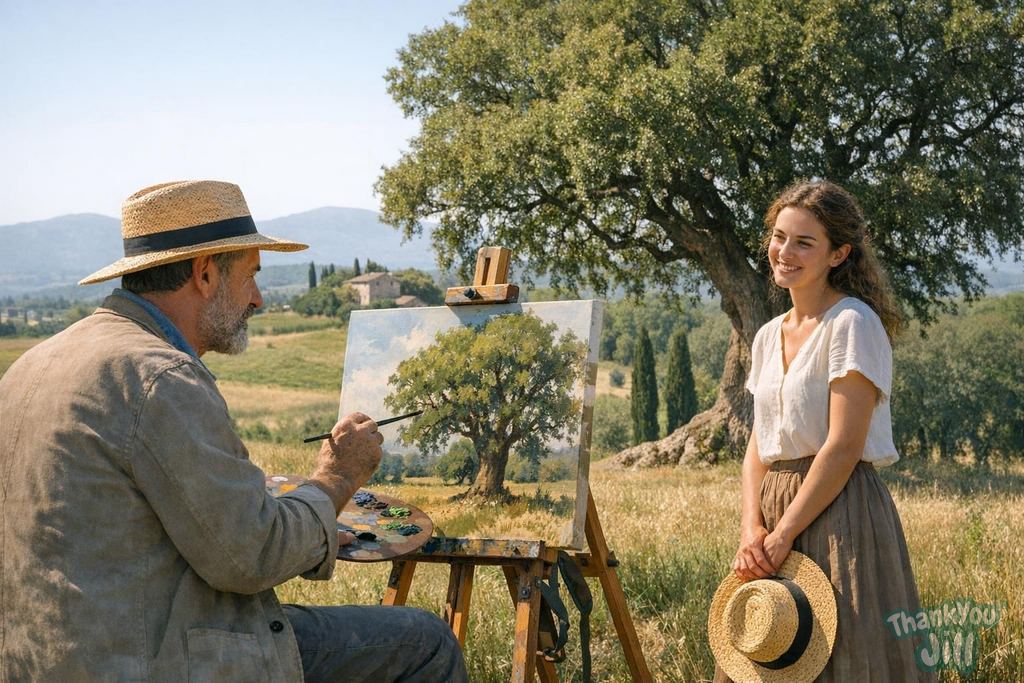
The movement of the Macchiaioli (Telemaco Signorini, Giovanni Fattori, Silvestro Lega, Serafino De Tivoli) was born in Tuscany in the 1850s-1860s as a reaction against academic painting — and the Italian landscape, with its olives, its oaks, its dusty roads bordered by pines, became the principal subject. The Macchiaioli painted en plein air — outdoors, in natural light — and Mediterranean vegetation (silvery olives, maritime pines, dark cypresses) became one of their primary visual vocabularies. Giovanni Fattori's olives — vigorous, twisted, painted with rapid brushstrokes and patches of color — are among the most iconic representations of the olive tree in modern Italian painting. Tuscan light, summer heat, the white dust of roads — all mediated through the trees.
Van Gogh's Cypresses: The Tree as Emotion
Vincent van Gogh painted the cypresses of Saint-Rémy-de-Provence (where he was hospitalized in the Saint-Paul-de-Mausole asylum in 1889-1890) obsessively — at least 15 paintings and numerous drawings. Cypresses (1889, Metropolitan Museum in New York), Starry Night (1889, MoMA New York, with cypresses in the foreground that seem like flames rising toward the sky), Road with Cypresses at Night — in all these paintings the cypress is not background but absolute protagonist. The tortuous spirals of brushstrokes, the almost violent energy of representation — reflect Van Gogh's perception, who wrote to his brother Theo: The cypresses still preoccupy me — I would like to do something with them like I did with the sunflower paintings. It surprises me that they haven't been painted yet the way I see them. They are as beautiful as an Egyptian obelisk... They haven't yet found their painter.
Constable's Oaks: Landscape as Natural Truth
John Constable (1776-1837), the great English landscape painter, was the first European painter to treat trees as subjects of scientifically precise study. He filled notebooks with studies of oaks, beeches, elms — observing the structure of canopies, the way light filters through leaves, the color of bark in different atmospheric conditions. His The Haywain (1821, National Gallery in London) — a riverside scene with large oaks and elms — revolutionized European landscape painting with its convincing rendering of natural atmosphere. Constable argued that painting should be based on direct observation of nature, not on academic conventions — a revolutionary position for the time that directly influenced French Realists and, through them, the Impressionists.
Klimt and Psychedelic Trees
Gustav Klimt painted trees equally personally and recognizably. The birches, pines, and flowering pear trees in his landscapes from summers spent on Lake Attersee present trees seen almost always in frontal plane, with canopies that fill the entire canvas in a flat, almost ornamental decoration that anticipates Art Nouveau aesthetics at its peak. Klimt's plants are never realistic in Constable's sense — they are transfigured into visual symbols that evoke mood rather than botanical description.

Van Gogh and Constable looked at the same cypress and the same elm that we look at today. But they saw them in completely different ways — and both differently from botanical reality. The tree as mirror: each painter projected something of himself into it. Perhaps that's why landscape painting never really ages.
How to Use Art to Look at Trees in a New Way
- Study a painting with trees at a museum: the next time you visit an Italian museum, actively seek out a painting with trees (there are some in almost every collection). Look at the tree in the picture: what species is it? What are the leaves like? The light? Did the painter understand the tree or just copy it superficially? This exercise in visual analysis develops both artistic and naturalistic sight simultaneously.
- Draw a tree from life: even without knowing how to draw, sitting in front of a tree with paper and pencil for 30 minutes completely changes the way you see that tree. The result doesn't matter: what matters is the observation that drawing forces you to make. How do the branches bifurcate? How does the color of the bark change from bottom to top? Where does the light go?
- Visit the Modern Art Gallery in Rome and the Fattori Museum in Livorno: both house important collections of Macchiaioli painting with Tuscan landscapes rich in olives and cypresses. Rome's Modern Art Gallery also has a section on 19th-20th century Italian landscape painting where trees are constant protagonists.
- With children — the "paint like Van Gogh" activity: take children outside with tempera or watercolors and ask them to paint a tree using twisted and swirling brushstrokes like Van Gogh. The result won't be a botanical documentary — but the process of looking at the tree to transfer it onto paper activates a type of attention different from any other activity. Children often paint trees with an expressive freedom that adults have lost.
- Seek out Tuscan cypresses: the rows of cypresses that dot the Sienese and Chianti countryside — along the white roads leading to farmhouses — are one of the most photographed and most picturesque landscapes in Italy. It's not just aesthetics: cypresses were historically planted as windbreaks, as road markers, as property boundaries. Every cypress in that landscape tells a human decision from the past.
Art teaches us to look at trees in ways that biology doesn't contemplate: as emotions, as symbols, as mirrors of the human condition. Van Gogh and Constable, the Macchiaioli and Klimt — each of them enriched the vocabulary with which we can look at a tree. Bringing that vocabulary into the forest, into the walk, into our daily proximity to trees — is one of the gifts that culture gives us freely.
Frequently Asked Questions
What is the difference between the representation of trees in Van Gogh's and Constable's paintings?
Van Gogh paints trees as emotional and subjective expression, with twisted forms and intense colors, while Constable represents them with botanical and scientific precision, focusing on direct observation of nature and light.
How did the Macchiaioli use olives in their plein air paintings?
The Macchiaioli painted Tuscan olives with rapid brushstrokes and patches of color, capturing natural light and Mediterranean atmosphere, transforming vegetation into a central and symbolic visual element of the Italian landscape.
How can art help develop a new way of observing trees in nature?
Studying paintings with trees or drawing trees from life stimulates detailed observation of forms, lights, and colors, improving both artistic and naturalistic perception and allowing us to see trees beyond simple botanical appearance.
Why are cypresses so recurring and significant in Tuscan painting?
Tuscan cypresses are landscape and historical symbols, used as windbreaks, road markers, and property boundaries. Their presence in paintings reflects both aesthetics and human decisions tied to the territory, making them iconic protagonists of the landscape.

Latest News



Comments
No comments yet. Be the first!
Leave a comment