


 Italiano
 Français
 Deutsch
 Español
 Português
 Svenska
 Suomi
Suomi
Trees in Children's Books
Classic illustrated stories to read together under a real tree
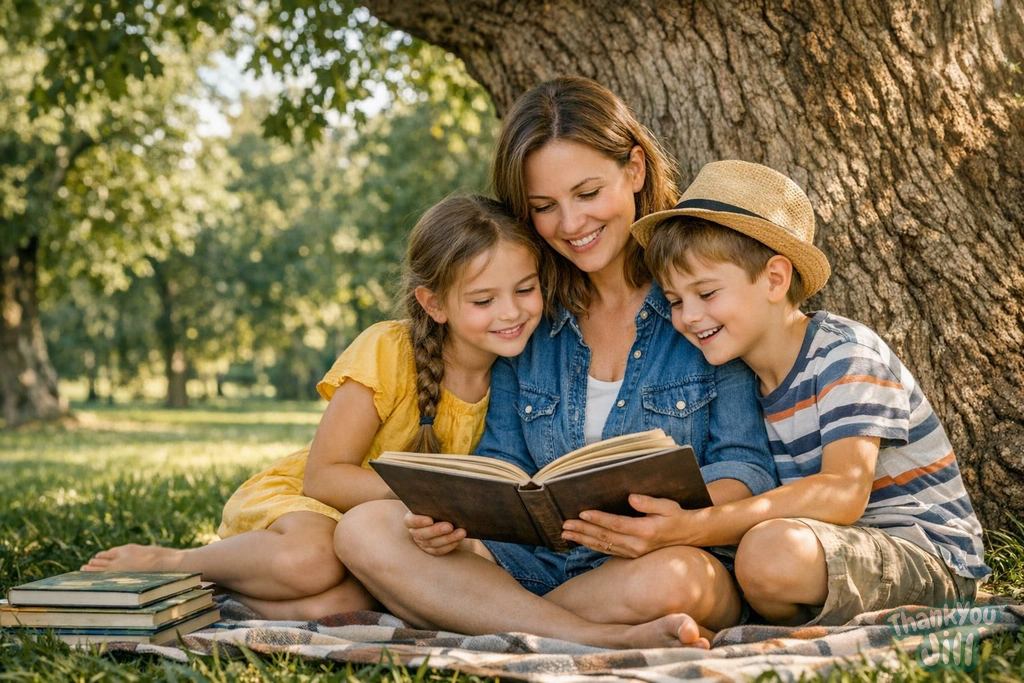
There's a reason why so many of the world's most beloved children's books have a tree at their center. A tree is big and children are small — that's already a story. A tree is alive but doesn't move — that's a mystery. A tree gives fruit, shade, roots, branches to climb — it's generous. Children's books understood all of this long before plant neurobiology explained it scientifically.
The Giving Tree by Shel Silverstein: total generosity
The Giving Tree by Shel Silverstein (1964) is perhaps the most debated, most beloved, and most discussed children's book in the history of American children's literature. An apple tree gives everything of itself to a growing boy — the apples, the branches, the trunk — until only a stump remains. The boy (later an old man) is always happy; the tree, which has sacrificed everything for him, is always happy to have done so. It's been read as a fable about pure generosity, as a metaphor for the parent-child relationship, as a critique of nature's thoughtless consumption. The visual and narrative simplicity (black and white drawings, very brief text) makes it suitable even for very young children. It has sold over 10 million copies worldwide.
The Enchanted Forest by Enid Blyton: The Magic Faraway Tree
The Magic Faraway Tree by Enid Blyton (1943) is one of the most classic fantasy novels for children in English literature. An enormous tree in the forest — with talking plants, gnomes, and elves — has its top reaching the clouds, where different magical "lands" take turns appearing (the Land of Games, the Land of the Moon, the Land of Dreams). The child protagonists climb the tree to visit the magical lands. It's a book that uses the tree's structure — roots, trunk, branches, crown — as a map of an entire narrative cosmos: the ordinary world below, extraordinary worlds above. It has inspired generations of European and world children, with translations in over 40 languages.
The Lord of the Rings and Fangorn Forest
Fangorn Forest in The Lord of the Rings by J.R.R. Tolkien (1954-1955) is one of the most famous imaginary forests in world literature. Inhabited by the Ents — the Shepherds of the Trees, ancient plant-animal beings that "shepherd" the forests — it is a living, ancient forest full of memory. Tolkien, a medieval philologist deeply influenced by Norse and Celtic mythology of trees, created in Fangorn and the Ents the most complex and powerful literary representation of the forest as a living being with intelligence and will. Treebeard's speech about the slowness of the Ents — Must we always be in such a hurry? ... I do not say anything with less than two branches — is one of the most quoted when discussing respect for natural rhythms. The series is suitable from about age 12 onwards.
The Little Prince and the Baobabs
Already mentioned but unavoidable: The Little Prince by Antoine de Saint-Exupéry (1943) uses baobabs as a metaphor for the danger of neglecting problems before they become insurmountable. A baobab, if you neglect it, you can never get rid of it again. It fills the entire planet... it's a matter of discipline. A book nominally for children that actually speaks to adults — and uses a real tree (the baobab) as a symbol of a profound philosophical concept. Suitable from age 8 onwards.
Other essential titles about trees
A selection of essential Italian and international illustrated books: The Thousand-Year Oak by Jan Brett — the annual cycle of an oak and all the animals that inhabit it. Grandmother Plum by Beatrix Potter — the narrator of English woods. The Forest of a Thousand Years by Nicola Davies — scientific education for children about forest ecosystems. Wherever There Are Words by Kate Messner — the cycle of leaves explained to children with poetry. Hector, the Wind Horse by Cécile Theis — a horse that lives in the forest and teaches respect for nature. For popular science non-fiction for young readers: The Incredible World of Trees by Peter Wohlleben (children's version of the worldwide bestseller The Hidden Life of Trees) — suitable from age 10 onwards.

Shel Silverstein wrote a book about an apple tree that gives everything of itself. Tolkien imagined trees that walk. Blyton built an entire universe on a tree that reaches the clouds. Children love these books because they feel, before they can explain it, that trees have something alive and extraordinary inside them. They're right. Science confirms it.
How to read tree books with children: practical ideas
- Read outdoors: take the book to a park or forest and read under the corresponding tree. The Giving Tree is read under an apple tree. The Magic Faraway Tree is read at the base of a large tree that the child can imagine climbing. The physical correspondence between the book and the real tree creates a powerful sensory and emotional association.
- Book first, then the forest: read a chapter of Tolkien about Fangorn, then take the children to a forest of old oaks or beeches. Ask them: does it look like Fangorn? What would Treebeard say about this tree? Literature as a lens for seeing the real world differently.
- Build your own Giving Tree in the garden: if you have a fruit tree in your garden, suggest to the children that they "adopt" it like Silverstein's apple tree. Give the tree a name. Visit the tree every season, photograph it, note what it gives (shade, flowers, fruit). A relationship with a single named tree — like the one between the boy and the tree in the book — is one of the most effective ways to build respect for nature in children.
- Create a tree library: collect on a dedicated shelf all the books (for children and adults) that talk about trees and forests. Show children that there is an entire literature dedicated to trees — from poetry to narrative, from scientific education to fairy tales. This library can grow over time like a tree grows.
- Organize a summer "book tree": during summer vacation, bring a different book about trees and nature to a wooded park every week. Read, then explore the environment around you looking for what the book describes. Every week a book, a tree, an activity. It's a summer program of environmental education at almost no cost.
Children's books about trees are not just entertainment — they are initiations. The child who cried for Silverstein's giving tree, who dreamed of climbing Blyton's Faraway Tree, who met Treebeard in Tolkien's pages — that child can never look at a tree with indifference again. Literature has done work that no biology lesson can do: it has made the tree a character. And characters are respected, loved, not cut down without thinking.
Frequently Asked Questions
What is the advantage of reading books about trees outdoors with children?
Reading books about trees outdoors creates a sensory and emotional association between the story and the real tree, strengthening the bond with nature and making reading more engaging and meaningful for children.
How can a book like "The Giving Tree" by Shel Silverstein help children understand respect for nature?
"The Giving Tree" shows the generosity and sacrifice of a tree toward a boy, teaching children the value of respect and care for nature through a simple yet profound story.
When is it appropriate to introduce children to more complex books about trees like "The Lord of the Rings"?
Books like "The Lord of the Rings," with complex themes and imaginary forests like Fangorn, are suitable for children from age 12 onwards, when they can better appreciate metaphors and narrative depth.
How can tree literature be used to educate children about environmental respect?
You can create a direct relationship with nature by adopting a tree, reading dedicated books, and organizing outdoor activities that connect the narrative to reality, thus fostering authentic and lasting respect for the environment.
Latest News




Comments
No comments yet. Be the first!
Leave a comment