


 Italiano
 Français
 Deutsch
 Español
 Português
 Svenska
 Suomi
Suomi
Cork Bark: Nature's Most Versatile Material
A miraculous and completely renewable resource: the history and uses of cork
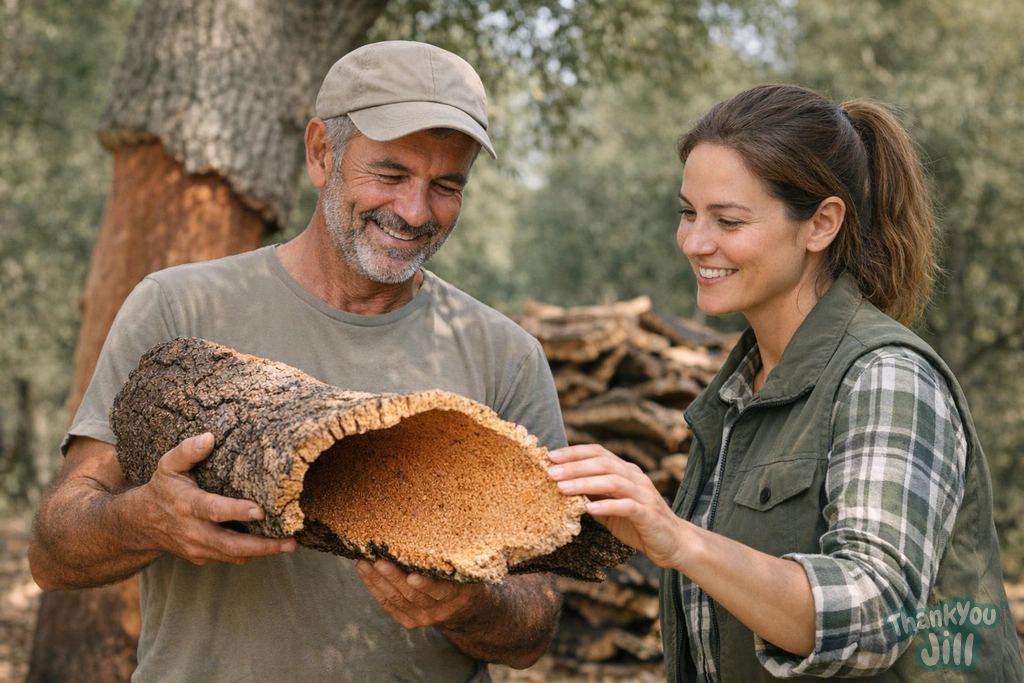
There's a tree in the Mediterranean that produces one of nature's most extraordinary materials — and it can be harvested repeatedly for centuries without ever being cut down. The cork oak. And the material it produces — cork — is waterproof, lightweight, insulating, elastic, biodegradable, fire-resistant, and built to last. It's been used to seal wine bottles for 2,000 years. But that's just the beginning of the story.
nnThe Cork Oak: Nature's Renewable Champion
nnThe cork oak (Quercus suber) is a Mediterranean evergreen that thrives in a narrow climate band spanning Portugal, southern Spain, southern France, southern Italy (Sardinia, Calabria, Sicily), and North Africa. Portugal is the world's largest producer, accounting for roughly 50% of global output, followed by Spain. In Sardinia, the cork oak (Quercus suber, locally called suelzu or suvera) is one of the most distinctive trees in the rural landscape, covering about 150,000 hectares. The botanical hallmark of the cork oak is its thick, spongy bark — cork itself — which forms as a protective outer layer on the trunk. This bark can be stripped by hand every 9–12 years without harming the tree (the inner bark remains intact), and it regenerates completely in preparation for the next harvest cycle. A single tree can be "stripped" up to 15–20 times over its lifetime (200–300 years), producing more cork with each harvest as the trunk grows. It's one of the most efficient and sustainable plant-based productions on Earth.
nnCork's Properties: Why It's So Extraordinary
nnCork is made up of dead cells with walls impregnated with suberin — a waxy, waterproof substance. The cellular structure is a biological foam containing roughly 40 million cells per cubic centimeter, each filled with gas (mainly nitrogen and oxygen). This structure gives cork exceptional physical properties: Waterproofing: suberin doesn't absorb water or organic liquids — hence its use in wine stoppers. Elasticity: compressed by up to 50%, it returns to its original shape — hence its use in bottle corks (the compressed cork slides into the bottle and expands to create an airtight seal). Thermal insulation: the foam of gas-filled cells conducts heat far more slowly than solid wood — hence its use in building insulation panels. Sound insulation: the cellular structure absorbs sound vibrations — hence its use in soundproofed floors and walls. Lightweight: cork weighs about 120 kg/m³ (regular oak wood weighs 700–900 kg/m³ — nearly seven times heavier). Fire resistance: it burns with great difficulty and produces no visible flames — hence its use as a fire barrier in certain building applications.
nnCork Through History and Today
nnCork is one of the oldest materials used by Mediterranean civilizations. The Romans used cork stoppers to seal wine and oil amphorae. In the Middle Ages, it was used to build beehives. The modern use of cork stoppers for glass bottles became widespread in the 17th–18th centuries with the invention of blown glass. Today, cork's industrial and artisanal applications include: wine and sparkling wine stoppers (the largest sector), cork flooring and wall coverings (a natural alternative to laminate), thermal and acoustic insulation in buildings, shoe soles, bags and accessories (sustainable fashion industry), sports equipment (bicycle grips, racket handles), aerospace materials (NASA uses cork as thermal shielding on rockets), cigarette filters, decorative objects and crafts. The sustainable fashion movement has recently embraced cork as an animal-leather alternative: cork bags, wallets, belts, and jackets are increasingly popular.
nnCork and the Biodiversity of Cork Forests
nnCork oak forests (cork woodlands) are ecosystems of extraordinary biodiversity. In Portugal and Sardinia, cork woodlands host rare nesting bird species (the Red Kite, the Lesser Kestrel, the Stone-curlew), endemic amphibians, reptiles (the Moorish Tortoise), and highly diverse flora. The traditional management practice of cork woodlands — maintaining low tree density with extensive grazing beneath the canopy — creates a mosaic of open and closed habitats of tremendous ecological value. This traditional agro-silvo-pastoral system (called montado in Portugal, dehesa in Spain) is recognized by the European Union as an agroforestry heritage worthy of protection.

The cork oak is the tree that lets itself be stripped bare every nine years and then grows back, richer than before. It's one of nature's most powerful metaphors, written in wood: to give without losing. To harvest without destroying. To produce without consuming. Perhaps we should take notes.
How to Recognize and Choose Authentic Cork Products
- Distinguish natural cork from agglomerated cork: Natural cork (used for quality bottle stoppers) has an irregular surface with visible micropores and a color ranging from beige to brown. Agglomerated cork (used for flooring and insulation) is made from cork granules bonded with resins — it has a more uniform surface and consistent color. Both are sustainable products, but natural cork is superior quality for stoppers.
- Prefer natural cork stoppers: In the debate between natural cork stoppers and synthetic (plastic) or screw caps, choosing cork supports the Mediterranean cork oak supply chain — a biodiverse ecosystem of tremendous ecological value. Cork stoppers are biodegradable; plastic ones are not. Screw caps are convenient but don't support this traditional agroforestry system.
- Visit a cork forest in Sardinia: Sardinia is home to some of Italy's most beautiful cork forests. The Nuoro region, Gallura, and Supramonte areas have vast cork oak forests accessible via CAI hiking trails. Summer (July) is cork harvest season — watching demasciatori (specialized cork harvesters) at work is a rare artisanal experience, passed down orally through generations.
- Buy handcrafted cork products: Support small Sardinian and Portuguese businesses that produce bags, wallets, coasters, frames, and handmade cork items. It's a sustainable purchase, biodegradable, with beautiful natural aesthetics and a positive environmental impact on the cork forest supply chain.
- With children — the buoyancy experiment: Place pieces of different materials in a basin of water: wood, metal, plastic, cork. Which floats best? Cork is among the lightest natural materials (120 kg/m³ versus 700 for regular wood). Explain that its lightness comes from its cellular foam structure — and observe the micropores with a magnifying glass. It's physics, chemistry, and botany all in one activity.
The cork oak tree is living proof that production and sustainability can coexist — that you can harvest from nature without destroying it, if you respect natural cycles and timelines. In an era of intensive monocultures and non-biodegradable synthetic materials, the Mediterranean cork forest is a model of 2,000 years of ecological and economic success. It deserves to be known, visited, and supported.
Frequently Asked Questions
What properties make cork an insulating and waterproof material?
Cork is composed of dead cells impregnated with suberin, a waxy waterproof substance. Its biological foam-like cellular structure with trapped gas provides waterproofing and thermal and acoustic insulation, making it ideal for stoppers and insulation panels.
How is cork harvested without damaging the cork oak tree?
Cork bark is removed manually every 9-12 years without felling the tree, since only the outer layer is harvested. The inner bark remains intact and the outer bark regrows completely, allowing for 15-20 harvests over 200-300 years.
What's the difference between natural cork and agglomerated cork?
Natural cork has an irregular surface with visible micropores and color variations, and is used for quality stoppers. Agglomerated cork is made from granules bonded with resins, has a uniform surface, and is used for flooring and insulation.
Why should you choose natural cork stoppers over synthetic or screw caps?
Natural cork stoppers support the sustainable cork forest supply chain, are biodegradable, and help preserve Mediterranean ecosystem biodiversity. Synthetic or screw caps are not biodegradable and don't contribute to conserving these habitats.

Latest News
Comments
No comments yet. Be the first!
Leave a comment