


 Italiano
 Français
 Deutsch
 Español
 Português
 Svenska
 Suomi
Suomi
Tree Resin
From medicine to perfume, from instrument-making to incense: the gifts of resin
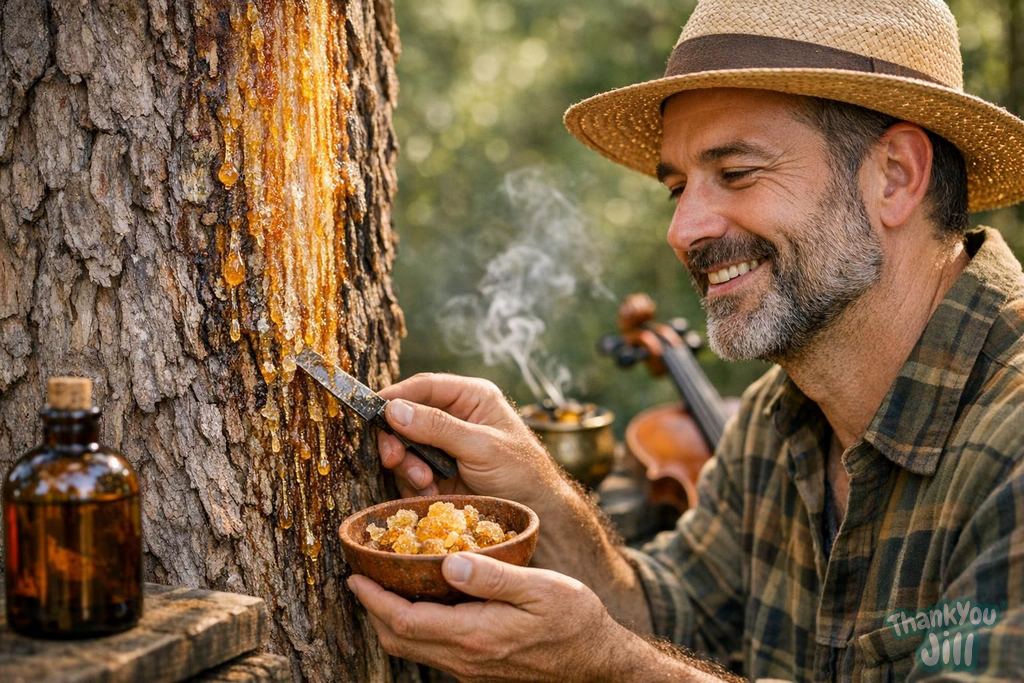
Place your hand on the bark of a pine tree and pull it back with fingers sticky from a transparent, fragrant substance, almost as dense as honey. That's resin. The tree is trying to heal a wound — a cut, a hole made by an insect, a crack in the bark. Resin is the forest's first-aid system. And over millennia, humanity has learned to intercept this plant medicine and use it in ways ranging from incense to the bow of a violin.
What is resin and why do trees produce it
Resin (botanical term: oleoresin in conifers, latex or gum-resin in some broadleaf trees) is a complex mixture of terpenes (volatile hydrocarbons such as α-pinene, limonene, myrcene), resin acids (such as abietic acid, which gives dried resin its solid consistency), and fatty acids. Conifers (pines, firs, larches) produce resin in resin canals — tubular structures that run through the wood and bark. Resin serves defensive functions: it fills and seals mechanical wounds (cuts, abrasions), physically traps wood-boring insects (larvae of jewel beetles and longhorn beetles attempting to tunnel into the wood), and releases antimicrobial volatile compounds that inhibit fungal and bacterial growth in wounds. Volatile terpenes (the "scent of a pine forest") are a form of chemical communication: they warn nearby trees of an ongoing parasitic attack. In broadleaf trees, some species produce gum arabic (Acacia), latex (Ficus, Hevea), balsams (Copaifera), or fragrant resins (myrrh, frankincense, storax).
Frankincense and myrrh: the sacred resins of antiquity
Two resins became religious symbols in nearly every ancient culture. Frankincense (olibanum) comes from the resin of Boswellia sacra — a gummy tree from the Arabian Peninsula, Somalia, and Oman. Myrrh comes from the resin of Commiphora myrrha, a shrub from the Horn of Africa and the Arabian Peninsula. Both were among the most precious commodities of antiquity — the Incense Route connected southern Arabia to Egypt, Greece, and Rome, transporting these resins for thousands of kilometers. Frankincense burned in Egyptian temples, Roman ceremonies, Christian churches, Islamic mosques, Buddhist and Hindu temples is the same resin from Boswellia. In the Gospel of Matthew, the Magi bring the infant Jesus gold, frankincense, and myrrh. Modern pharmacological research has discovered that frankincense compounds (especially boswellic acid) have significant anti-inflammatory properties — giving scientific basis to 5,000 years of medicinal use.
Rosin and the violin: resin as music
Rosin (also called colophony) is the solid resin that remains after distilling turpentine (the volatile part of pine resin). It's the only substance that the bows of stringed instruments (violin, viola, cello, double bass) rub on the strings to produce sound. Without rosin, the horsehair of the bow slides across the strings without making them vibrate — rosin creates the right amount of friction that makes the string vibrate. Every professional violinist has their preferred rosin — there are variants in hardness, granularity, and composition that produce slightly different timbres. Stradivari's violin sounded with the same rosin (from pine resin) used today. Turpentine distilled from pine resin is also used as a solvent for varnishes, as a component in pharmaceuticals, and as a natural biocide.
Amber: fossilized resin from prehistory
Amber (in Latin succinum) is fossilized conifer resin, hardened over millions of years under the pressure of sediments. Most Baltic amber is about 44 million years old — produced by extinct conifer forests (Pinus succinifera) that once covered the coasts of the Baltic Sea. Amber is precious not only for its beauty (it has been used in jewelry for 13,000 years — the oldest known amber jewelry dates to the Mesolithic) but especially for the prehistoric organisms trapped in its inclusions: insects, spiders, plants, even small vertebrates, preserved in extraordinarily fine detail. Over 50% of what we know about Cretaceous and Eocene fauna and flora comes from Baltic amber.

A Stradivari violin sounds because someone rubbed pine resin on horsehair. Christmas smells of frankincense because 5,000 years ago someone in Arabia understood that burning the resin of a tree made the gods feel near. Resin has been there since before humanity. We found it and transformed it into music, into prayer, into fragrance.
How to use tree resin in everyday life
- Collect pine resin with respect: resin that naturally flows from wounds on pine trees can be collected in small quantities (never make artificial cuts). Fresh resin is sticky and fragrant; hardened resin is dry and brittle. You can use it as natural incense — place it on a burning charcoal and enjoy the scent of the forest. It melts and smells extraordinarily different from commercial incense.
- Use certified organic incense: frankincense from Boswellia sacra in tears (small solid pieces) is available in herbal shops and Orthodox churches. Burning it on charcoal at home produces an ancestral fragrance with proven stress-reducing properties. Look for Fair Trade certified products from Somalia or Dhofar (Oman) — the frankincense tree is threatened by overharvesting.
- Rosin for bows: if you play a stringed instrument (or if your child studies violin), deepen your knowledge of the rosin you use. There are standard pine rosins (Bernardel, Hill) and special rosins for different climates (harder rosins for humid climates, softer ones for dry climates). It's a natural, biodegradable consumable, extracted from managed pine forests.
- With children — amber and inclusions: buy a small piece of Baltic amber (available online at affordable prices — from 5 euros for pieces without inclusions, more for those with insects) and observe it with a magnifying glass. Even without a visible inclusion, the internal structure of amber is beautiful — bubbles, filaments, plant inclusions. With an insect inclusion (often gnats or ants), amber becomes a portal to prehistory: that insect was alive 44 million years ago. Explaining this to a child is one of the most immediate ways to help them understand the scale of geological time.
- Visit the amber museum: the Amber Museum in Gdańsk (Poland) has the world's largest collection of Baltic amber, with extraordinary inclusions. In Italy, the amber gallery at the Natural History Museum in Bolzano displays Alpine amber and fossil inclusions. For those who cannot travel, the Gdańsk Amber Museum website has an excellent online photo gallery.
Tree resin has healed wounds, perfumed prayers, made violins sing, and preserved insects for 44 million years. It is one of nature's most silently extraordinary gifts to us. The next time your fingers get sticky with resin after touching a pine tree's bark — don't wash them right away. Smell it. It's the fragrance of 300 million years of plant evolution.
Frequently asked questions
What are the main functions of resin in conifer trees?
Resin in conifer trees seals wounds, traps wood-boring insects, and releases antimicrobial compounds to prevent fungal and bacterial infections, acting as a natural immune system.
How is rosin used in music and what variants exist?
Rosin, obtained from pine resin, is applied to the bows of stringed instruments to create friction and make the strings vibrate. There are variants in hardness and composition suited to different climates and sound preferences.
Why were frankincense and myrrh so precious in antiquity and what medicinal properties do they have?
Frankincense and myrrh were precious commodities for their ritual and fragrant use. Frankincense contains boswellic acid with anti-inflammatory properties, confirming the medicinal efficacy recognized for millennia.
How to identify and collect pine resin sustainably for personal use?
Collect only resin that naturally flows from tree wounds, avoiding artificial cuts. Fresh resin is sticky and fragrant, ideal for natural incense, while hardened resin is dry and brittle.
Latest News




Comments
No comments yet. Be the first!
Leave a comment