

 English
 Italiano
 Français
 Deutsch
 Español
 Português
 Svenska
 Suomi
Suomi
Xylella fastidiosa
The bacterium destroying Puglia's olive trees: history and the fight against it
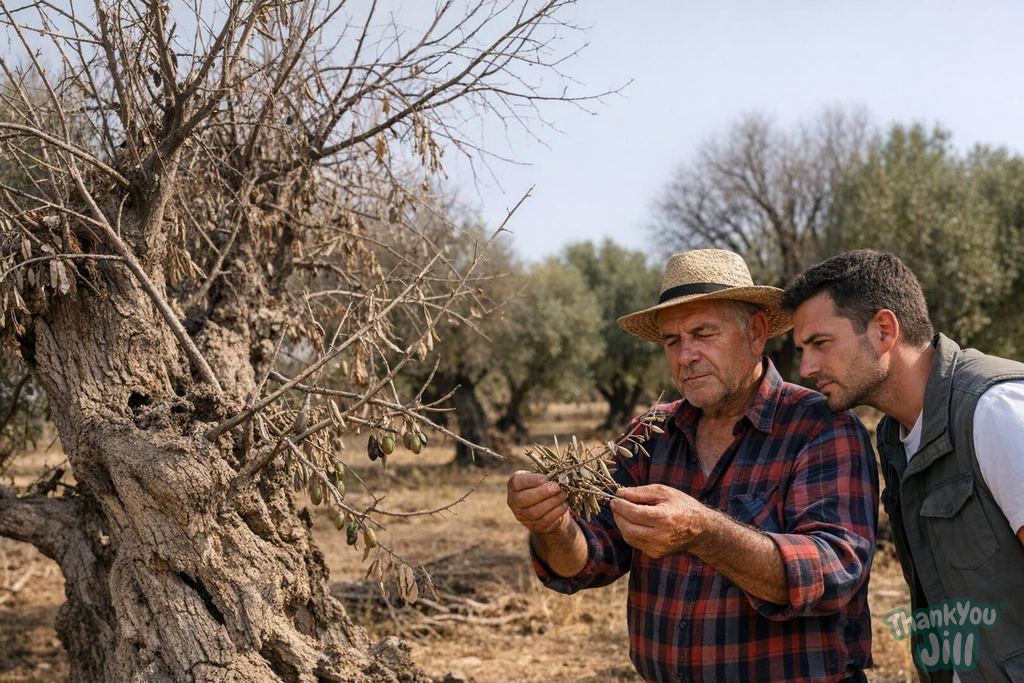
In 2013, in the Gallipoli area in Salento, researchers from the Puglia Region identified an unknown disease that was killing olive trees at an alarming rate. Branches dried out from the top, leaves turned brown, and the canopy progressively faded. Within a few months, the bacterium was identified: Xylella fastidiosa, subspecies pauca. It had never been reported in Italy before. And there was no cure.
What is Xylella fastidiosa
Xylella fastidiosa is a gram-negative bacterium that lives and multiplies inside the xylem — the vascular vessels that transport water and nutrients from the roots to the leaves in the tree. Massive colonization of xylem vessels progressively causes hydraulic occlusion: water can no longer reach the branches and leaves, causing rapid drying and death. The bacterium is transmitted through insect vectors that feed on xylem sap — in Puglia the main vector is the meadow spittlebug (Philaenus spumarius), a small hemipteran insect very common in grassy meadows. The adult spittlebug feeds on olive xylem and transmits the bacterium during feeding. Each infected spittlebug can inoculate the bacterium into dozens of olive trees. Transmission is extremely rapid: even trees far apart can be infected if there are vector spittlebugs in the area. There is currently no effective treatment that eliminates the bacterium from already infected trees.
The scale of the disaster: millions of olive trees lost
Since the first report in 2013, Xylella has progressively spread northward from the initial Gallipoli area. In the zone of maximum infestation (infected zone), which includes the entire province of Lecce and part of Brindisi, millions of olive trees — many of which have hundreds of years of history — are already dead or in terminal condition. The most recent estimate (2023) speaks of over 21 million olive trees potentially affected in Puglia alone. The loss is not only economic (Puglian olive oil production has dropped 30-50% in affected areas) — it is a cultural and landscape loss of historic proportions. Olive trees of 500, 800, 1,000 years old — living beings that had traversed the entire modern history of Italy — are dying within a few years. It is one of the greatest plant health disasters in European history.
Containment measures and scientific controversy
The European strategy for containing Xylella involves three zones: the infected zone (where the bacterium is present), where the initial prescription was to fell symptomatic trees and host plants within a 100-meter radius; the buffer zone (20 km north of the disease front), with intensive monitoring and preventive measures; the disease-free zone, where surveillance is concentrated. The obligation to fell olive trees in containment zones generated enormous controversy and social resistance: many owners opposed the felling of century-old olive trees, often triggering legal conflicts. Some scientists contested the effectiveness of the eradication approach, arguing that the bacterium was already too widely distributed to be eliminated through felling. In 2020, the Court of Justice of the European Union confirmed the legitimacy of the felling measures. Intense scientific research over recent years is producing olive varieties resistant to the bacterium (some native varieties such as Leccino and FS-17 show tolerance), and new vector control strategies through soil management and grass reduction (the spittlebug habitat).
Xylella beyond olives: a broader threat
Xylella fastidiosa does not only affect olive trees. In Puglia, positive samples have been found on over 350 different host species, including oleander, almond, grapevine, oak, rosemary, lavender, and many ornamental plants. Worldwide, different subspecies of Xylella cause Bacterial Leaf Scorch of grapevines in California, Pierce's Disease of grapevines in California, Phony Peach Disease of peaches in the southern USA, and dozens of other diseases of cultivated and wild plants. In Europe, the spread of Xylella is considered by EFSA (European Food Safety Authority) one of the most serious plant health threats to agriculture and natural landscapes across the continent.

A bacterium that lived quietly in Latin America arrived in Puglia on an ornamental plant that was imported. It found millions of olive trees with no evolutionary defenses and is killing them one by one. It's nobody's fault — it's the globalization of pathogenic species. But understanding how it happens helps us figure out how to prevent it next time.
How to stay informed and contribute to the fight against Xylella
- Don't move host plants from the infected zone: the most important rule for the average citizen is not to move potentially infected plants from Puglia's infected zone to other regions. Buying olive, oleander, lavender, or rosemary plants from nurseries in the infected zone and planting them elsewhere can spread the bacterium. Always buy plants from nurseries with certified phytosanitary passports.
- Report suspicious symptoms: if you notice progressive drying on olive trees, oleanders, or almonds (especially in Puglia, Basilicata, Campania, and Calabria), report it to the competent Regional Phytosanitary Services. Early reporting is essential for monitoring the disease front's advancement.
- Support scientific research: the Mediterranean Agronomic Institute of Bari (CIHEAM-IAMB), the University of Bari, and the CNR are conducting intensive research on resistant varieties and vector control methods. Some of this research is partially funded by private contributions and crowdfunding campaigns.
- Visit Salento with awareness: if you visit Puglia, seeing hundreds of dead or dying olive trees in the Salento landscape is one of the most heartbreaking testimonies to the ongoing disaster. Many local agritourisms offer guided tours that explain the situation on the ground. Understanding what you see transforms a tourist experience into a form of direct environmental education.
- With children — the story of Xylella as a lesson in globalization: the story of Xylella is a perfect example of how the globalization of trade also transports pathogenic species into ecosystems that have no evolutionary defenses. The bacterium that lived in Costa Rican citrus arrived on an ornamental plant in Puglia. Explaining it to children — with a map of its journey — is a concrete way to understand the environmental consequences of the global trade in plants and animals.
Xylella fastidiosa is the most serious plant health crisis in Italian history and one of the most painful environmental disasters in contemporary Europe. Millions of ancient olive trees that will never be seen again. A cultural landscape that changes forever. Knowing this story doesn't stop the disease — but it creates more aware citizens of the consequences of our choices on the landscapes and ecosystems around us.
Frequently Asked Questions
How is Xylella fastidiosa transmitted to olive trees?
Xylella fastidiosa is transmitted mainly through insect vectors such as the meadow spittlebug (Philaenus spumarius), which feed on the xylem sap of olive trees and inoculate the bacterium during feeding, rapidly infecting even distant trees.
What containment measures have been adopted against Xylella fastidiosa?
The measures involve three zones: infected zone with felling of symptomatic trees and host plants, buffer zone with monitoring and prevention, and disease-free zone with surveillance. Felling has sparked controversy but is confirmed by the EU Court of Justice.
Which olive varieties show tolerance to Xylella fastidiosa?
Native varieties such as Leccino and FS-17 have demonstrated some tolerance to the bacterium, and scientific research is working to develop additional resistant cultivars to counter the spread of the disease.
Why is it important not to move host plants from the infected zone?
Moving infected plants such as olives, oleanders, or lavender from the infected zone can spread Xylella to new areas. It is essential to buy plants with certified phytosanitary passports and respect restrictions to prevent the bacterium's expansion.
Latest News

Comments
No comments yet. Be the first!
Leave a comment