


 Italiano
 Français
 Deutsch
 Español
 Português
 Svenska
 Suomi
Suomi
Public Transportation
How to improve it in cities
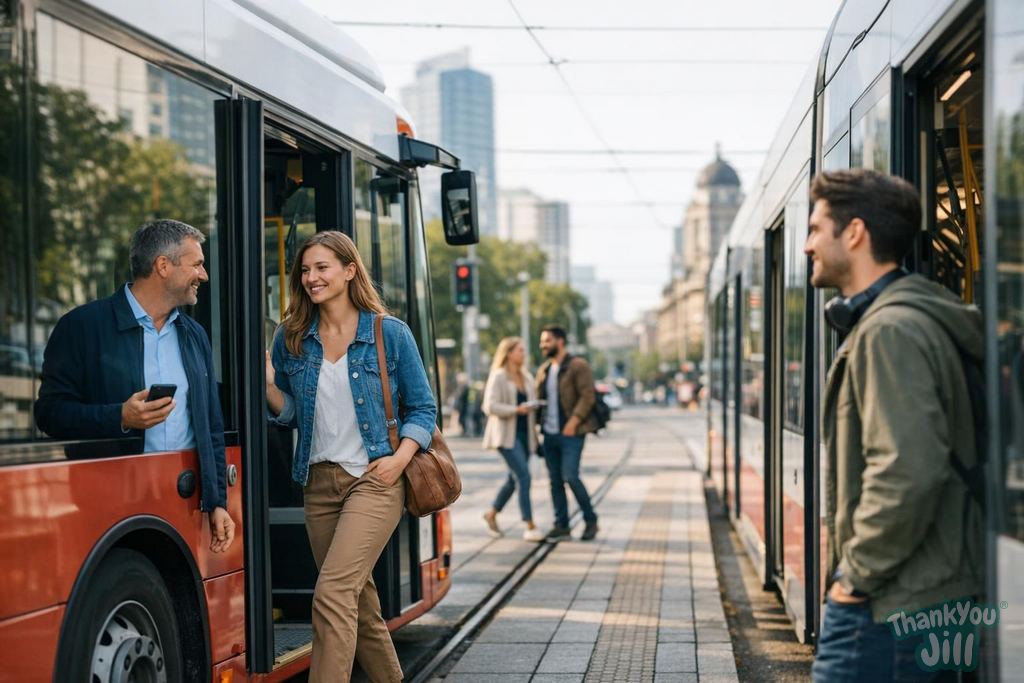
Public transportation is the most efficient solution for large-scale urban mobility: a metro line can carry 40,000-60,000 passengers per hour in each direction, compared to 2,000-4,000 passengers on a congested urban highway. It produces 33 g CO2/pkm (metro) versus 116-171 g/pkm for private cars. It reduces congestion, noise pollution, and land use for parking. Yet in Italy, local public transit (TPL) is systematically underfunded compared to the European average, with service quality varying widely between North and South and between large and medium-sized cities.
World-class models: what works
Vienna (Austria): the city with Europe's best public transit system according to international rankings. Annual pass (Jahreskarte) at 365 euros (1 euro per day), integrated metro-tram-bus network with extremely high frequencies (metro every 2-3 minutes during peak hours), coverage of the entire metropolitan area. Result: 38% of Viennese trips use public transit. Helsinki (Finland): public transit system with integrated multimodal network (metro, tram, bus, ferries), Whim app that integrates payment for all modes including taxis and car sharing in a single monthly subscription (mobility as a service, MaaS). Singapore: metro (MRT) and bus system completely integrated with unified fares for transfers, 99.9% punctuality, air conditioning, extremely high frequencies. Tokyo: the world's most comprehensive urban rail and metro system, with legendary punctuality (average delay is 18 seconds), operated by multiple private companies under regulatory oversight.
Public transit in Italy: strengths and weaknesses
Leading cities: Milan has Italy's most efficient urban public transit, with integrated metro, tram, and bus service and an integrated monthly pass at around 39 euros. Bologna has an integrated regional system (SFM) with regional trains, buses, and bike sharing. Turin has a well-structured metro-tram-bus network. Naples has the Metropolitan Railway with some of Europe's most beautiful stations (the "art stations"). Structural challenges: chronic underfunding of public transit (Italy allocates to public transit users about 40% of the per-capita subsidies of Germany or Austria), fragmentation of operators and ticketing systems (each city has its own non-interoperable pass system), systematically lower service quality in Southern Italy compared to the North, lack of regional fare integration in many areas. The gap between Northern and Southern Italy in public transportation is one of the country's most pronounced infrastructure divides.
How to improve public transit: the main levers
Funding: public transit operates at a loss almost everywhere (fares cover an average of 30-40% of operating costs in Europe). The political choice is whether to subsidize it as an essential public service (like education or healthcare) or leave it to the market (which inevitably leads to cuts on less profitable routes, penalizing peripheral areas and lower-income populations). Free public transit (piloted by Tallinn since 2013, Luxembourg nationwide since 2020, various German cities) increases ridership but requires substantial public funding. Frequency: the most important factor for public transit appeal. A bus every 30 minutes can't compete with a car. One every 7-8 minutes can. Modal integration: bike sharing and car sharing physically and tariffically connected to public transit nodes (metro stations, major bus stops) create the multimodal mobility that works in the world's most advanced cities. Technology: public transit apps providing real-time information, integrated contactless payment, predictive delay information: these reduce wait anxiety and increase satisfaction.

A metro moves 40,000 people per hour in the space occupied by 4-5 highway lanes. The math of urban mobility is unambiguous: mass public transit is the only scalable solution to city congestion. The problem isn't technical: it's political. Funding public transit the way we fund healthcare is the choice that separates functioning cities from those stuck in traffic.
How to use public transit more effectively in your city
Tools for using public transit: Google Maps (public transit trip planning is integrated into Google Maps with real-time schedules for major Italian cities), Moovit (multimodal navigation app specialized in public transit, with real-time information on delays and disruptions), local operator apps (ATM Milan, ATAC Rome, GTT Turin, ANM Naples have official apps with real-time information). Affordable passes: monthly or annual passes are almost always much cheaper than single tickets. In many Italian cities, public transit monthly passes are tax-deductible. Regional integration: for commuters, check if there's an integrated train + bus pass covering your route (Lombardy's integrated regional system "Io viaggio" is one of Italy's most advanced examples).
Citizens' role in improving public transit
Improving public transit depends not only on public policy but also on citizen behavior and political voice. How to contribute: use public transit even when driving would be equally convenient (each public transit trip signals demand to the system), report service issues through official transit company channels (app, email, toll-free number: aggregated reports influence operational decisions), participate in your municipality's PUMS planning process (public consultations are legally required for PUMS and have real impact on infrastructure choices), politically support candidates and parties that prioritize public transit in their electoral platform. In Italy, municipal and regional budget decisions directly determine public transit quality: local voting has a direct impact on daily mobility.
The future of public transit: autonomous vehicles, MaaS, and on-demand transit
Emerging technologies are transforming the public transit model. Autonomous buses: already operating in pilot programs in some European cities (Helsinki, Oristano in Italy). They can reduce operating costs by 50-70% (driver salary is the main cost), making low-frequency routes economically sustainable. Mobility as a Service (MaaS): integration of all transportation modes (public transit, taxis, car sharing, bike sharing, scooters, railways) in a single app with integrated payment. Whim in Helsinki is the global reference model. On-demand transit: electric minibuses following flexible routes based on real-time user bookings (ride-pooling algorithm). More efficient than fixed-route buses in low-density areas. Pilots underway in many Italian cities (Rome, Palermo, various northern cities). These technological innovations don't replace traditional public transit funding: they complement it, especially in peripheral and low-density areas where fixed service isn't economically sustainable.
Frequently asked questions
What are the main levers for improving local public transit efficiency?
The main levers are adequate funding, increased service frequency, modal integration with bike and car sharing, and use of technologies like real-time information apps and contactless payment, which increase service appeal and quality.
How does the integrated pass model work in multimodal public transit?
The integrated model allows using different modes (metro, tram, bus, taxi, car sharing) with a single pass or app, facilitating trips and reducing costs. Best-practice examples include Helsinki's Whim app and Singapore's unified fares.
When is it worth using monthly or annual public transit passes?
Monthly or annual passes make sense when making frequent trips, as they're more economical than single tickets. Additionally, in many cities they're tax-deductible, increasing savings for users.
What's the role of emerging technologies like autonomous buses and on-demand transit?
Emerging technologies reduce operating costs and improve service flexibility, especially in low-density areas. Autonomous buses lower personnel costs, while on-demand transit offers flexible routes based on real-time bookings.


Latest News




Comments
No comments yet. Be the first!
Leave a comment