


 Italiano
 Français
 Deutsch
 Español
 Português
 Svenska
 Suomi
Suomi
Blockchain and Food Traceability
Food Traceability and Technology
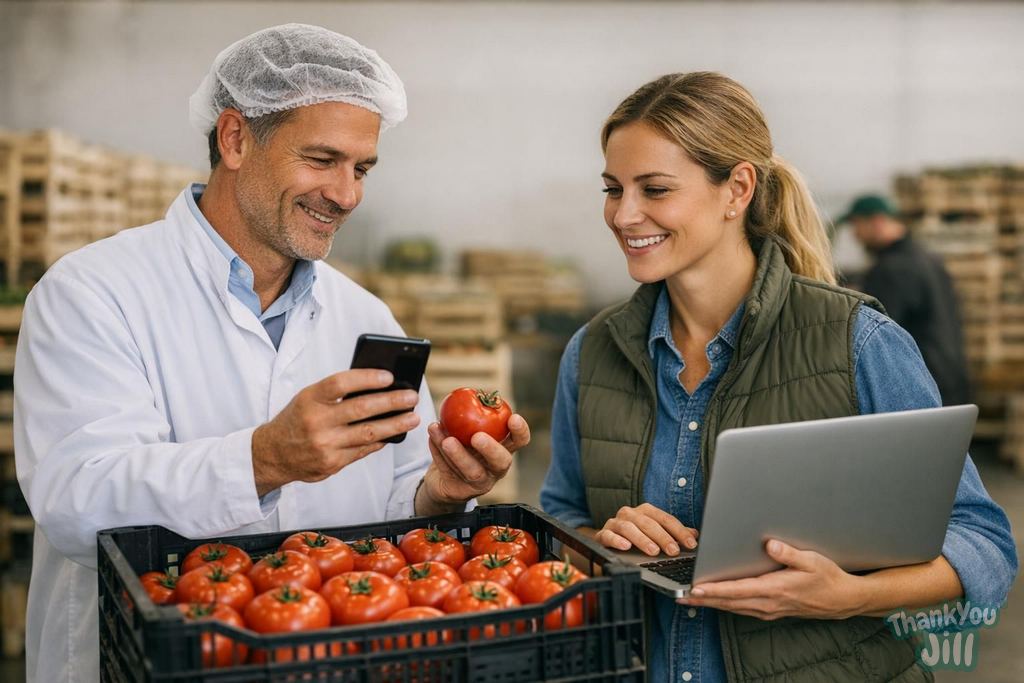
Blockchain is a distributed and immutable digital ledger: a database shared among thousands of independent nodes, where every transaction (or event in the supply chain) is recorded in a "block" cryptographically linked to previous blocks. Once written, data cannot be modified or deleted without altering the entire chain (and thus being detected by all network participants). This property of immutability and transparency makes it theoretically ideal for food traceability: every phase of production, processing, and distribution can be recorded in a way that's verifiable by anyone.
How blockchain traceability works in the food supply chain
The typical flow of a food blockchain traceability system: the farmer registers planting, phytosanitary treatments, and harvest on the system, with immutable GPS data and timestamps. The collection warehouse registers receipt, analyzed quality, and storage conditions. The transporter registers pickup, conditions (temperature, humidity) during transport, and delivery. The processing facility registers incoming batches, processes, and outgoing products. The distributor registers warehouse movements. The retail point scans the product's QR code to display the entire history. The end consumer can scan the QR code with their phone and see the product's complete story: which field it comes from, who transported it, when it was processed. Each operator has limited access to their part of the chain, but the integrity of the whole is guaranteed by the blockchain structure.
Real examples of implementation in the food supply chain
Walmart and IBM Food Trust (Hyperledger): the most well-known project. Walmart implemented blockchain traceability for E. coli lettuce in 2019: the time to trace the origin of a contaminated batch dropped from 7 days (using traditional paper-based traceability methods) to 2.2 seconds. The system now covers hundreds of suppliers. In Italy: Coop and IBM Food Trust launched a pilot project in 2019 on organic kiwis and later on other produce, allowing consumers to scan the QR code to access the complete product history. Carrefour Food Blockchain: in France (and partially in Italy), Carrefour has extended blockchain traceability to eggs, chicken, honey, and milk. The system is accessible via QR code on packaging. TE-FOOD: a blockchain food traceability platform for small and medium operators, used in several countries for meat supply chain control.
The real limitations of blockchain in the food supply chain
Blockchain solves the problem of falsifying digital data, but it doesn't solve the problem of entering false data at the source ("garbage in, garbage out"). If a farmer registers on the blockchain that they used only organic pesticides when they actually used chemical pesticides too, the blockchain faithfully records the false data with the same immutability as true data. The weak point isn't the technology: it's the controls on the physical world. To truly work, blockchain must be combined with: independent and certified physical inspections at critical points in the supply chain, laboratory analysis of residues and composition on a sample basis, IoT sensors (physical sensors that automatically record parameters without human intervention), verified digital identity systems for operators (is the person registering the data who they claim to be?). Another limitation: the complexity and cost of implementation make blockchain poorly accessible to small agricultural businesses, which are the majority in Italy. The risk is that blockchain traceability becomes a competitive advantage for large companies instead of a tool for universal transparency.

Blockchain can't tell you if your prosciutto is really from Parma if the wrong data was entered at the beginning. But it can guarantee that no one changes it along the way. It's a powerful tool for supply chain trust, not a magic wand against fraud. It works best where a rigorous system of physical controls already exists and makes it more efficient and verifiable.
How to use blockchain traceability as a consumer
More and more products on the Italian market (especially in organic, PDO/PGI products, and premium produce) have QR codes that provide access to supply chain history. How to leverage it: scan the QR code with your phone's camera (many systems work without an app), read the information about origin (agricultural company, geographic area, harvest date), look for linked third-party certifications (organic, fair trade, MSC for fish: verifiable on the same platform), compare declared information with expectations (a product claiming "zero km" with a distance of 500 km from the retail point is a red flag). The most widespread traceability platforms in Italy: Trustrace (for textiles but expanding into food), TE-FOOD, IBM Food Trust (accessible via IBM's "Food Trust" app or QR codes on partner packaging).
Blockchain traceability in fighting greenwashing
Greenwashing in the food supply chain is widespread: labels claiming unverifiable sustainable practices, environmental certifications of dubious reliability, incorrect geographic origin claims. Blockchain can help reduce greenwashing by making every supply chain claim verifiable. Examples: a product's "carbon neutral" claim can be verified by tracing calculated emissions at each supply chain phase and purchased offset credits, with publicly verifiable audits. "FSC certified forest" claims can be verified in real time through the blockchain registry of FSC certifications. "Sustainable fishing MSC" claims can be verified by linking the fishing vessel's MSC certificate to the distributor's chain of custody. The European Union has included digital traceability among the tools in the proposed Green Claims regulation (2023): environmental claims on products must be verifiable from reliable sources and cannot be generic or undocumented.
Blockchain vs other traceability systems: the comparison
Blockchain isn't the only solution for food traceability. Traditional centralized traceability systems (shared databases, integrated ERPs): simpler, less costly, already widespread in large companies. The limitation is trust in the central database manager. RFID and barcodes: traceability with RFID and GS1 standards (EAN/GLN) is already mandatory in the EU for many food categories (reg. 931/2011). Simpler than blockchain, less manipulable than a simple text QR code. Third-party certifications (organic, MSC, FSC, Fair Trade): physical verification of standard compliance by independent bodies. Less efficient than blockchain for real-time traceability but with physical verification that blockchain alone cannot offer. Blockchain is more useful as an additional layer of immutability and transparency on top of these existing systems, not as their replacement.
Frequently Asked Questions
How does blockchain-based food traceability work in the supply chain?
Blockchain records every phase of the food supply chain, from farmer to retail point, with immutable data such as GPS, timestamps, and transport conditions. The consumer can scan a QR code to see the entire product history in a transparent and verifiable way.
What are the main limitations of blockchain in food traceability?
Blockchain cannot prevent the entry of false data at the source, so it must be combined with independent physical controls, laboratory analysis, IoT sensors, and digital identity systems to ensure the reliability of recorded information.
When is it worthwhile to use blockchain compared to other food traceability systems?
Blockchain is advantageous when a high level of transparency and immutability is needed, especially in complex supply chains or those with fraud risk. However, traditional systems like RFID or centralized databases can be simpler and less costly for smaller companies or less critical supply chains.
How can blockchain help fight greenwashing in the food supply chain?
Blockchain makes environmental claims verifiable in real time by tracking emissions, certifications, and offset credits. This reduces the risk of misleading labels and supports public audits, increasing trust in sustainable practices claimed by producers.


Latest News




Comments
No comments yet. Be the first!
Leave a comment