


 Italiano
 Français
 Deutsch
 Español
 Português
 Svenska
 Suomi
Suomi
Lab-Grown Meat: Pros, Cons, and Current State
Pros, cons, and state of the art
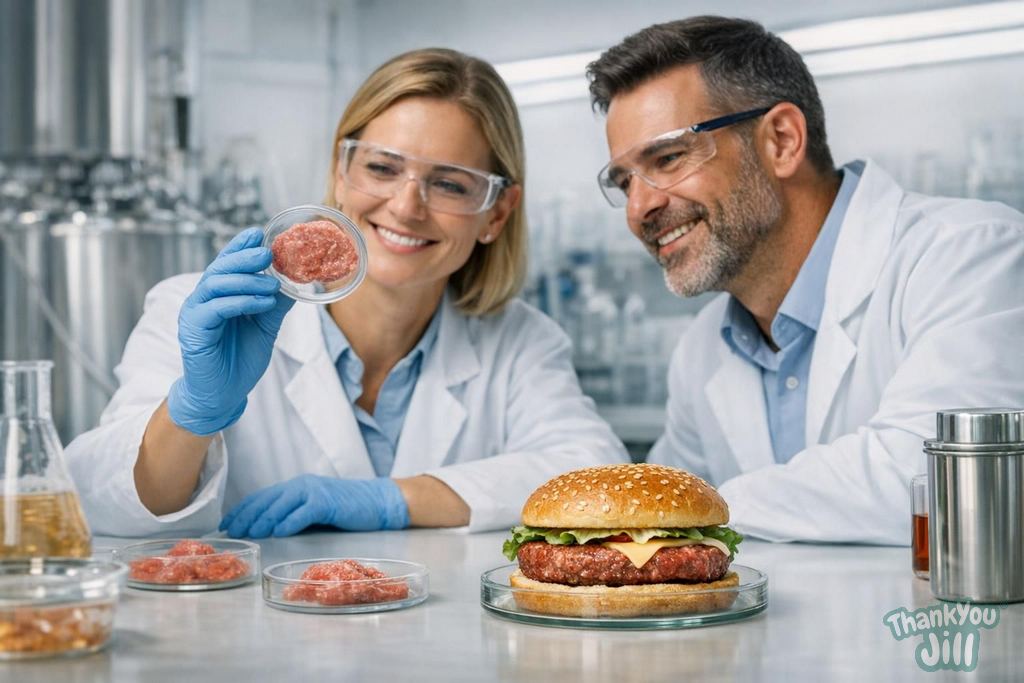
Cultivated meat (also lab-grown meat or cell-based meat) is meat produced by growing animal muscle cells in bioreactors instead of raising and slaughtering entire animals. The idea was proposed by Winston Churchill in 1931 ("in fifty years we will eat chicken grown in vats instead of raising whole birds") and the first cultivated meat burger was publicly presented by Mark Post (Maastricht University) in 2013, at a cost of $325,000. In ten years, the cost has dropped to $10–15 per lab-grown burger, with market targets of $2–5. However, large-scale commercialization remains distant.
How cultivated meat is produced: the process
The production process for cultivated meat unfolds in four main phases. Cell harvesting: muscle stem cells (myoblasts or satellite cells) are harvested from a muscle biopsy of the animal (a small amount of tissue, without slaughter). Cells can be harvested just once and then maintained in culture indefinitely. Proliferation in bioreactor: the cells are grown in a growth medium rich in nutrients, amino acids, vitamins, and growth factors, in temperature-controlled bioreactors. They multiply exponentially: from 1 cell, billions of cells are obtained. Differentiation: the proliferated cells are stimulated to differentiate into mature muscle cells (muscle fibers) that fuse into structures resembling animal muscle tissue. Structuring (scaffolding): to achieve texture similar to whole meat (steak, chicken breast) instead of a homogeneous paste, muscle fibers are organized on biodegradable scaffolds made of collagen, fibrin, or plant-based materials. The main unresolved technical challenge is vascularization: thick tissues require a network of capillaries to deliver nutrients to all cells (as happens in a living animal). Without vascularization, only thin layers or ground products (burgers, nuggets) can be produced.
Environmental impact: better than traditional meat?
The environmental impact of cultivated meat is the subject of scientific debate. Theoretical advantages over traditional livestock farming: 80–90% reduction in land use (no need for pastures or feed crops), 90% reduction in water use, near-total elimination of methane emissions from livestock enteric fermentation (bovine methane is a potent short-term greenhouse gas). However, a study published in Nature Food (Lynch and Pierrehumbert, 2023) highlighted a complication: the production process requires high electrical energy (mainly for thermal control of bioreactors). If this energy comes from fossil fuels, the CO2 emissions from cultivated meat could exceed those of beef in the long term (CO2 remains in the atmosphere for centuries, while methane degrades in decades). With 100% renewable energy: cultivated meat has a significantly lower emissions profile than traditional meat. Conclusion: the environmental impact of cultivated meat critically depends on the energy mix used in production.
Regulatory status: where it's already legal
Singapore (2020): the first country in the world to approve cultivated meat for public sale. Good Meat (Eat Just) sells cultivated chicken nuggets in select restaurants. USA (June 2023): the FDA and USDA jointly approved Upside Foods and Good Meat for public sale. Available in select restaurants at premium prices ($30–50 per serving). Production is still very limited. Israel: regulatory approval is underway. Several Israeli startups (Aleph Farms, Steakholder Foods) are leaders in research. European Union: approval process is still ongoing (Novel Food Regulation 2015/2283). EFSA (European Food Safety Authority) evaluation is in progress. Approval expected no earlier than 2025–2027. Italy: the Italian government approved a law in November 2023 banning the production and sale of cultivated meat in Italy (the first law of its kind in Europe). A unique case that has sparked both scientific and political discussion across Europe.

Cultivated meat is not science fiction: it's real technology already approved in the USA and Singapore. It's not yet on our tables and costs still need to drop significantly. But a burger made from cow cells without slaughtering anything: it's one of the most significant food innovations of recent decades. Where it goes depends on policy, energy costs, and our willingness to embrace a new food.
The ethical debate: cultivated meat and animal rights
Cultivated meat is positioned as a solution to animal welfare: no animal is slaughtered (only the initial, painless biopsy). But the ethical debate is more complex. Concerns: fetal bovine serum (FBS) has traditionally been used as a component of the growth medium: derived from the blood of bovine fetuses, it involves slaughter of pregnant cows. Producers are developing plant-based alternatives to FBS ("serum-free medium" is now a research priority). UPSIDE Foods announced it had eliminated FBS from its processes in 2023. Biodiversity of animal breeds: if cultivated meat takes off, some meat-producing breeds risk extinction as livestock breeds. The counterargument: cattle "for the table" currently live in intensive farming conditions that many consider ethically unacceptable. Cultivated meat would eliminate this problem at its root.
The most advanced startups worldwide
Upside Foods (USA, formerly Memphis Meats): the most advanced in cultivated chicken production. Received FDA/USDA approval in 2023. Raised over $400 million in investments (Bill Gates, Tyson Foods, Cargill among investors). Good Meat (Eat Just, USA/Singapore): the only company with a product in commercial sale (Singapore and USA). Focus on cultivated chicken. Aleph Farms (Israel): pioneer in cultivated steaks (structured product, not ground). Grew cells in space (ISS, 2019). Steakholder Foods (Israel, formerly MeaTech): uses 3D bioprinting of cellular bioink to create three-dimensional meat structures. Mosa Meat (Netherlands, founded by Mark Post): successor to the original 2013 burger project. Focus on cultivated beef. BlueNalu (USA): focus on cultivated fish (tuna, mahi-mahi, kingfish). Potentially important for reducing pressure on fishing.
When will it arrive at the supermarket at affordable prices?
The most optimistic forecasts (from industry companies) point to market prices competitive with traditional meat by 2025–2030. More cautious forecasts from independent analysts: 2030–2040. Main obstacles: scaling up bioreactors (current bioreactors produce only a few kg per cycle: scaling to tons requires very complex engineering), cost of growth medium (currently the main variable cost), regulatory approval in the EU (necessary for the European market), consumer acceptance ("disgust" toward "unnatural" food is a real psychological barrier documented by research). The sector has received over $3 billion in total investments from 2015 to 2023: a sign of investor confidence, but not a guarantee of short-term commercial success.
Frequently Asked Questions
How is cultivated meat produced in the laboratory?
Cultivated meat is produced by harvesting muscle cells from an animal without slaughtering it, then the cells are proliferated in bioreactors with nutrients, differentiated into muscle fibers, and organized on scaffolds to achieve the structure of meat.
What is the environmental impact of cultivated meat compared to traditional meat?
Cultivated meat can reduce land and water use by up to 90% and eliminate methane from animal fermentation, but it requires significant electrical energy. If the energy comes from renewable sources, CO2 emissions are lower; otherwise they could exceed those of beef.
When is cultivated meat expected to be commercialized at affordable prices?
Industry companies forecast prices competitive with traditional meat between 2025 and 2030, while independent analysts estimate broader adoption between 2030 and 2040, due to technical challenges, costs, and regulatory approvals.
What are the main ethical challenges related to cultivated meat?
Ethical challenges include the historical use of fetal bovine serum in the growth medium, which involves slaughter of pregnant cows, and the risk of extinction of some meat-producing animal breeds. However, cultivated meat eliminates the direct slaughter of animals.

Latest News




Comments
No comments yet. Be the first!
Leave a comment