


 Italiano
 Français
 Deutsch
 Español
 Português
 Svenska
 Suomi
Suomi
Kitchen Aids and Adaptive Tools
Practical Equipment for Independent Cooking
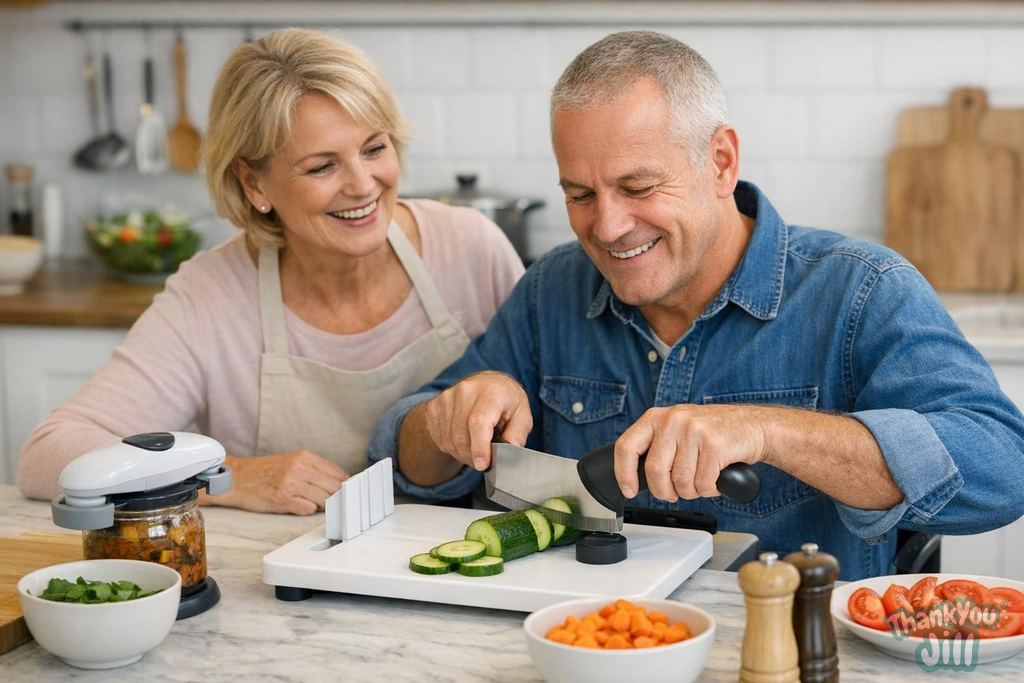
The kitchen is one of the most barrier-filled domestic spaces for people with motor disabilities: unreachable surfaces, jars that won't open, knives requiring a firm grip, heavy pots, turn-knob faucets. Yet the kitchen is also one of the spaces where independence holds the deepest meaning: preparing your own meals is dignity, creativity, and health. Kitchen aids are concrete tools that break down these barriers, making what seemed impossible possible. This article is a systematic guide organized by difficulty category, not a generic catalog.
Aids for Single-Hand Use (Hemiplegia, Amputation, Unilateral Paralysis)
Adapted cutting board with stabilizers: the most important aid for single-handed cooking. A wooden board with stainless steel spikes (for securing meat, bread, vegetables while cutting), a raised corner (for spreading butter or halving fruit), and a suction cup underneath (anchors to the table). Called a "One-handed cutting board" in English. Manufacturers: Homecraft Rolyan, Maddak, Patterson Medical. Cost: €30–60. Electric jar openers: Electric models (Black+Decker EasyCut, Hamilton Beach, Black+Decker Jar Opener) open any jar with a button press. Essential for those unable to use both hands or lacking sufficient strength. Cost: €15–40. Vertical peelers: Y-shaped or vertical vegetable peelers work by pressing downward rather than holding horizontally—much easier with one hand. Cost: €5–10. Self-opening kitchen scissors: Open automatically after each cut (return spring), requiring no alternating open-close motion. Also useful for those with weak grip or hand pain. Cost: €10–20. Soap dispensers: Pressing the palm on a pump dispenser releases soap without squeezing the bottle. Cost: €5–15. Pump-action or side-tap pitchers: Pour liquids without lifting and tilting the pitcher. Electric pump water dispensers: For those unable to operate traditional faucets.
Aids for Reduced Hand Strength or Mobility (Arthritis, Parkinson's, Incomplete Tetraplegia)
Knives with ergonomic pistol-grip handles (Oxo Good Grips, Victorinox with soft grip): reduces wrist stress and distributes cutting force across the entire hand. Rocking knives (crescent-shaped with two-handed handle above): used by pressing down with both hands or the palm; requires no lateral cutting force. Electric hand mixer and immersion blender (powerful yet lightweight): replace manual stirring and blending. Blenders with fixed bowls (NutriBullet, Vitamix Personal): no need to hold the cup—it locks onto the motor and you press a button. Electric can openers: no dial to turn, just position and press. Food processors with simple controls (Thermomix, Kenwood Chef XL): prepare complete dishes from start to finish with just a few buttons, reducing the need to handle knives, spoons, and pots. Expensive (€700–1,400) but transformative for significant upper-limb disabilities. Scales with large display and oversized buttons: for those with visual difficulties or tremors. Non-slip silicone cutting boards or those with dycem bases: stay firmly on the table without being held.
Cooking Aids: Safety and Stovetop Accessibility
Cooking presents specific safety risks for those with motor disabilities (burns, spilled pots) or cognitive impairment (forgetting the stove is on). Pots with bilateral dual handles (both sides): much more stable than single-sided handles for those with weak grip or single-hand use. Lightweight pots (aluminum or titanium instead of cast iron): essential for those with reduced strength. Induction cooktops: safer than gas or traditional ceramic (the surface doesn't heat, only the pot does), automatically shut off without a pot, precise and controllable temperature. Cooktops with front-facing controls (not above the burners): accessible from a wheelchair and without leaning over hot burners. Slow cookers (e.g., Crock-Pot): all preparation involves adding cold ingredients, setting the timer, and letting it cook for 6–8 hours. Zero burn risk, zero supervision needed. Microwave ovens with simple digital controls (large buttons or touchscreen): accessible even with limited mobility. Microwave cooking is often the best option for independent cooking with disabilities. Automatic timers with voice alerts: remind you the oven is on. Smoke detectors with smartphone alerts to the caregiver for added safety.
The Accessible Kitchen: Structural Adaptations
Beyond individual aids, a truly accessible kitchen for people with significant disabilities requires structural modifications. Height-adjustable work surfaces (70–85 cm): accessible from a wheelchair. Models like Ikea's with floor-mounted adjustable installation, or custom kitchens with motorized countertops. Clear space beneath the work surface: 68–70 cm height and 50–60 cm depth free to allow wheelchair access directly to the counter. Heat sources at wall level (induction cooktop mounted at counter level, not on a raised block): accessible from a wheelchair. Long-lever or motion-sensor faucets: turn-knob faucets are inaccessible to those unable to grip or rotate. Long levers or touch/motion-sensor faucets eliminate this barrier. Drawers and doors with horizontal bar handles: easier to open with reduced grip or open hand. Low drawer units with deep drawers: preferable to tall cabinets for those unable to open overhead doors. Designing an accessible kitchen follows Universal Design best practices: reference standards in Italy include Law 13/1989 and Decree 236/1989 on architectural barriers, updated for new smart home technologies.

A €40 spiked cutting board, a €20 electric jar opener, a €150 food processor: with a €210 investment, many people with hemiplegia, severe arthritis, or Parkinson's can return to preparing their own meals independently. An adapted kitchen isn't someone else's kitchen—it's your kitchen, designed for who you are now. Ask your occupational therapist about it.
The Occupational Therapist for Kitchen Adaptation: How to Request an Evaluation
An occupational therapist (OT) specializing in ADL (Activities of Daily Living) is the professional who assesses specific kitchen difficulties and prescribes the most suitable aids. An OT kitchen evaluation ideally takes place in the actual home environment (home visit) or in a simulated kitchen at a rehabilitation center. It includes: direct observation of specific kitchen tasks (opening a jar, cutting a vegetable, pouring a liquid), analysis of difficulties encountered (where the activity breaks down, which movement or strength is lacking), prescription of specific aids, and training in using the chosen aids. How to request an OT home evaluation: prescription from your general practitioner or specialist (physiatrist, neurologist, orthopedist), contact with your local health authority (rehabilitation department or home care service), or private visit with a freelance OT (cost €80–150 for home evaluation). Where to find OTs in Italy: AITO (Italian Association of Occupational Therapists: aito.it) has a national registry searchable by province and specialization. Many hospitals and rehabilitation clinics have OTs on staff who can perform home evaluations.
Kitchen Safety for People with Cognitive Decline
For people with dementia or mild-to-moderate cognitive decline living at home, the kitchen presents specific risks that must be managed while balancing safety and independence. Main risks: forgetting the stove is on (leading cause of house fires in people with dementia), confusing containers (mistaking dish soap for water, medications for candy), not recognizing spoiled or expired food. Safety solutions: cooktops with automatic shutoff timers (automatic cutoff after 15–30 minutes of non-use), anti-gas devices for gas stoves (sensors detecting unburned gas and automatically closing the gas valve), stove knob covers (safety covers for gas knobs, available for €10–20), smart refrigerators with reminder systems (notifying the caregiver if the fridge isn't opened during usual times), large and clear labels on all containers (helpful for those with reduced visual memory). Maintaining independence: people with mild cognitive decline benefit from continuing to cook under supervision. Cooking as a cognitively stimulating activity slows decline more than eliminating it entirely. Caregiver support: advance meal preparation, pre-portioned containers with dates, simplified kitchen layout (removing non-food products from the cooking area to reduce confusion).
Where to Buy Kitchen Aids: Best Sources
Main sources for purchasing kitchen aids in Italy. Regional aids centers (SIVA portal: portale.siva.it): allow you to see and try aids physically before purchase. Have specialized consultants who can advise. Pharmacies and medical supply stores with orthopedic sections: stock common aids (ergonomic utensils, adapted cutting boards, jar openers). Staff aren't always trained in disability aids. Specialized online shops: Ortopedia Ciccarelli, Arzignano Ausili, Disabilityshop.it, Ottobock shop, Amazon (wider range but no consultation). Design and kitchen stores with ergonomic lines (Oxo Good Grips: available at Coop, Leroy Merlin, online): excellent quality and design included in many aids. NHS and reimbursement: the Nomenclature of Aids (D.M. 332/1999) provides reimbursement for certain kitchen aids for people with specific disabilities. Prescription must be made by a physiatrist or specialist. Contact your local health authority for the list of reimbursable aids in your region (varies by region).
Frequently Asked Questions
Which kitchen aids are best for single-handed cooking?
Adapted cutting boards with stabilizers, electric jar openers, vertical peelers, and self-opening scissors are ideal for single-handed cooking, making cutting, opening, and preparation easier without requiring bilateral strength or grip.
When is a food processor recommended for people with motor disabilities?
A food processor with simple controls is recommended for those with significant upper-limb disabilities, as it allows meal preparation with just a few buttons, reducing the need to handle heavy or complex utensils, though it comes at a higher cost.
How do you choose a safe cooktop for people with motor or cognitive disabilities?
An induction cooktop with front-facing controls is safer and more accessible, as only the pot heats, it automatically shuts off without a pot, and allows precise temperature control, reducing burn and accident risks.
What structural adaptations make a kitchen accessible for wheelchair users?
An accessible kitchen includes height-adjustable work surfaces, clear space beneath counters for wheelchair access, long-lever or motion-sensor faucets, and drawers with horizontal handles, enabling safe and independent use of spaces and equipment.

Latest News




Comments
No comments yet. Be the first!
Leave a comment