


 Italiano
 Français
 Deutsch
 Español
 Português
 Svenska
 Suomi
Suomi
Accessible Tourism
Destinations and Tips
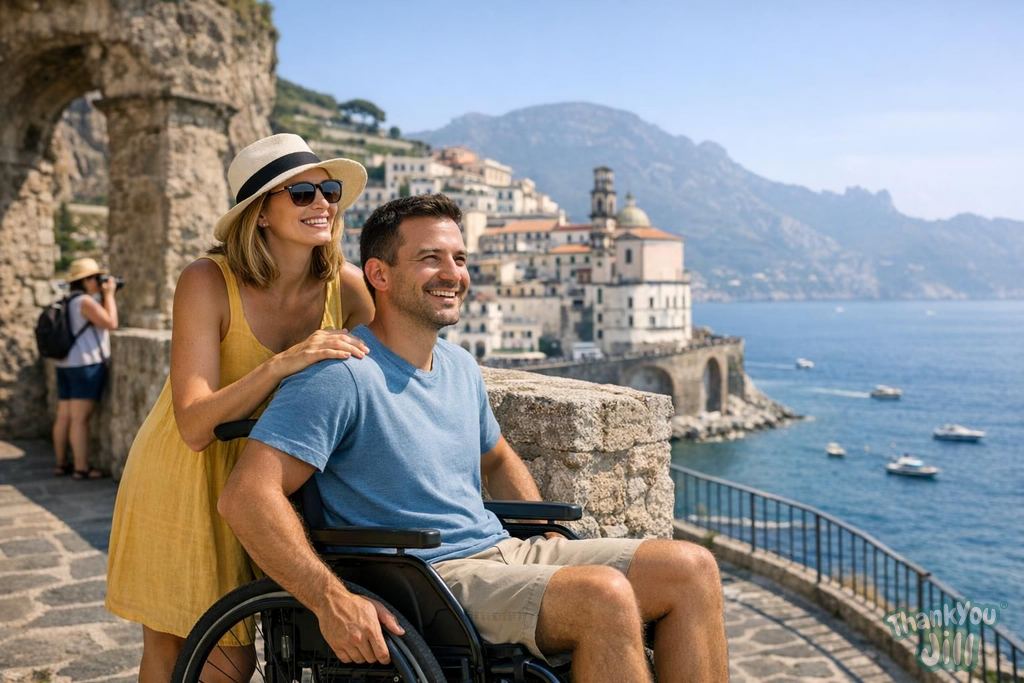
Accessible tourism is a right enshrined in the UN Convention on the Rights of Persons with Disabilities (CRPD, ratified by Italy through Law 18/2009), which in Article 30 affirms the right of persons with disabilities to participate in cultural life and recreational activities on an equal basis. Tourism is not a luxury but an essential component of quality of life and social participation. People with disabilities in Italy number approximately 3.1 million (ISTAT 2019), with significant tourism purchasing power (often including companions in spending): a huge market that the tourism industry is finally beginning to court more systematically.
Rights of Travelers with Disabilities in Europe
The European framework guarantees specific rights to travelers with disabilities. Air transport (EC Reg. 1107/2006): airlines cannot refuse transport to persons with disabilities, must provide free assistance at airports and on board, must transport electric wheelchairs free of charge as special baggage, must allow priority boarding. Airport assistance: must be booked at the time of ticket purchase or at least 48 hours in advance. It's called "PRM assistance" (Persons with Reduced Mobility). In Italy, Rome Airports (ADR) and SEA Milan have well-structured PRM services. Rail transport (EC Reg. 1371/2007): railway companies must provide free assistance for boarding and disembarking, must have bookable seats for persons with disabilities on every train, must transport a manual wheelchair free of charge. Trenitalia: the Sala Blu service (bookable online or at 800274307) coordinates assistance at major stations. Maritime transport (EU Reg. 1177/2010): similar rights for European ferries. Italian ferries (Tirrenia, GNV, Grimaldi Lines) have accessible cabins on many routes.
The Most Accessible Destinations in Italy
Some Italian destinations stand out for their investment in tourism accessibility. Turin: Italy's most accessible city for transport (complete metro system, low-floor buses) and cultural attractions (Egyptian Museum, National Cinema Museum: both with complete routes for motor, visual, and cognitive disabilities). Bolzano and South Tyrol: numerous mountain trails accessible by wheelchair, refuges with adapted rooms and bathrooms, ski lifts and equipment adapted for sit-ski. The Province of Bolzano's "Vacanze per tutti" (Holidays for All) project is a European model. Romagna Riviera (Rimini, Riccione, Cesenatico): beaches are among Italy's most equipped for accessibility: JOB (Job Beach Assistance), JOB chairs for water access, accessible changing rooms, operators specialized in beach assistance. Romagna coastal municipalities have a very structured accessible tourism policy. Venice: paradoxically, one of the "impossible" cities for accessibility, is improving through the "Venice for All" project: maps of accessible routes (avoiding inaccessible bridges), assistance service at main pontoons, accessible water taxis. Not yet ideal but much improved from the past. Sicily: some coastal areas (Palermo, Cefalù, Syracuse) have accessible beaches. The historic interior (Agrigento, Valley of the Temples) has partially accessible routes with assistance.
Planning an Accessible Trip: The Practical Checklist
A checklist for planning an accessible trip. Transport: verify the accessibility of means (plane, train, ferry) by booking PRM assistance at least 48 hours in advance. For flights: notify the airline of specific needs (wheelchair type, oxygen if necessary, bathroom assistance). Accommodation: always ask for precise details from the hotel before booking: bathroom dimensions (minimum 120x120 cm to turn in a wheelchair), shower type (walk-in with seat or tub: specify), bed height (45-50 cm from floor for transfer), distance between furniture (90 cm for passage), availability of hospital bed or anti-bedsore mattress if needed. Don't settle for the label "accessible room" without verifying details. Attractions: look for museums and attractions with verified accessible routes (not generically "accessible": it's often greenwashing). Major museum websites (Uffizi, Colosseum, Egyptian Museum) have dedicated accessibility sections with precise information. Pharmacies and health services: identify pharmacies and emergency points at your destination. If you have specific medical needs (sterile supplies, particular medications, electric wheelchair with charger), verify local availability.

The perfect accessible trip doesn't yet exist for everyone: there are always unexpected obstacles. But the difference between those who plan carefully and those who improvise is enormous. An accessible tourism association, a dedicated platform, PRM service booked in advance: these tools exist. Using them transforms travel from a stressful adventure into an authentic experience. Traveling is a right, not a privilege.
Digital Resources for Accessible Tourism
Platforms specializing in accessible tourism. Handiscover (handiscover.com): Europe's leading platform for verified accessible accommodations. Each facility has a detailed accessibility assessment with photos. Accessible Travel Online (accessibletravel.online): international guide with accessible destinations, hotels, and attractions. Tourism For All (tourismforall.org.uk): British organization with a database of accessible destinations in the UK and Europe. DisabiliTOUR (disabilitour.com): Italy's leading platform for accessible tourism. Database of facilities, attractions, and services. Visited (visited.eu): European accessible tourism platform with user reviews. Specific apps: Wheelmap.org: map of accessible public places (crowd-sourced). AccessNow (accessnow.ca): map of accessible places with detailed ratings. Open wheelchair: international map of accessible public restrooms. Websites of Italian disability tourism assistance companies: Accessible Italy (accessibleitaly.com), Guide your tour (guideyourtour.it), Sage Traveling (sagetraveling.com). These specialized travel agencies manage the complex logistics of accessible travel and are particularly useful for international trips.
Skiing and Accessible Outdoor Activities in Italy
Outdoor sports in nature are accessible to many people with disabilities, with the right equipment and support. Sit-skiing (sit-ski or mono-ski): adapted winter sports are widespread in the Italian Alps. Many ski resorts have instructors certified by FISI (Italian Winter Sports Federation) for adapted skiing. The main ones: Bormio (Lombardy), Madonna di Campiglio, Cortina d'Ampezzo (Veneto), Sestriere (Piedmont). The FEDERSCI association for adapted skiing. Wheelchair trekking: the off-road wheelchair (joëlette: single-wheeled with guides front and back, Parajoëlette) allows you to traverse mountain trails with volunteer assistance. Organizations throughout Italy organize joëlette excursions. Handbike and adapted cycling: handbikes (manually propelled bicycles) enable cycling routes for people with lower limb disabilities. Many Italian cycling paths (in Veneto, South Tyrol, Tuscany) are completely accessible by handbike. Accessible sailing: the Italian Sailing Federation (FIV) has a paralympic sailing program with local sections in many coastal cities. Adapted climbing: many climbing gyms offer specific sessions for people with disabilities. The CSEN association and SAI have adapted climbing programs.
Traveling with Specific Medical Needs: Advanced Planning
For those with specific medical needs, travel requires additional planning. Oxygen therapy while traveling: airlines do not allow personal oxygen cylinders on board. You must request on-board oxygen (available on long routes, for a fee, with medical certificate). Alternatively, portable oxygen concentrators (FAA and EASA approved: Invacare Platinum Mobile, Respironics SimplyGo) are permitted on board and can be rented. Dialysis while traveling: the Italian nephropathy association (ANED) has a service for locating dialysis centers worldwide for dialysis patients on vacation. Many tourist destinations have dialysis centers equipped for tourists. Electric wheelchairs on planes: require notification to the airline of battery specifications (lithium or gel: lithium batteries have specific restrictions, gel batteries are generally accepted). Many wheelchairs require disassembly for cargo transport. Medical assistance abroad: Form S1 (for posted workers) or the TEAM (European Health Insurance Card) guarantees access to healthcare in EU countries. For non-EU countries: travel health insurance with specific coverage for pre-existing health conditions.
Frequently Asked Questions
What rights does EC Regulation 1107/2006 guarantee to travelers with disabilities on planes?
EC Regulation 1107/2006 guarantees free assistance at airports and on board, priority boarding, free transport of electric wheelchairs as special baggage, and prohibits refusing transport to persons with disabilities.
How do you plan an accessible trip to ensure the accommodation is truly suitable?
It's essential to ask for specific accessibility details, such as bathroom dimensions, shower type, bed height, and space between furniture, avoiding relying solely on the generic label "accessible room."
What are some European or Italian destinations particularly suited for accessible tourism?
Turin is known for accessible transport and museums, Bolzano for adapted trails and winter sports, the Romagna Riviera for equipped beaches, and Venice is improving with accessible routes and water taxis.
What apps or digital platforms help find facilities and services for accessible tourism?
Platforms like Handiscover, Accessible Travel Online, Tourism For All, and DisabiliTOUR offer databases of accessible accommodations and attractions, while apps like Wheelmap.org and AccessNow map accessible public places with detailed ratings.

Latest News




Comments
No comments yet. Be the first!
Leave a comment