


 Italiano
 Français
 Deutsch
 Español
 Português
 Svenska
 Suomi
Suomi
Deforestation and Food
The Hidden Connections
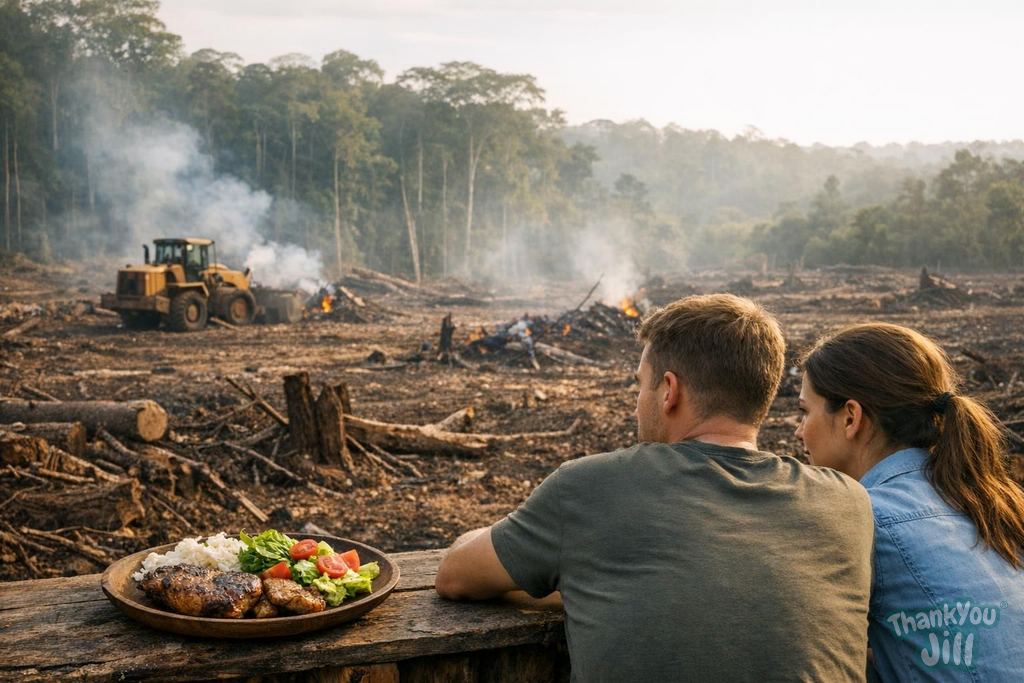
Tropical forests are the planet's lungs: they absorb CO2, regulate the water cycle, host 50% of terrestrial biodiversity, and stabilize local and global climate. Yet they're being cleared at the rate of a football field every 2 seconds. 87% of this deforestation is directly linked to agricultural expansion, and the food we buy every day is the silent engine driving this destruction. The four main drivers of food-related deforestation are: beef (especially in Latin America), soy for animal feed, palm oil, and cocoa.
South American Beef and the Amazon
Brazil is the world's largest beef exporter. Cattle production accounts for approximately 70-80% of Brazilian Amazon deforestation, both direct (pastures) and indirect (soy cultivation for feed). The chain is often poorly visible: cattle raised on deforested pastures in Brazil produce meat exported to Europe as "South American beef" or used in the food industry. Sustainability certification for Brazilian beef (such as the Rainforest Alliance system) is controversial and difficult to verify throughout the entire supply chain. As a consumer: reducing or eliminating beef of uncertain origin is the choice with the most direct impact on Amazon deforestation.
Feed Soy: The Hidden Driver
70-75% of soy produced worldwide is used as animal feed (chickens, pigs, cattle, farmed fish). Soy is one of the main culprits behind deforestation of the Brazilian Cerrado (the world's most biodiverse tropical savanna: it has lost 50% of its original extent). The European paradox: Europe, which has strict internal deforestation regulations, imports enormous quantities of deforested soy to feed animals that are then sold as "local products." When you buy an Italian chicken breast, you're implicitly also buying the Brazilian soy that fed that chicken: the supply chain is global even when the product seems local.
Palm Oil: Biodiversity vs. Ubiquitous Ingredient
Palm oil is the most-produced vegetable oil in the world and is present in approximately 50% of packaged products (biscuits, snacks, crackers, cosmetics, biodiesel). Its production is concentrated in Indonesia and Malaysia, where deforestation of tropical forests and peatlands for palm plantations is one of the main regional environmental problems. Drained peatlands for plantations emit enormous quantities of CO2 stored for thousands of years. The RSPO (Roundtable on Sustainable Palm Oil) certification exists but is criticized by many environmental organizations for its insufficient effectiveness. The simplest solution for consumers: reduce packaged products in general (which are also the main source of refined sugars and ultra-processed foods in the diet).
Cocoa: Forests for Chocolate
Cocoa is grown primarily in Côte d'Ivoire and Ghana (two-thirds of global production), where it has contributed to massive deforestation of West African tropical forests. Côte d'Ivoire has lost 90% of its forest cover in the last 50 years, in significant part due to the expansion of cocoa plantations. Major chocolate companies have committed to "zero deforestation" plans by 2025 that in most cases have not been met. As a consumer: chocolate certified Rainforest Alliance or Fairtrade has stricter criteria (though not perfect) on deforestation. Dark chocolate (less sugar, less milk, more cocoa) is preferable both environmentally (fewer additional ingredients) and nutritionally.

The forest they're clearing isn't far away: it's on your plate. Beef of uncertain origin, a snack with palm oil, chicken raised on Brazilian soy: every product like this carries an invisible signature of deforestation. You don't need to be an activist: just read the labels and prefer the alternative that didn't destroy anything to reach the shelf.
How to Avoid Deforestation Beef
The problem with deforested beef is traceability: it's almost impossible for the end consumer to know whether the beef purchased comes from deforested areas. Practical strategies: prioritize Italian or European beef certified with traceability systems (Italian DOP beef or with origin certification reduce the risk), reduce beef consumption in general (reducing demand is the most effective pressure on the system), prefer restaurants and butcher shops that declare the origin, avoid low-quality beef in industrial products (anonymous frozen hamburgers, industrial kebab) where origin is less controlled.
How to Recognize Palm Oil on Labels
Palm oil must be declared by name on European labels since 2014 (it can no longer be hidden as "vegetable fats"). Look for it in the ingredients list as "palm oil" or "palm kernel oil." Products that often contain it: biscuits, crackers, packaged cakes, snacks, ice cream, margarines, industrial peanut butter, some brands of Nutella and similar products, cosmetics, hair products. Reading the label is the first act of market pressure: manufacturers change formulas when consumers demand different ingredients.
Certifications That Reduce Deforestation Risk
Certifications aren't perfect but indicate a verifiable commitment: Rainforest Alliance (green frog leaf): used for cocoa, coffee, bananas, tea. Has criteria on deforestation, worker welfare, biodiversity. RSPO (sustainable palm oil): improvable criteria but better than nothing. Fairtrade: more focused on worker welfare but includes environmental criteria. FSC (Certified Forest): for wood products but relevant for paper used in packaging. UTZ (now integrated into Rainforest Alliance): cocoa and coffee. These certifications cost more for the producer and usually for the consumer: paying a premium for certification is one of the most concrete forms of support for sustainable production.
Frequently Asked Questions
How can I tell if the beef I buy contributes to Amazon deforestation?
It's difficult to verify beef origin, but prioritizing certified European or Italian meat with traceability, reducing consumption, and choosing restaurants or butcher shops that declare origin are effective strategies to avoid beef linked to deforestation.
What is the impact of soy used as animal feed on global deforestation?
70-75% of global soy is destined for animal feed, contributing to deforestation of the Brazilian Cerrado. Even local products like chicken or pork can involve deforested soy, since the supply chain is global and often hidden.
How can I recognize palm oil on food labels and why is it important to avoid it?
Since 2014, palm oil must be declared by name on European labels, often as "palm oil" or "palm kernel oil." Avoiding it reduces demand linked to deforestation in Indonesia and Malaysia, where its production destroys forests and peatlands.
When is it worth choosing certified products to reduce deforestation risk?
Choosing products with certifications like Rainforest Alliance, RSPO, or Fairtrade is recommended when you want to support more sustainable agricultural practices. These certifications, while not perfect, guarantee stricter environmental and social criteria compared to non-certified products.
Latest News



Comments
No comments yet. Be the first!
Leave a comment