


 Italiano
 Français
 Deutsch
 Español
 Português
 Svenska
 Suomi
Suomi
Sustainable Household Economics
Save Money While Doing Good
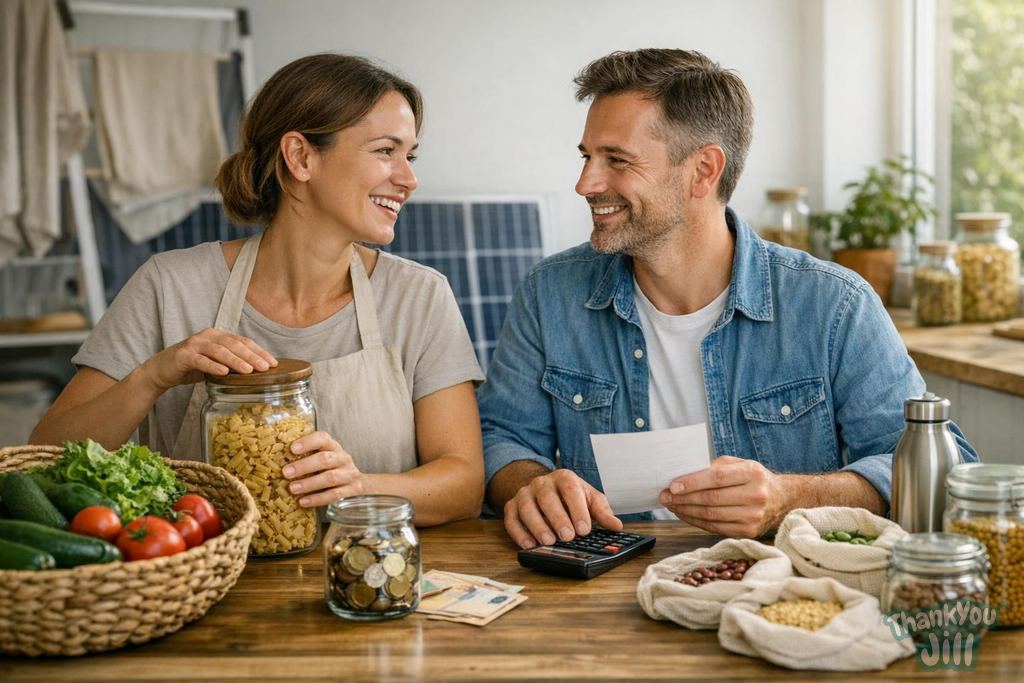
There's a widespread misconception that "living sustainably costs more." This is true for some specific purchases (organic food, solar panels, electric cars), but it's false as a general rule. Most sustainable practices applicable to everyday household management reduce both environmental impact and expenses. Sustainable household economics is the strategic alignment between financial savings and reduced environmental impact: you don't need to choose between the two goals.
Sustainable practices that save money: the complete picture
Reducing energy consumption: every kWh not consumed is both CO2 not emitted and money saved. Zero-cost measures: turn off lights, set the thermostat to 20°C instead of 22°C (10-15% reduction in heating consumption per degree), don't leave appliances on standby (they consume 5-10% of energy even when off). Low-cost measures: LED bulbs (paid back in 6-12 months, last 15-20 years), thermostatic valves on radiators (10-20% savings on heating). Significant cost but with returns: heat pump (30-50% savings compared to gas), solar panels (paid back in 8-12 years with current incentives), building thermal insulation (effective but expensive: consider government grants or similar). Reducing food waste: 59% of Italian household food waste happens at home. Planning meals and shopping reduces waste by 20-30%: average savings of 300-500 euros per year for a family of 4. Water: showers instead of baths (70-80% water savings per wash), dual-flush toilet, fixing leaky faucets (a dripping faucet loses 15-20 liters per day: 5,500-7,300 liters per year, which in many Italian cities equals 5-15 euros in annual water bills).
Making things at home instead of buying: the best savings opportunities
Cleaning products and household items: homemade detergent (baking soda, citric acid, Marseille soap) costs 70-80% less than equivalent commercial products. For an Italian family that spends an average of 150-250 euros per year on detergents: savings of 100-200 euros. Homemade broth: chicken broth made from the carcass (zero cost: using scraps you already have) replaces 2-3 bouillon cubes per week (annual cost: 15-30 euros). Kombucha, kefir, homemade yogurt: a liter of store-bought kefir costs 3-5 euros; homemade with 1 liter of milk and some starter grains (a gift from friends or purchased once): 0.70-1.20 euros. Annual savings for a family that regularly consumes kefir: 100-200 euros. Home garden: 4 m² of garden produces 120-200 euros in annual value of vegetables and herbs with seed costs of 10-15 euros.
Creative frugality: saving with quality instead of deprivation
Creative frugality (distinguish it from simple deprivation) is the ability to get the same value or quality at lower cost through creativity, skill, and planning. Examples: quality secondhand items better than cheap new ones (a used cashmere dress for 15 euros vs. a new acrylic one for 30 euros), repair vs. replacement (a quality shoe resoled lasts another 5 years; cheap ones are thrown away after 1-2 years), borrowing vs. buying (tools used once a year: rent or borrow them), off-season vacations (October instead of August: same quality destination, 30-50% lower prices). Creative frugality isn't deprivation: it's optimizing the value you get per euro spent.
The sustainable household budget: how to build it
The 50/30/20 budget method adapted for sustainability: 50% for essential needs (housing, food, transportation, utilities), 20% for savings and investments (emergency fund, retirement, investments), 30% for wants (but with conscious purchase screening). In this structure, every saving in essential expenses (energy efficiency, reducing food waste, active transportation) translates directly into greater availability for savings and investments. Energy efficiency, homemade broth, home gardening, reducing single-use plastics: these aren't sacrifices, they're investments that produce measurable financial returns.

Turning off lights, not wasting food, making broth from chicken bones, buying quality secondhand items: these aren't sacrifices. They're the same things previous generations did not because they were green, but because it made sense. It still makes sense. And now it also produces a sense of well-being that unchecked consumerism doesn't provide.
Home energy savings: high-return measures
Annual financial return for average Italian family (approximate): LED bulbs (complete replacement, cost 30-50 euros): savings 60-100 euros/year, return in 6-8 months. Smart thermostatic valves (cost 150-300 euros): savings 150-300 euros/year, return in 1-2 years. Multi-outlet power strips with standby switch (cost 15-20 euros per room): savings 30-60 euros/year on standby, return in 3-6 months. Short showers (2 minutes less per shower, family of 4): savings 50-100 euros/year on hot water. Fixing leaky faucets (cost 20-50 euros for plumber): savings 5-20 euros/year on water, return in 2-4 years. Together, these measures produce savings of 300-600 euros per year with initial investments of 200-400 euros: total return in 1-2 years.
How to track your sustainable expenses and the savings they produce
To motivate yourself and measure progress: create a simple Excel spreadsheet with columns: "what I did," "initial cost," "estimated monthly savings," "months to break even." Update monthly by checking your water, gas, and electricity bills. After 3-6 months of tracking, you'll have real data for your specific situation (not general estimates). This data is the most powerful motivator to continue: seeing "I saved 47 euros this month with consumption changes" is far more convincing than any article about how much money you can theoretically save.
Savings as an act of freedom: the FIRE perspective
The FIRE movement (Financial Independence, Retire Early) proposes that intentional frugality isn't deprivation: it's accumulating freedom. Every euro saved is a unit of future independence: the ability to work less, to choose a job you love even if it pays less, to have time for personal projects. Many FIRE movement members spontaneously adopt sustainable lifestyles not for environmental reasons but for financial ones: ultimately, reducing consumption to gain financial freedom and reducing consumption to reduce environmental impact lead to the same behaviors. The convergence between frugality, sustainability, and personal freedom is one of the most powerful and most undervalued alignments of our time.
Frequently Asked Questions
What are the low-cost measures to reduce home energy consumption and how much can you save?
Low-cost measures include LED bulbs, thermostatic valves on radiators, and turning off appliances on standby. These interventions can reduce energy consumption by 10-20% and lead to annual savings of 150-300 euros, with a financial return in 6-24 months.
How can meal planning help reduce food waste and save money?
Planning meals and shopping reduces household food waste by up to 20-30%, with average savings of 300-500 euros per year for a family of four, optimizing food use and avoiding unnecessary purchases.
How does creative frugality differ from simple deprivation and how does it help you save?
Creative frugality consists of obtaining quality and value at lower costs through creativity and planning, such as buying quality secondhand items, repairing instead of replacing, or choosing off-season vacations. It's not deprivation, but optimization of value spent.
How can you effectively monitor sustainable expenses and household savings?
It's recommended to create an Excel spreadsheet with columns for actions taken, initial costs, estimated monthly savings, and months to break even. Updating it monthly with real data from your bills gives you concrete motivation and precise control over the savings achieved.


Latest News




Comments
No comments yet. Be the first!
Leave a comment