


 Italiano
 Français
 Deutsch
 Español
 Português
 Svenska
 Suomi
Suomi
3D Food Printing
Real-World Applications
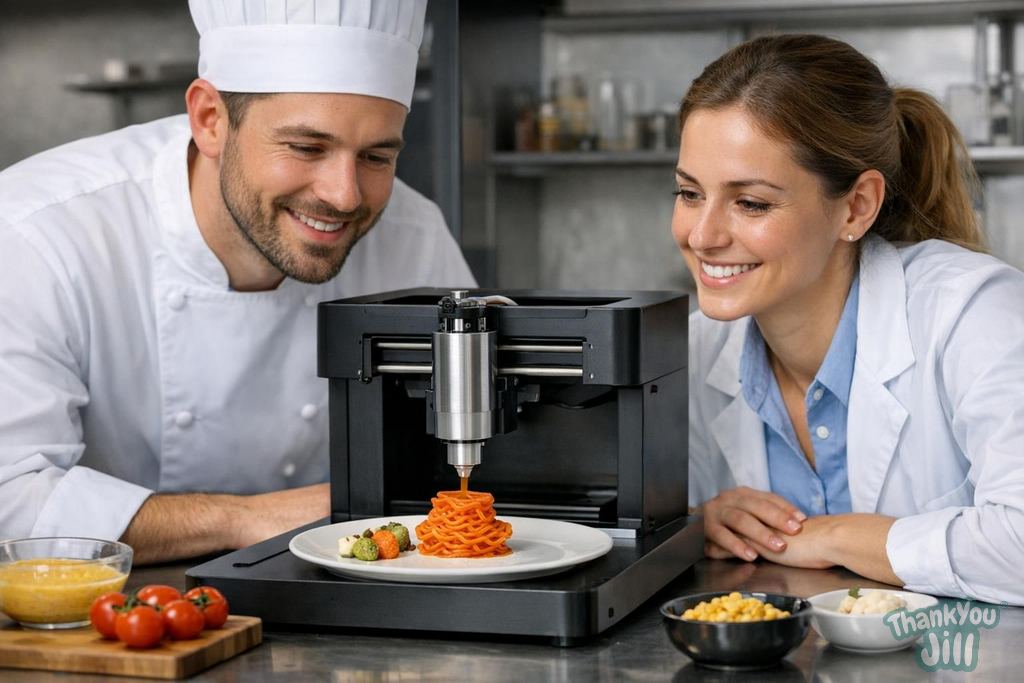
3D food printing (additive food manufacturing) is the production of food through layer-by-layer deposition of food material (food inks) following a three-dimensional digital model. It's no longer futuristic technology: some applications are already in commercial use, others are in advanced development stages. The most common technology is extrusion-based material deposition (FDM adapted for food): nozzles that dispense semi-liquid materials (vegetable purees, chocolate, meat paste, protein gels, doughs) onto a platform that lowers layer by layer.
Applications Already in Use
Nutrition for patients with dysphagia: the most important current application. Dysphagia (difficulty swallowing) affects approximately 15% of elderly people and many neurological patients. Modified-texture foods (purees, soft, minced) are necessary but often aesthetically unappealing, reducing nutritional intake due to lack of appetite. 3D printing allows creation of purees of traditional foods (carrot, pea, fish, pasta) in shapes that replicate the original appearance of food: a 3D-printed carrot made from carrot puree looks like a carrot but has the soft texture safe for those with dysphagia. The IDDSI project (International Dysphagia Diet Standardisation Initiative) has promoted the use of 3D printing in European care facilities. In Germany, the PERFORMANCE project (Fraunhofer Institute) has installed 3D food printers in hospitals and care facilities with positive results on patient nutritional intake. Fine dining and pastry: Hershey's, Nestlé, and numerous pastry chefs use 3D printers for chocolate (shapes impossible to achieve with traditional molds). The Sugar Lab (Los Angeles) prints sugar decorations of geometric complexity that would be impossible otherwise. Chefs like Ferran Adrià have explored 3D printing as a tool for culinary innovation. Personalized chocolate: chocolate 3D printers (ChocEdge, Cocoa Press) enable production of chocolates with custom shapes, messages, corporate logos, and figures on demand. Growing B2B market (corporate events, weddings, personalized gifts).
Most Promising Future Applications
Nutritional personalization: 3D printing could enable creation of foods with exact nutritional profiles calibrated to individual needs (age, health conditions, prescribed diet). A 3D-printed meal with exactly 25g of protein, 45g of carbohydrates, and 15g of fat, with specific prescribed vitamins and minerals. This is particularly relevant for hospital and geriatric nutrition. Food waste valorization: food "inks" can be produced from processing byproducts (whey from cheese production, okara from soy milk production, vegetable waste from retail) that are transformed into nutrient powders or gels and then printed into appealing shapes. A circular system of zero food waste. Structured alternative proteins: 3D printing allows structuring of insect, algae, fungal, and soy proteins into textures that mimic meat (muscle fiber, marbling, consistency). It solves the texture problem (alternative proteins tend to be pasty or granular) without the difficulties of vascularization in cultured meat. Space nutrition: NASA has funded research on 3D food printing for long space missions (space pizza, balanced meals from time-stable powders reconstructed in orbit).
Current Technology Limitations
3D food printing has several significant limitations that explain why it's not yet in home kitchens. Speed: a 3D printer produces a plate in 15-30 minutes (incompatible with fast food or home cooking). Limited texture: FDM technology works well with semi-fluid materials (chocolate, puree, gel) but cannot reproduce the fibrousness of meat, the flakiness of baked pastry, or the crispness of a tart crust. Cost: quality food 3D printers (ByFlow, Natural Machines Foodini, BCN3D) cost €3,000-15,000. Hygiene: extrusion systems are difficult to clean completely: risk of bacterial contamination if not maintained with rigorous protocols. Acceptance: many people find "printed" food psychologically unappealing (the neofood effect: disgust toward food produced with non-traditional technologies). Research investment: food 3D printing has received far less investment than other food tech, reflecting lower short-term market expectations.

3D food printing won't revolutionize home cooking in the coming years. But it's already changing the lives of thousands of elderly people in European care facilities who can eat a carrot with a normal shape even though they have difficulty swallowing. And that, quietly, is already a real and important change.
Currently Available Food 3D Printers
Foodini (Natural Machines, Spain): the most well-known food 3D printer for professional use. Refillable food ink capsules with any ingredient (fresh pasta, doughs, purees, chocolate). Costs approximately €4,000. Used in avant-garde restaurants and European care facilities. ByFlow Focus: Dutch, widely used in restaurants and university research. Allows multi-material (up to 5 different inks in a single print). Choc Edge / Choc Creator: specialized chocolate printer. Used by chocolate artisans and for personalized gadgets. FoodBot (Italian, Turin startup): research project for 3D printing of functional foods for Italian hospital nutrition. For home use: domestic food 3D printers remain niche and require much more setup and cleaning than a normal kitchen. The home is not the primary market for this technology in the short term.
3D Printing and Precision Nutrition: The Frontier
The most ambitious vision for food 3D printing is "precision nutrition": foods designed digitally and produced to order for each individual's genetic, metabolic, and health profile. The pathway: genetic and metabolomic analysis of the patient (pharmacogenomics applied to nutrition), definition of optimal nutritional profile (exact quantities of macronutrients, micronutrients, fiber, phytochemicals), digital design of the food with that profile, production with 3D printer from bioreactors of standardized nutritional inks. This scenario is already technically feasible for highly specialized hospital applications. Large-scale diffusion requires: reduction of printer costs, standardization of food inks, integration with telemedicine and digital nutrition platforms. Companies like Nourish3D (UK) are developing integrated personalized nutrition systems with 3D printing for care facilities and hospitals.
Environmental Impact of Food 3D Printing: Circular Potential
Food 3D printing has significant potential for reducing food waste. The "print on demand" model eliminates overproduction: exactly the required meals are produced, without preparation waste and without unconsumed meals. Waste valorization: food inks can be produced from food processing byproducts (whey from cheese production, okara from soy milk production, vegetable waste from retail). Transformed into nutrient powders or gels through dehydration, they are used as "cartridges" for the printer. Storage: dehydrated powders and gels have much longer shelf-life (months-years) compared to fresh ingredients (days). This reduces waste in the distribution chain. The distribution model: prepared meals (which have short shelf-life) are not distributed but nutritional powders (long shelf-life) that are assembled locally on demand. A paradigm shift in food distribution for healthcare settings.
Frequently Asked Questions
How does 3D food printing improve nutrition for patients with dysphagia?
3D printing allows creation of purees of traditional foods with realistic shapes, maintaining a soft and safe texture for those with difficulty swallowing, thus improving palatability and nutritional intake for these patients.
What are the main current limitations of food 3D printing for home use?
Limitations include slow production (15-30 minutes per plate), difficulty reproducing complex textures like crispness or fibrousness, high printer costs, and hygiene challenges related to cleaning extruders.
How can food 3D printing contribute to reducing food waste?
3D printing enables on-demand production, eliminating overproduction and waste. Additionally, it uses food inks derived from byproducts and waste transformed into nutrient powders or gels, increasing shelf-life and reducing waste in the distribution chain.
When is it worthwhile to use 3D chocolate printing in pastry and fine dining?
It's worthwhile for creating complex shapes and decorations impossible with traditional methods, personalizing chocolates with messages or logos, and for innovating in fine dining with advanced geometric designs, offering unique aesthetic and creative value.
Latest News




Comments
No comments yet. Be the first!
Leave a comment