


 Italiano
 Français
 Deutsch
 Español
 Português
 Svenska
 Suomi
Suomi
The Beech Tree
The green cathedral of the Apennines and the Alps
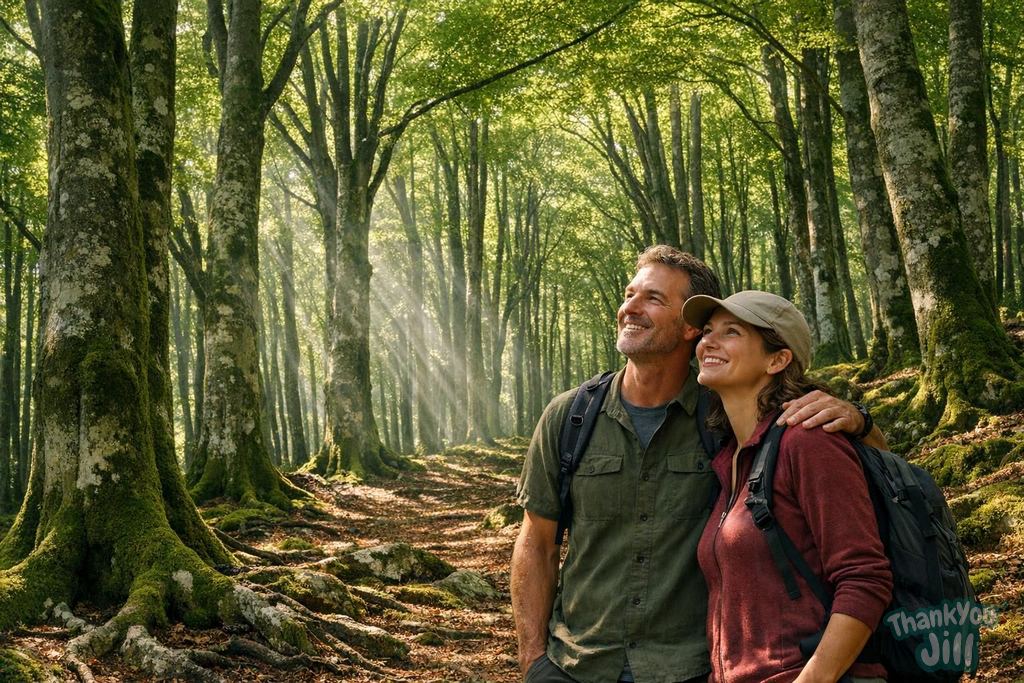
There are forests in Italy where light filters vertically between gray trunks like marble columns, where silence is so dense it seems solid, where the ground is a soft carpet of rust-colored leaves. These are the beech forests — forests of beech trees — and anyone who has walked through them at least once understands why they are called green cathedrals.
What is the beech tree
The beech tree (Fagus sylvatica) is the dominant broadleaf species in European mountain forests between 600 and 1,800 meters in elevation. In Italy it grows throughout the Apennines and the southern Alps, forming pure and mixed forests of extraordinary beauty. It is a majestic tree: it can reach 40 meters in height, with a smooth, light gray trunk that resembles elephant skin. The canopy is broad and dense — so dense that very little other vegetation grows beneath a mature beech forest: the beech is an ecological dominant, one of those organisms that shapes the environment around it.
A patient and resilient tree
One of the most fascinating characteristics of the beech tree is its shade tolerance. Young beech plants can survive for decades in the understory with almost no light, in a state of nearly imperceptible growth, patiently waiting for a gap to open in the canopy of older trees. When light finally arrives — through the death of an old tree, a storm, or logging — young beeches explode with growth, recovering in just a few years decades of waiting. This strategy, called competitive tolerance, makes the beech one of Europe's most competitive trees in mature forests.
Beech forests as UNESCO World Heritage
In 2017, the Primeval Beech Forests of the Carpathians and Other Regions of Europe were inscribed on the UNESCO World Heritage List. Among the Italian sites included are the Foresta Umbra in the Gargano (Puglia), the beech forests of Monte Cimino (Lazio), and other beech forests of the central Apennines. They are among the last primeval beech forests remaining in Europe — forests never logged, with trees hundreds of years old and an abundance of dead wood that hosts extraordinary biodiversity. Walking through a primeval beech forest is an experience that changes the way you see the forest.
The beechnut: a small fruit almost forgotten
The beech tree produces small triangular nuts called beechnuts, contained in a four-lobed husk. Beechnuts are edible and nutritious — rich in oils, proteins, and vitamin E — but are almost completely ignored by modern cuisine. In the past they were used to produce lamp and cooking oil, to feed pigs in the forests, and in times of famine as human food. Today it is mainly the forest wildlife that benefits from them: thrushes, jays, finches, wild boar, and dormice eagerly eat beechnuts in the autumn months, building up reserves for winter.
The beech tree and climate change
Unfortunately, the beech tree is one of Italy's forest species most vulnerable to climate warming. It loves cool, humid conditions. Increasingly intense summer droughts and hotter summers are putting stress on Apennine beech forests at lower elevations. Some studies show that the lower limit of Italian beech forests is shifting upward by tens of meters per decade. Beech forests in southern Italy are particularly at risk.

Entering a beech forest is like entering a place that exists outside of time. The beech tree teaches you patience: it grows slowly, waits for the right moment, then takes over the entire forest.
What to do if you visit a beech forest: tips for truly experiencing it
- Choose the right time: the beech forest is extraordinary in every season, but has moments of absolute magic. In May, when new leaves are still tender yellow-green and light passes through them. In October, when the forest becomes orange and gold. In winter, when gray trunks in the snow look like a black and white drawing.
- Walk slowly: beech forests are not meant to be rushed through. Stop, place your hand on a smooth, cold trunk, look up into the canopy. Listen: the silence of a beech forest is rare and precious.
- Look for dead wood: fallen and decomposing trunks are teeming with life. Observe the fungi growing on the bark (especially the famous Fomes fomentarius, the horse hoof fungus), green mosses, and galleries of wood-boring insects. Dead wood is not waste: it is a fundamental habitat.
- Recognize the leaves: the beech leaf is oval, with wavy and slightly serrated edges, bright green in summer and copper-colored in autumn. The bud is elongated and pointed, bronze-colored, one of the most elegant in the temperate forest.
- Bring children: ask them to find a beechnut, to measure a trunk's circumference with their arms, to collect leaves of different colors. The beech teaches the scale of time: a 200-year-old tree is there, tangible, real.
- Don't collect mushrooms without permission: in state forests a regional mycological permit is required. Check before you go.
Italian beech forests are a national treasure. Some are accessible via trails marked by the CAI, others require a guide. Before you go, consult the website of the nearest National Park or Nature Reserve. Every step is worth it.
Frequently Asked Questions
What is the beech tree's growth strategy in mature forests?
The beech uses 'competitive tolerance', surviving for decades in the shade of the understory with slow growth, then growing rapidly when a gap opens in the canopy, using available light to recover years of waiting.
How does climate change affect European beech forests?
Climate warming puts stress on beech forests, especially at lower elevations, causing the lower growth limit to shift upward by tens of meters per decade, with greater risks for forests in southern Europe.
What are the ecological characteristics of dead wood in beech forests?
Dead wood is a fundamental habitat rich in biodiversity, hosting fungi like Fomes fomentarius, mosses, and wood-boring insects, contributing to the health and natural cycle of the forest.
How to recognize a beech leaf and when to visit a beech forest to experience it best?
The beech leaf is oval with wavy and serrated edges, bright green in summer and copper-colored in autumn. The best times to visit a beech forest are May, October, and winter, to appreciate the unique colors and atmosphere.
Latest News




Comments
No comments yet. Be the first!
Leave a comment