


 Italiano
 Français
 Deutsch
 Español
 Português
 Svenska
 Suomi
Suomi
The Olive Tree
Three thousand years of history, culture, and health in a single tree
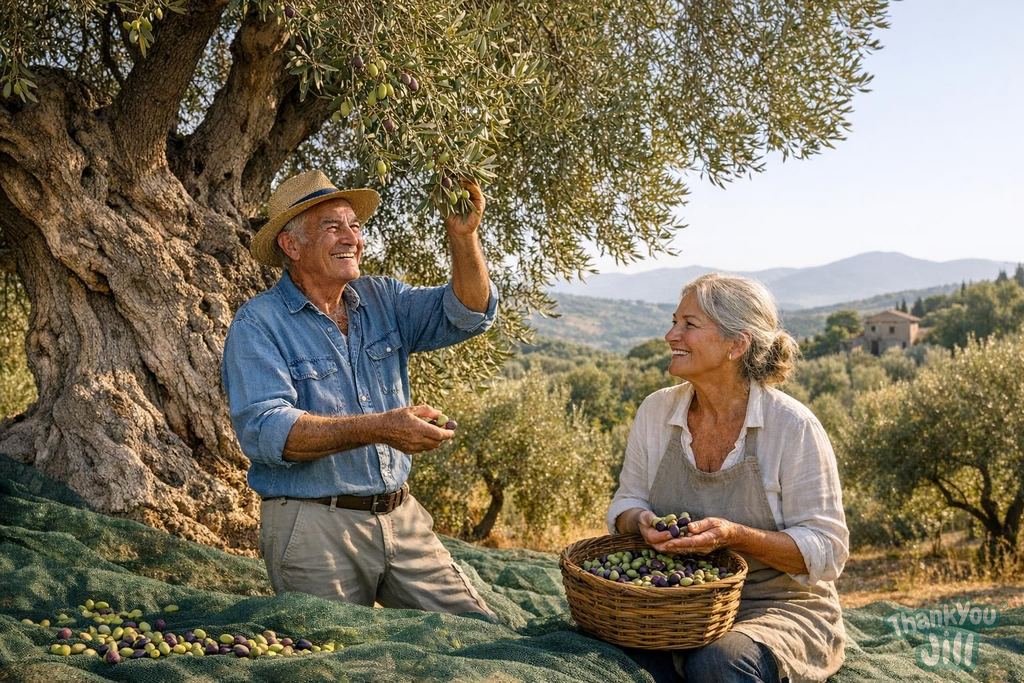
If there's one tree that embodies the soul of the Mediterranean, it's the olive. Gnarled, weathered, silvery, with roots like claws gripping the rock—the olive tree is living proof that life always finds a way to endure. And it does so with extraordinary beauty.
Three thousand years of history
The olive tree (Olea europaea) was first cultivated in the Middle East roughly 6,000 years ago. It reached the Mediterranean with the Phoenicians and Greeks, and quickly became the economic and cultural foundation of the entire basin. For the Greeks, the olive was a gift from the goddess Athena: legend tells that Athena and Poseidon competed for patronage of Athens, and Athena won by giving the city its first olive tree. The oil extracted from its fruit was used not only for cooking, but as fuel for lamps, as medicine, as perfume, as an athlete's ointment, and as a medium of exchange. In the Old Testament, the olive branch brought back by the dove to Noah symbolizes peace restored between God and humanity. The Romans spread olive cultivation throughout their empire, from Italy to Spain to Tunisia. Today, Italy is the world's second-largest olive oil producer, after Spain.
The olive tree lives almost forever
Among the olive tree's most extraordinary characteristics is its almost legendary longevity. The Castagno dei Cento Cavalli on Mount Etna, one of Italy's most famous olive trees, is estimated to be between 2,000 and 4,000 years old. The wild olive in Luras, Sardinia, has been carbon-dated to around 3,000-4,000 years—it's one of Europe's oldest living organisms. In Jerusalem, in the Garden of Gethsemane, eight olive trees grow whose age researchers from La Sapienza University estimate at around 900 years. Olive trees withstand drought, fire (they regrow from their roots), wind, and moderate frost. They're among the most resilient organisms in the Mediterranean biosphere. An olive tree cut down to its base will regrow from the stump and become productive again within a few years: a botanical resurrection that has inspired religious symbolism throughout the Mediterranean.
Olive oil and health: what science tells us
Extra virgin olive oil is one of the most studied foods in nutritional science. Its cardiovascular benefits are documented by decades of research, including the famous PREDIMED study (Prevention with Mediterranean Diet), which demonstrated a 30% reduction in the risk of major cardiovascular events in people following a Mediterranean diet rich in extra virgin olive oil. The polyphenols in olive oil—particularly oleuropein, hydroxytyrosol, and squalene—have antioxidant and anti-inflammatory properties. The polyphenol content depends on the variety, growing region, and freshness of the oil: freshly pressed oil has much higher concentrations than oil stored for months. The slight peppery sensation in the throat you feel when tasting good fresh extra virgin olive oil is oleocanthal—a compound with anti-inflammatory effects similar to ibuprofen.
Xylella: an existential threat
Since 2013, the provinces of Lecce, Brindisi, and Taranto in Puglia have been facing one of the most serious plant health crises in Italian history: Xylella fastidiosa, a bacterium transmitted by insects that clogs the olive tree's vascular system, killing it within a few years. Millions of Puglian olive trees—many of them hundreds of years old—are already dead or doomed. It's a cultural, landscape, and economic loss of extraordinary proportions. We discuss this in detail in our dedicated article on threats to trees.

An ancient olive tree doesn't need us to survive. We're the ones who need it—for food, for beauty, to remind us that some things endure far beyond our brief lives.
How to recognize, choose, and respect the olive tree
- Recognize the olive tree: The leaves are narrow, lance-shaped, dark green above and silvery beneath—this dual coloration is what makes olive groves shimmer in the afternoon light. The trunk of ancient specimens is hollow, gnarled, with deep vertical grooves. Olives progress in color from green to yellow, to purplish, to black as they ripen: color indicates ripeness stage, not variety.
- How to choose good extra virgin olive oil: Look for the pressing date on the label (not just the expiration date). Quality oil has the aroma of fresh grass, artichoke, or green tomato, not rancid butter. Intense green color isn't a guarantee of quality, but freshly pressed oil is often greener than older oil.
- Visit a mill in October-November: The harvest and pressing of olives is one of the most engaging moments in the Italian rural calendar. Many artisanal mills welcome visitors. The smell of freshly pressed olive must is unforgettable.
- If you have garden space: You can grow an olive tree even in northern Italy (it survives down to -10°C with protection). Choose hardy varieties like Frantoiana or Leccino. Don't expect large harvests, but it will give you aesthetic satisfaction every day of the year.
- Respect monumental olive trees: In Puglia, Calabria, Sicily, and Sardinia there are olive groves with centuries-old trees that are cultural heritage sites in every sense. When you visit them, don't carve the bark, don't break branches, don't pick olives without permission.
The olive tree is perhaps the tree that more than any other reminds us of the connection between food, land, and identity. Every time you drizzle extra virgin olive oil on a slice of toasted bread, you're participating in a tradition spanning three thousand years. That's no small thing.
Frequently asked questions
What characteristics make the olive tree such a long-lived and resilient tree?
The olive tree is long-lived thanks to its ability to withstand drought, fire, wind, and moderate frost. It can regrow from the stump even when cut to the base, demonstrating extraordinary resilience that allows it to live for thousands of years.
How do you recognize good quality extra virgin olive oil?
Quality extra virgin olive oil has a fresh aroma of grass, artichoke, or green tomato and a recent pressing date on the label. Intense green color doesn't guarantee quality, but freshly pressed oil tends to be greener than oil stored for a long time.
What is the impact of Xylella fastidiosa on olive trees and why does it represent a serious threat?
Xylella fastidiosa is a bacterium that clogs the olive tree's vascular system, killing it within a few years. It has caused the death of millions of olive trees, especially in Puglia, representing a cultural, landscape, and economic loss of major proportions.
Is it possible to grow an olive tree in colder climates and which varieties are recommended?
Yes, the olive tree can be grown in colder climates, surviving down to -10°C with protection. Hardy varieties such as Frantoiana and Leccino are recommended for these conditions, although olive production may be limited.

Latest News


Comments
No comments yet. Be the first!
Leave a comment