


 Italiano
 Français
 Deutsch
 Español
 Português
 Svenska
 Suomi
Suomi
The Scots Pine
The tireless pioneer of Italian mountains
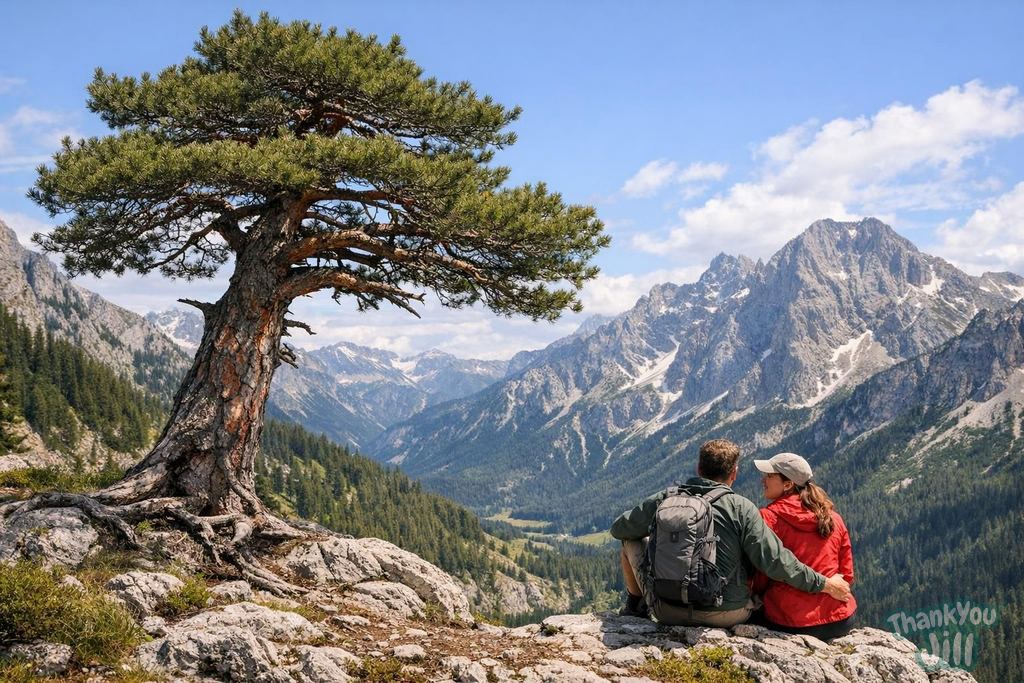
There are lands that seem impossible: rocky slopes, acidic soils, altitudes where winter lasts six months. Places where life seems ready to give up. Then you arrive, Scots pine, and everything changes. Without fanfare, without asking for anything, you plant your roots in the rock and begin your work.
The pine that won't surrender
The Scots pine (Pinus sylvestris) is one of the trees with the widest geographic distribution in the world: it grows from Siberia to Scotland, from northern Italy to Spain. In Italy, it's found in the Alps and the northern Apennines, typically between 700 and 2,000 meters in elevation. It's the quintessential pioneer tree: one of the first tree species to colonize bare ground, abandoned land, or terrain disturbed by fires, landslides, and deforestation. Its roots penetrate deep into rock crevices, stabilize the soil with extraordinary tenacity, and prepare conditions for more demanding forest species to arrive. In many ways, the Scots pine is the first brick with which nature rebuilds a forest.
How to identify it instantly
The Scots pine is unmistakable for three characteristics: the reddish-orange bark on the upper trunk (grayish-brown below), needles in pairs, short and slightly twisted (3-7 cm), and small, asymmetrical cones of gray-green color that take two years to mature. The crown of mature specimens is irregular, flattened at the top in older trees—a distinctive silhouette instantly recognizable in the Alpine landscape. The solitary old Scots pines you see emerging from rocky slopes, their trunks twisted by wind, are among the most photographed and picturesque features of the Italian mountain landscape.
The ecological role: a tree that works for others
The Scots pine is not just a colonizer—it's an ecosystem builder. Its symbiotic roots with ectomycorrhizal fungi gradually transform poor, acidic soil into something richer. Its fallen needles form a thick layer of litter that retains moisture and nourishes soil microorganisms. The cones are a precious food source for many species: the nuthatch, the crossbill (a bird with a specially adapted beak for opening cones), squirrels, and many others feed on them eagerly. Natural cavities that form in old trunks shelter pygmy owls, bats, and tree-dwelling dormice. When the Scots pine ages and dies, its decomposing wood becomes one of the richest habitats in the mountain forest.
Italy's great historic pine forests
Beyond mountain forests, Italy has a thousand-year tradition of artificial coastal pine forests—largely built by the Romans and expanded in subsequent centuries. The Pineta di Ravenna (which inspired Dante, then Byron and Boccaccio), the Pineta di Castel Fusano near Rome, and the Macchia della Magona in Tuscany are historic forests of stone pine (Pinus pinea) and maritime pine (Pinus pinaster). These coastal ecosystems are essential for protection against storm surge, for biodiversity, and for the well-being of local communities. Many of these historic pine forests are now threatened by climate change and the spread of parasites like the pine wood nematode, introduced from Asia.
The scent of a pine forest
The characteristic resinous scent of conifer forests—that sense of well-being you feel walking through a pine forest—is produced by terpenes (mainly α-pinene and β-pinene) released by the needles and bark. Japanese scientific research on Shinrin-yoku (forest bathing) has documented that inhaling these terpene compounds increases the activity of Natural Killer cells in the immune system, reduces cortisol, and improves mood. Walking through a pine forest isn't just pleasant: it's a concrete form of physical and psychological well-being.

The Scots pine doesn't demand perfect soil. It settles where it can and transforms that place into something better. It's the perfect definition of resilience—and a way of life worth remembering.
The Scots pine in practice: how to identify it, visit it, and respect it
- Recognize the two-tone bark: the reddish-orange bark on the upper trunk is the most immediate sign of the Scots pine. From a distance, Scots pines stand out from firs by their less dense, more irregular crown and the visible bark color between the branches.
- Look for cones on the ground: Scots pine cones are small (3-6 cm), asymmetrical, and hard. The seeds inside have a small wing that carries them on the wind. In spring, you'll find cones opened by the work of squirrels and woodpeckers extracting the seeds.
- Walk through a pine forest in the morning: the scent is most intense in the early hours, when temperatures rise and the resin becomes more volatile. If you have children, ask them to touch a branch (carefully, as the resin is sticky) and breathe deeply: it's one of the most easily recognizable scents in Italian nature.
- Don't build fires near pines: conifer forests burn easily because of the resin. Even a poorly extinguished cigarette can start a fire. In summer, always avoid any heat source in pine forests.
- Collect pine nuts only where permitted: edible pine nuts come from the stone pine (Pinus pinea), not the Scots pine. In coastal pine forests, pine nut collection is regulated by local laws. Always check first.
- Watch for the crossbill: if you're lucky, in a winter pine forest you might encounter the crossbill (Loxia curvirostra), a small red bird with a crossed beak, specialized in opening pine cones. It's one of the most extraordinary birds of the Italian mountain forest.
The Scots pine awaits you in nearly every corner of the Italian mountains. The next time you climb to 1,000 meters, stop in front of a pine twisted by wind and think about how many winters it has endured. Then pull out your phone and photograph that orange bark. No filter needed.
Frequently asked questions
How do you identify a Scots pine compared to other conifers in the mountains?
The Scots pine is recognized by its reddish-orange bark on the upper trunk, short needles in pairs (3-7 cm) that are slightly twisted, and small, asymmetrical, gray-green cones. Its crown is irregular and flattened at the top in older trees.
What is the ecological role of the Scots pine in difficult mountain terrain?
The Scots pine stabilizes soil with deep roots, enriches the soil through symbiosis with ectomycorrhizal fungi, and creates habitat for alpine fauna such as woodpeckers, squirrels, and owls, promoting biodiversity and the formation of new forests.
When should you avoid lighting fires near Scots pine forests?
It's essential to avoid fires near Scots pine forests especially in summer, because the resin makes these forests highly flammable. Even a poorly extinguished cigarette can start fires, so it's important to avoid any heat sources near pine forests.
How does the scent of Scots pine affect human well-being?
The resinous scent of Scots pine, produced by terpenes such as α-pinene and β-pinene, promotes physical and psychological well-being by increasing immune cell activity, reducing cortisol, and improving mood, especially during morning walks in pine forests.

Latest News



Comments
No comments yet. Be the first!
Leave a comment