


 Italiano
 Français
 Deutsch
 Español
 Português
 Svenska
 Suomi
Suomi
Ladybugs
The aphid hunters in the trees: biology, species, and an invasion from Japan
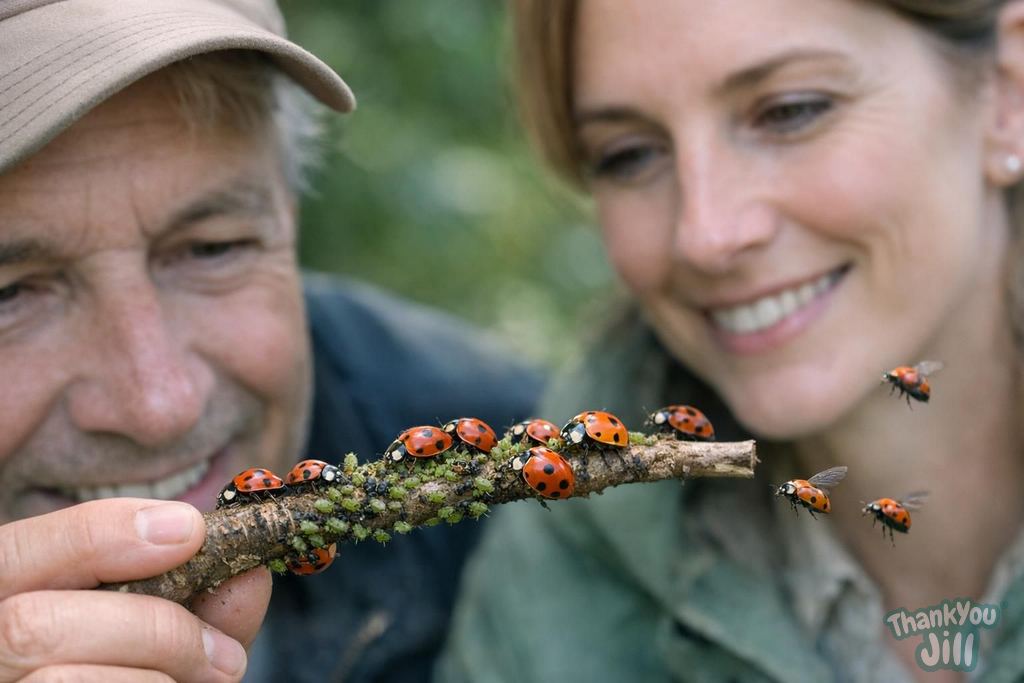
Few animals enjoy the universal affection that ladybugs do. Red with black spots, perfectly geometric, small enough to fit on a fingernail — it's one of the most beloved animals of the forest and garden, in every culture and every language. But behind the colorful and harmless facade lies one of the most efficient predators nature has given to our trees.
Ladybug biology: a life as a predator
Ladybugs (Coccinellidae) are beetles — the same family as stag beetles, leaf beetles, and soldier beetles. About 80 different species live in Italy, from the classic seven-spotted ladybug (Coccinella septempunctata) to the tiny two-spotted ladybug (Adalia bipunctata), all the way to yellow and black species that many people don't recognize as ladybugs. The vast majority are predators of aphids, scale insects, and mites — plant-sucking parasites. A single seven-spotted ladybug consumes between 3,000 and 5,000 aphids over its lifetime (1-3 years). On a single good hunting day, it can consume 200-300 aphids on the leaves of shrubs. The larva — brown and spiny, very different from the adult — is equally voracious and consumes hundreds of aphids before pupating. An aphid invasion on a linden, cherry, or urban ash tree can be controlled in just a few days by a colony of ladybugs — without needing any insecticide.
Red color as a signal: aposematism
The bright red color with black spots of the ladybug is not decorative — it's a warning signal to predators called aposematism. When threatened, the ladybug secretes from the joints of its legs (reflex autohemorrhage) a bitter and toxic yellow liquid (hemolymph). Birds and other predators that have already tasted a ladybug learn to associate the red-black color with the unpleasant taste and avoid it. This signal is so effective that numerous non-toxic species (some moths, some spiders) have evolved similar coloration to take advantage of the ladybug's aposematic protection — a phenomenon called Batesian mimicry. The black spots are quite variable even within the same species: they don't always count exactly 7 — they can be 5, 7, 9, with individual variations. The number of spots is not necessarily a reliable indicator of the species.
Ladybug hibernation: winter clusters
In autumn, adult ladybugs seek sheltered places to spend the winter in a state of torpor — under tree bark, in wall crevices, under accumulated leaves, in reed stems. The most striking characteristic is that they tend to form winter clusters: tens, hundreds, or even thousands of individuals that gather in the same spot. It's not yet entirely clear how they coordinate — it's hypothesized that they use aggregation pheromones left over from clusters from previous years, or that they respond to common visual signals (bark color, cavity structure). In California and some Alpine zones, winter clusters of ladybugs can contain millions of individuals.
Harmonia axyridis: the great replacement
Since 2001, Italy (and all of Europe) has been facing the expansion of a ladybug native to East Asia introduced as a biological control agent in the USA and then arriving in Europe accidentally: the harlequin ladybug (Harmonia axyridis). It's larger, more voracious, more tolerant of cold and environmental variations than European species, and reproduces faster. It feeds on aphids but also on larvae of European ladybugs, butterfly eggs, and other beneficial insects. Wherever it spreads, populations of seven-spotted and two-spotted ladybugs decline dramatically. In Belgium, Great Britain, and some parts of Germany, the two-spotted ladybug (A. bipunctata) has declined by 80-90% in 15 years due to H. axyridis. In Italy the expansion is underway: Harmonia is already common in Piedmont, Lombardy, Veneto, and Tuscany. It's recognizable by its many color variations (red with many black spots, black with red spots, orange with spots...) and by its characteristic smell when crushed — unpleasant and pungent.

The ladybug has spent millennia eating aphids on the trees in our gardens without ever asking us for anything. Then we imported its replacement from Japan and now we're replacing it without even noticing. It's not a story of good and evil: it's the story of how unforeseen consequences always catch up with us.
How to help native ladybugs in your garden and forest
- Don't use insecticides during aphid invasions: resist the urge to spray when you see aphids on your roses or cherry tree. Wait 7-10 days: in most cases, ladybugs, hoverflies, and lacewings will arrive naturally and solve the problem. If the number of aphids is truly unbearable, use only water with Marseille soap spray (physical insecticide, not systemic, harmless to natural predators).
- Plant species with open flowers for hoverflies: hoverfly larvae are aphid predators just as effective as ladybugs. Adults need nectar and pollen from open, simple (not double) flowers to feed: wild carrot, dill, fennel, calendula, phacelia. A corner of your garden with these plants attracts hoverflies that then lay eggs near aphid colonies.
- Install winter shelters for ladybugs: make a bundle of reeds (10-15 cm long, 5-8 mm diameter) tied with twine and hung in a sheltered position (under a gutter, in a shed) with the opening facing east-south. Ladybugs use it as a wintering site. It should be left in place from October to March without disturbance.
- Recognize the harlequin ladybug: learn to distinguish Harmonia axyridis from native species. It's larger (6-8 mm vs 5-7 mm of the seven-spotted), has the characteristic M or W shape of "spots" on the pronotum (the segment between head and elytra), and its smell is unpleasant if crushed. Report sightings on iNaturalist with precise location: contribute to monitoring of the invasive species.
- With children — count the spots: look for ladybugs in your garden or forest in spring-summer. For each ladybug found, count the spots and try to identify the species with a photo guide. Explain that the number of spots varies: not all ladybugs with 7 spots are the same species, and not all ladybugs have 7 spots. The variety always surprises children who think they already know everything about ladybugs.
- Photograph the larvae: ladybug larvae — spiny, dark with orange patches, vaguely resembling tiny dragons — are almost unrecognizable as ancestors of the adults. Photographing them on aphids during predation and then showing the adult they'll become is one of the most fascinating biological sequences for children, comparable to butterfly metamorphosis.
The ladybug is there, in your cherry tree, on your rose, on the linden tree of the avenue. It's doing its job silently every day, as it has for millions of years. The least you can do is not poison its prey and let it do its work. It's a very simple agreement, and it works beautifully.
Frequently Asked Questions
How do you recognize the harlequin ladybug compared to native species?
The harlequin ladybug is larger (6-8 mm), has an 'M' or 'W' shape on the pronotum, and has an unpleasant smell if crushed. Its color varies greatly, from red with many black spots to black with red spots, making it distinguishable from native species.
What is the role of ladybugs in biological pest control against aphids?
Ladybugs are natural predators of aphids, consuming thousands of these pests during their lifetime. A colony can quickly control an aphid invasion on trees and plants, reducing the need for chemical insecticides in the garden or forest.
How can you help native ladybugs survive in your garden?
To protect native ladybugs, avoid using chemical insecticides during aphid invasions, plant open flowers to attract predatory hoverflies, install winter shelters such as reed bundles, and monitor the presence of harlequin ladybugs to limit their spread.
What happens if you use insecticides during an aphid invasion?
Using insecticides can kill not only aphids but also ladybugs and other natural predators, compromising biological control. It's better to wait 7-10 days to allow natural predators to intervene or use only harmless physical insecticides like water and Marseille soap.

Latest News




Comments
No comments yet. Be the first!
Leave a comment