


 Italiano
 Français
 Deutsch
 Español
 Português
 Svenska
 Suomi
Suomi
Tree Galls: Nature's Insect Architecture
Tiny plant structures built by insects: the biology and wonders of galls
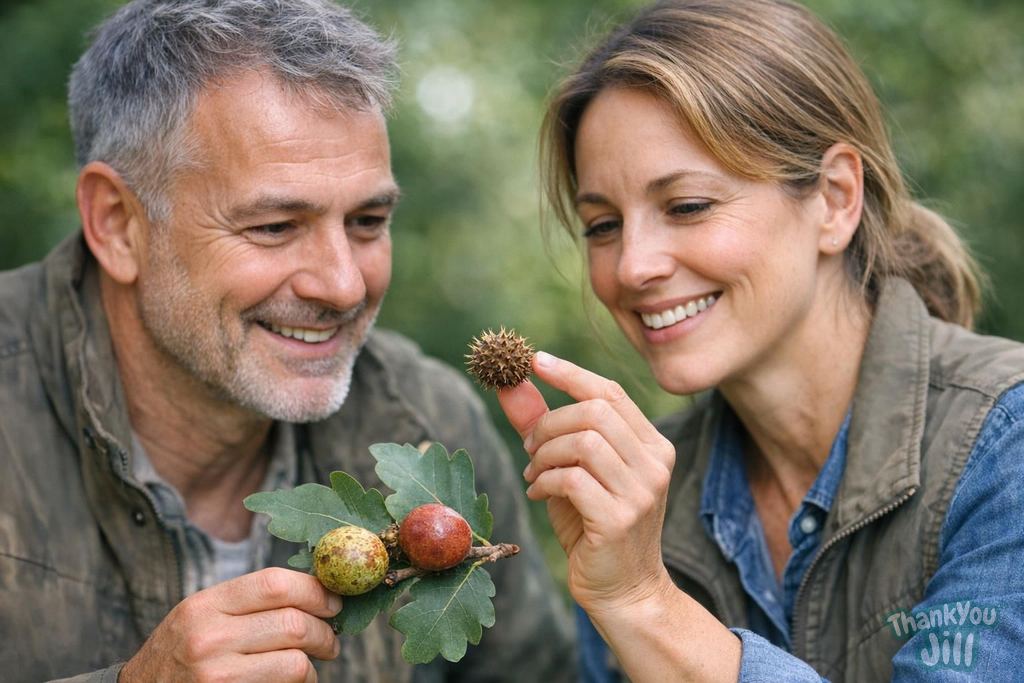
You're walking through an oak forest, pick up a leaf, and notice perfect spheres—red and glossy—attached to the underside. Or you find on a branch a spindle, a knot, a miniature pineapple just millimeters long. These bizarre structures are called galls — and they're homes built by insects using the plant itself as building material. It's one of the strangest, most beautiful, and least-known biological phenomena in the Italian forest.
What is a gall and how does it form?
A gall (or cecidium) is an abnormal proliferation of plant tissue induced by the presence of an insect (or mite, fungus, or bacterium) within or near the plant's tissues. The gall-forming insect lays eggs at a precise point on the plant (bud, leaf, branch, root), and the hatching larva injects chemical substances (a mixture of amino acids, plant hormones, effector proteins) that reprogram the cellular development of the host plant: instead of developing normally, cells around the larva proliferate in a controlled way, forming a specific structure — the gall — that provides the larva with food, shelter, and protection from predators. The gall's shape is genetically determined by the insect, not the plant: the same insect species always produces the same gall shape on the same host tree, with extraordinary precision. Each shape is a biological signature identifying the gall-forming species.
Oak galls: the most common and most beautiful
The oak tree hosts the largest number of gall-forming species in Europe — about 80 different species of Cynipidae (tiny microscopic wasps) form galls only on Italian oaks. The easiest to find: Spherical oak gall (Cynips quercusfolii): smooth, perfect red or green spheres attached to the underside of oak leaves. They turn brown and hard in autumn. Diameter 1-2 cm. Spongy gall (Biorhiza pallida): on the apical bud, a spongy yellowish-green structure 2-4 cm across with many internal chambers — each containing a different larva. Ivy gall (Diastrophus rubi): on branches, irregular cylinders resembling tiny wooden pineapples of green wood. Artichoke gall (Andricus fecundator): on the bud, a structure that looks like a tiny green artichoke. Twig gall or Robin's gall (Andricus quercusramuli): a tuft of green thread-like structures hanging from branches like a small jellyfish.
Galls as ecosystems: inhabitants and parasites
A gall is not just the home of the larva that formed it — it's an entire ecosystem. Inside each gall often live not only the gall-forming larva but also inquilines (other insect species that don't form the gall but exploit it: other cynipid larvae, dipteran larvae, beetle larvae) and parasitoids (tiny chalcid wasps that lay eggs inside the gall, whose larvae feed on the gall-forming larva by parasitizing it). In some complex galls, up to 20-30 different species are found, in a tight and intricate food web. The spherical oak gall (Cynips quercusfolii) is one of the most studied systems: it regularly hosts the gall-forming larva, 2-3 inquiline species, and 5-8 parasitoid species — a microcosm of predation and coevolution inside a 1.5 cm sphere.
Galls in history: from ink to medicine
Oak galls (particularly those of Andricus gallae-tinctoriae, historically called gall nuts) were for millennia one of the most important commercial resources of the Mediterranean. Their extremely high content of gallic acid and tannins (40-70% of dry weight) made them indispensable for producing iron gall ink — the type of ink used for writing from antiquity through the 20th century on all official documents, manuscripts, and European books, including the Gospels, the Magna Carta, constitutions, and Bach's scores. They were imported throughout Europe from Anatolia and Greece. In traditional medicine, oak gall infusions were used as astringents, hemostatics, and antiseptics.

The gall is proof that two living beings can coevolve so long that they learn to speak the same chemical language — one says grow in this specific way and the other, without understanding, obeys. Is it manipulation or collaboration? Biology doesn't answer this question easily.
How to find and study galls in the forest and garden
- Look for oak galls in autumn: oak leaves in September-October are full of galls at various stages of development. Collect 10-15 leaves from different trees and examine the galls: shape, color, position (upper or lower surface, along the edge, at vein junctions). Each gall type is a different species. Photograph them and use iNaturalist for identification — there are gall experts on this platform who usually respond within 24 hours.
- Open a gall carefully: in late summer (August-September), galls still contain larvae. With a sharp knife, cut a mature gall in half. You'll see the white, glossy larva in its chamber — a chamber built with a wall of dense, nutritious plant cells on which it feeds. It's not disgusting: it's fascinating. Then place the gall back on the branch or in soil near the tree.
- Collect them in autumn and wait for spring: gather some round galls from the oak in September-October and place them in a glass container covered with gauze (not sealed airtight). Keep the container in a cool but not cold place. In March-April, adult wasps will emerge — tiny, almost invisible, moving about on the glass. Release them outside near the oak. This observation cycle is one of the most complete and accessible nature projects for all ages.
- Look for galls on other trees: not just oaks. Willow has leaf galls produced by midges (Pontania spp.) — green or red swellings on the leaf with a larva inside. Hazel has galls at the leaf axil. Cherry and plum have Taphrina galls (fungi) that deform leaves into "tongues." Rose has the beautiful bedeguar (Diplolepis rosae) — a spongy, hairy red-green tuft that looks like it came from a fantasy film. Every shrub and tree has its specific galls.
- With children — galls as treasures: invite children to collect a sample of each gall type they find on a walk. Back home, they draw each type on a sheet and search for the name with iNaturalist. Each gall becomes a personal discovery. The round oak gall is often the favorite — perfectly smooth, almost artificial in its geometric appearance.
Galls are everywhere on our trees — dozens of different forms on oaks, roses, willows — and almost no one notices them. Learn to recognize them and every forest walk becomes a treasure hunt for invisible creatures that have reprogrammed a tree to build themselves a home. It's biological magic, accessible at any age, on any tree.
Frequently Asked Questions
How does a gall form on trees and what is the insect's role in this process?
A gall forms when an insect lays eggs at a specific point on the plant. The hatching larva injects chemical substances that reprogram the plant's cellular growth, creating a structure that serves as both home and food source for the larva.
What are the distinctive characteristics of the most common oak galls and how do you recognize them?
The most common oak galls include smooth red or green spheres on the underside of leaves, spongy structures on apical buds, and artichoke or pineapple-like shapes on branches. Each shape is specific to the insect species that creates it.
What type of ecosystem develops inside a gall and which species inhabit it?
Inside a gall, a micro-ecosystem develops that hosts the gall-forming larva, inquilines such as other insect larvae, and parasitoids—tiny wasps that lay eggs in the gall and feed on the larvae, creating a complex food web.
How can you safely and educationally observe and study a gall?
You can collect mature galls in autumn, carefully open them to observe the larvae, or preserve them in ventilated containers to watch adult wasps emerge in spring. It's an educational activity suitable for all ages and helps understand gall biology.
Latest News



Comments
No comments yet. Be the first!
Leave a comment