


 Italiano
 Français
 Deutsch
 Español
 Português
 Svenska
 Suomi
Suomi
Tree Sap: Nature's Liquid Gold
Maple syrup, birch water, and global traditions of spring sap harvesting
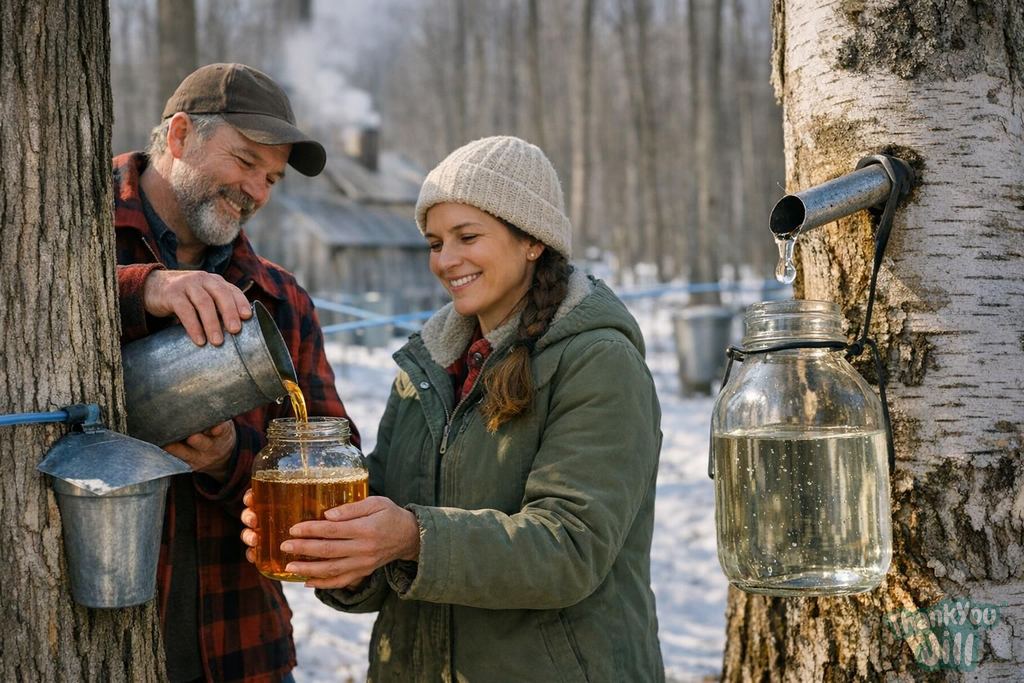
In March, when snow melts but leaves haven't yet emerged, something extraordinary happens in the maple forests of Canada and Vermont: sap rises with such pressure that it flows spontaneously from any small wound in the trunk. Indigenous peoples of North America had discovered this phenomenon thousands of years before Europeans arrived—and they understood how to transform it into one of the forest's most precious gifts: maple syrup.
Sugar maple sap: the forest's sweetest liquid
North America's sugar maple (Acer saccharum) produces spring sap each year with a sugar concentration of 2-3%. This sap is collected by drilling a small hole in the trunk and inserting a tube that channels it into a container. To produce one liter of maple syrup (sugar concentration ~66%), approximately 40 liters of raw sap are needed—an evaporation process requiring enormous amounts of energy. The Algonquin and Iroquois nations accomplished this by boiling sap in clay vessels using heated stones. European colonists quickly adopted the technology and transformed maple syrup production into one of North America's most distinctive food industries. Today, Canada produces roughly 75% of the world's maple syrup (about 70,000 tons annually), primarily from Quebec. The harvest cycle lasts 4-8 weeks in late winter to early spring, when daytime temperatures rise above freezing and nights remain below—the temperature difference that creates the pressure necessary for sap flow.
Birch water: Europe's spring beverage
Throughout Northern and Eastern Europe—from Scandinavia to Russia, Poland to the Baltic states, and extending to Belarus and Georgia—birch sap (Betula pendula and B. pubescens) harvested in March-April is traditionally consumed as a fresh drink, fermented into light wine, or evaporated into sweet syrup. In Russian it's called berёzovyj sok (birch juice), in Polish sok brzozowy. Fresh birch sap is nearly colorless, slightly sweet with a crisp, subtly tart taste, rich in sugars (xylitol, fructose, glucose), minerals (potassium, calcium, magnesium), amino acids, and B vitamins. It's consumed fresh (delicious when just collected but ferments quickly—keeps only 2-3 days in the refrigerator without treatment) or transformed into birch wine (fermented with wild yeasts). In Italy, birch sap harvesting remains a living tradition in alpine valleys—Val di Fiemme in Trentino and certain valleys in the Aosta Valley have documented traditions of using birch sap in folk medicine.
Walnut sap: the forgotten lamp oil
Walnut trees produce abundant, slightly sweet sap in spring. In some areas of the Apennines, folk tradition involved harvesting walnut sap in March as a spring purifier—small amounts were consumed to "cleanse the blood" after winter. This practice has a real pharmacological basis: walnut sap contains juglone, minerals, and polyiodic compounds with astringent and antimicrobial effects. The green walnut husk (the fresh outer shell of walnuts) has an even more ancient use: macerated in alcohol, it produces a bitter liqueur (nocino, typical of Emilia-Romagna) with recognized digestive properties. Nocino is traditionally prepared with walnuts harvested on the night of Saint John (June 24, the summer solstice night).
Sap in Italian traditions: fir and pine syrup
Italian conifers also produce spring sap traditionally used. In alpine areas, syrup made from young shoots (cipollini) of Norway spruce or Scots pine in spring is a traditional remedy for bronchitis and colds: the bright-green shoots (emerging in May-June) are macerated with sugar or honey for weeks, then the liquid is filtered. The product has a resinous-balsamic flavor and expectorant properties certified by phytotherapy.

In March, when snow melts and roots begin pushing upward, trees produce their first gift of the season: sap. It's sweet, it's fresh, it's loaded with minerals and life. Our ancestors knew this. We forgot. But the birch hasn't forgotten—every spring, the sap rises.
How to harvest and use birch sap in Italy
- When to harvest: the window is short and precise—from late February through late March, during weeks when daytime temperatures consistently exceed 32°F (0°C) and nighttime temperatures remain below. In the Italian Alps: typically from mid-March through early April, at elevations between 2,000 and 4,600 feet (600-1,400 m). Once leaves begin to emerge, the sap becomes bitter and harvesting stops.
- How to harvest without harming the tree: drill a hole no more than 0.4 inches (1 cm) in diameter and 1.2-1.6 inches (3-4 cm) deep into the trunk (using a hand auger or drill), insert a food-grade plastic tube, and hang a container below. Collect no more than 0.25-0.5 gallons (1-2 liters) per tree per season. When harvesting ends, remove the tube and seal the hole with clay or beeswax—the tree heals itself within a few weeks.
- How to use it: drink the fresh sap within 24-48 hours. It has a very delicate flavor, almost devoid of sweetness, slightly vegetal. You can also let it ferment naturally (leave it at room temperature for 2-3 days with a small amount of honey) to create a lightly sparkling, subtly tart beverage. Fermentation produces minimal alcohol (roughly 1-2% vol).
- Commercial birch water: organic birch sap from Finland, Latvia, and Russia is available in Italian natural food stores—in pasteurized form with long shelf life or frozen. It's one of the most interesting functional beverages available: zero calories, rich in silicon, manganese, and xylitol.
- With children—the miracle of sap: take children to a birch forest in March. Together, drill a small hole in a trunk and watch the sap flow out—almost immediately, slowly, as if from a hidden spring. Taste it. Children's reactions when they discover that the tree "weeps sweet water" are invariably pure wonder.
Tree sap is the most concrete sign that spring has arrived—before leaves, before flowers. It's the tree's blood rising toward the branches, charged with energy and nutrients accumulated during months of dormancy. Feeling it flow fresh and slightly sweet across your tongue is one of the most direct ways that exist to physically communicate with a tree's life. It's priceless.
Frequently Asked Questions
What's the best time to harvest birch sap without damaging the tree?
The ideal time to harvest birch sap is from late February through late March, when daytime temperatures exceed 32°F (0°C) and nighttime temperatures remain below. Harvesting stops as soon as leaves begin to emerge to prevent the sap from becoming bitter.
How is maple sap transformed into syrup and how much sap is needed for one liter of syrup?
To produce one liter of maple syrup with approximately 66% sugar content, about 40 liters of raw sap are required. The sap is collected through a hole drilled in the trunk and then evaporated to concentrate the sugars—a process requiring significant energy.
What are the nutritional properties and consumption methods for birch sap?
Birch sap is rich in natural sugars, minerals, amino acids, and B vitamins. It's consumed fresh within 2-3 days or fermented to create a lightly alcoholic, sparkling beverage. It's valued for its delicate flavor and purifying properties.
How can birch sap be harvested sustainably and safely for the tree?
Drill a hole no more than 0.4 inches (1 cm) in diameter and 1.2-1.6 inches (3-4 cm) deep into the trunk, insert a food-grade tube, and harvest up to 0.25-0.5 gallons (1-2 liters) per tree per season. After harvesting, seal the hole with clay or beeswax to allow the tree to heal.

Latest News


Comments
No comments yet. Be the first!
Leave a comment