


 Italiano
 Français
 Deutsch
 Español
 Português
 Svenska
 Suomi
Suomi
Forest Fires
How they start, how to prevent them, and how forests recover
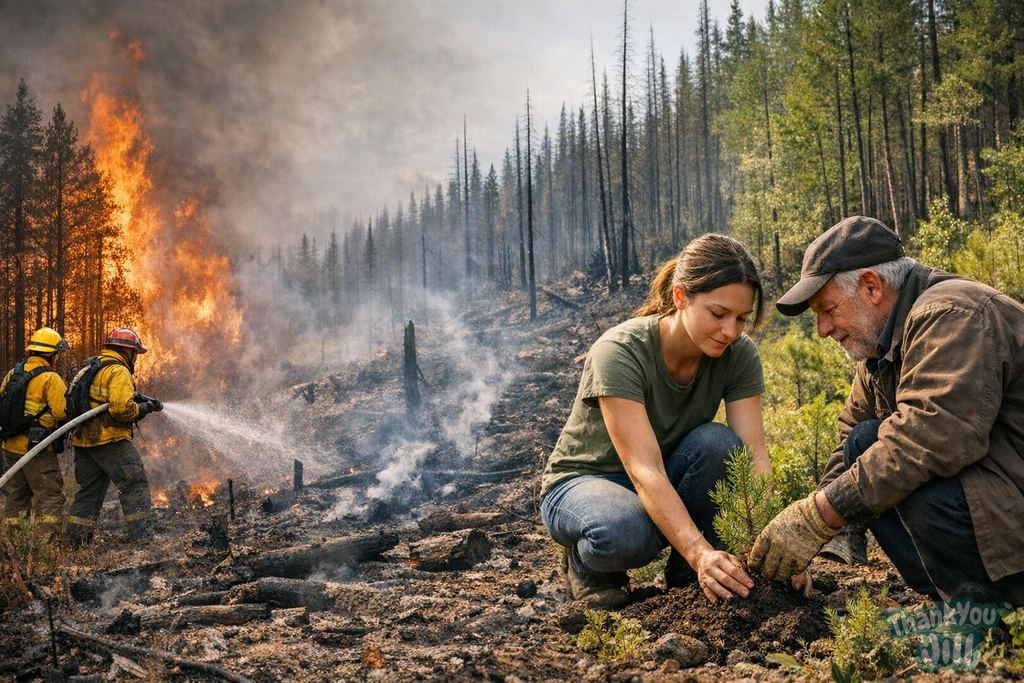
In August 2021, forest fires burned 160,000 hectares of forest across Italy in just a few months — from Sicily and Sardinia to the Alps. Images of burning forests, smoke covering cities, and fleeing animals made headlines worldwide. But what do we really know about forest fires? And what can we do?
The physiology of fire in forests
A forest fire requires three elements — the fire triangle: fuel (dry plant biomass), oxidizer (oxygen), and ignition source (spark or high temperature). In a Mediterranean or coniferous forest in summer, fuel is abundant (dry grass, leaf litter, dead twigs). The oxidizer is everywhere. The only factor often missing is the ignition source — and in the vast majority of cases, the ignition is human-caused, either deliberate or accidental. Data from the State Forestry Corps show that over 90% of Italian forest fires are of anthropogenic origin: deliberate (intentionally set), negligent (cigarettes, campfires, burning stubble), or caused by infrastructure (power lines, train sparks). Naturally occurring fires (lightning) are relatively rare in Italy. Once ignited, the fire spreads depending on wind (which brings fresh oxygen and carries embers), slope (fire spreads faster uphill), and vegetation type (coniferous forests burn much more easily because of resin content).
The ecological role of fire: it's not just destruction
In many Mediterranean ecosystems, fire has played a natural ecological role for millennia. Before humans systematically suppressed fires, Mediterranean forests burned at regular intervals (every 5-30 years, depending on vegetation type), maintaining an open and diverse landscape. Many Mediterranean plant species have evolved to adapt to fire: phyllyrea, holm oak, strawberry tree, and tall maquis vigorously regrow from their roots after fire passes. Some Australian forest plants have seeds that germinate only after fire (the same strategy used by giant sequoias in America). The problem isn't fire itself — it's the frequency and intensity: fires that are too frequent don't give vegetation time to recover; fires that are too intense (caused by the buildup of dry biomass from artificial fire suppression) kill even fire-adapted species. The total fire suppression policy adopted in the 20th century in Europe and America often made the problem worse, accumulating fuel for decades and ultimately producing catastrophic fires instead of the low-intensity fires that would have kept the ecosystem in balance.
Italy's fire management system
Italy's forest fire prevention and suppression system involves: the Forestry Corps (later merged into the Carabinieri Forestali) for prevention, monitoring, and initial investigations; the Fire Department for ground-based firefighting; the Civil Protection air fleet (Canadair CL-415, Hercules, helicopters) for aerial firefighting. In summer, high-risk regions activate active surveillance systems (lookout towers, aerial patrols, automatic smoke detection cameras). The prevention phase — clearing dry vegetation along roadsides, creating firebreaks, public awareness — is the most important but often the most neglected due to lack of resources. The role of volunteer firefighters (Civil Protection, National Alpine Rescue Corps) is essential in managing local emergencies.
After the fire: the forest reborn
A forest's recovery after a fire follows predictable patterns. In the first months: pioneer herbaceous species (thistles, prickly pears, annual grasses) rapidly colonize the burned soil. In the first year: shoots from the roots of fire-adapted shrubs (holm oak, strawberry tree, phyllyrea, bramble) emerge vigorously. In 2-5 years: the understory is restored; faster-growing tree species (pine, birch, poplar, rowan) begin to colonize. In 10-20 years: tree cover gradually closes. In 50-100 years: the forest approaches its pre-fire state again. This natural process can be accelerated by active reforestation efforts, but it requires careful species selection — replanting the same pine monocultures that burned easily is counterproductive.

The forest burns and then grows back. It has always done so. The problem isn't fire — it's that we're burning too often, too intensely, and forests don't have time to recover between fires. Fire isn't the forest's enemy. Our inability to manage it is.
How to behave during and after a forest fire
- Daily prevention: never light outdoor fires during high-risk months (usually June-September, with regional variations). Don't throw lit cigarettes from car windows. Don't burn stubble during prohibition periods (check local ordinances). Don't park cars with hot exhausts on dry grass.
- Quick reporting: if you see smoke in a forested area, immediately call the emergency number 112 (or 1515 for the Forestry Corps) with the precise location using GPS or visible landmarks. Speed of reporting is crucial: a fire detected in the first 5 minutes is much easier to control than one detected after 30 minutes.
- If a fire is nearby: never try to extinguish a forest fire alone — it's dangerous. Move quickly in a direction perpendicular or opposite to the wind, not toward the fire. Don't run uphill (fire spreads faster uphill than you can run). If you're in a car, don't drive through roads crossed by fire. Call emergency services and follow authorities' instructions.
- Join volunteer firefighting: Civil Protection volunteer associations in many Italian regions offer training courses for forest fire volunteers. It's one of the most concrete and useful forms of environmental volunteering available in Italy.
- Visit an area burned a few years earlier: taking children to an area burned 2-3 years before is one of the most immediate and positive lessons about ecosystem resilience. Seeing vegetation vigorously regrowing, pioneer species colonizing the blackened soil, first shrubs already providing shade — it's concrete proof that nature doesn't give up. The forest always begins again.
The vast majority of Italian forest fires are preventable. Advanced technology isn't needed: what's needed is for every person who enters a forest in summer not to light fires, not to leave cigarettes or barbecue coals in the grass. Preventing a fire costs nothing. The consequences of not doing so sometimes cost an entire forest.
Frequently Asked Questions
What is the natural ecological role of fire in Mediterranean forests?
Fire in Mediterranean forests has a natural ecological role, maintaining an open and diverse landscape. Many plant species have adapted to fire, regrowing from roots or germinating only after flames pass, contributing to ecosystem renewal.
How can you effectively prevent a forest fire during high-risk months?
Effective prevention includes not lighting outdoor fires, avoiding throwing lit cigarettes, not burning stubble during prohibition periods, and not parking cars with hot exhausts on dry grass. Public awareness and clearing dry vegetation are essential.
What happens to the forest after a fire and how long does recovery take?
After a fire, the forest regenerates in phases: pioneer herbaceous species colonize immediately, fire-adapted shrubs regrow within the first year, fast-growing trees colonize in 2-5 years, and tree cover closes in 10-20 years. The forest can return to its pre-fire state in 50-100 years.
When should you report a forest fire and what is the correct behavior in its presence?
It's essential to report a fire immediately upon seeing smoke by calling the emergency number with the precise location. In the presence of fire, don't attempt to extinguish it alone, move perpendicularly away from the wind, and don't head uphill or toward roads crossed by fire, following authorities' instructions.
Latest News
Comments
No comments yet. Be the first!
Leave a comment