


 Italiano
 Français
 Deutsch
 Español
 Português
 Svenska
 Suomi
Suomi
The Green Lizard and the Wall Lizard
How they use trees and walls as basking and hunting habitats
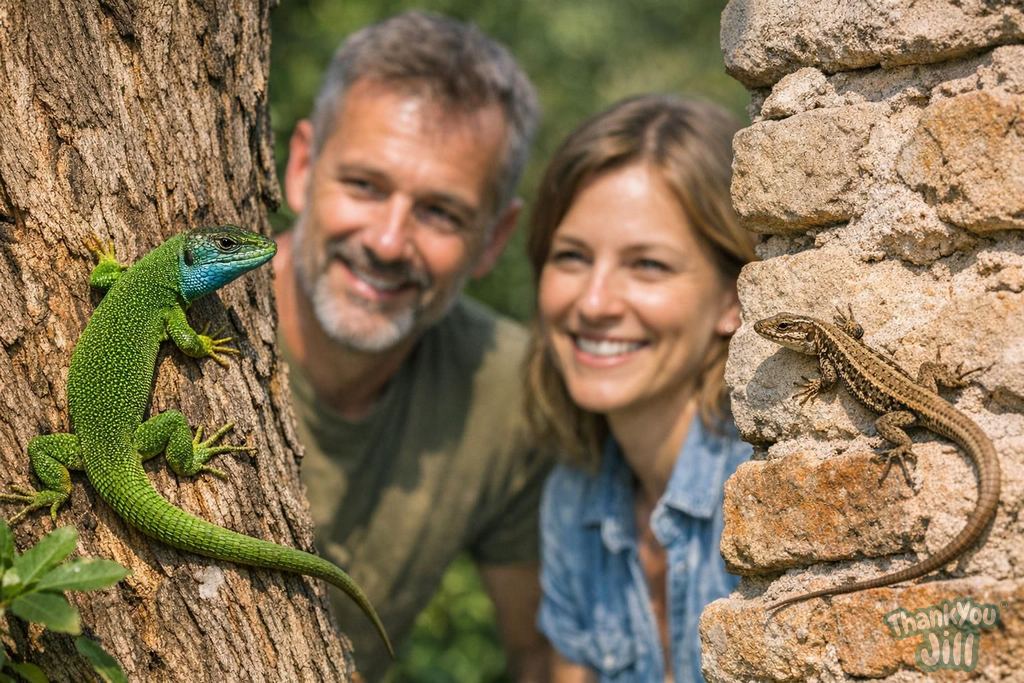
There's a moment at midday in summer, on sunny forest trails, when you hear a quick rustle in tall grass and an emerald green shape vanishes into the brambles. The green lizard. Incredibly fast, impossible to approach, yet unmistakable for that brilliant green that seems almost artificial. It's the most beautiful and largest reptile in Italy, and its life is intertwined with trees in ways that are rarely noticed.
The green lizard: the jewel of Italian forests
The western green lizard (Lacerta bilineata) is Italy's largest lizard, reaching a total length of 40-45 cm (two-thirds of which is the tail). The adult male is a brilliant emerald green with a vivid blue throat during breeding months (April-June)—a color combination that makes it one of Europe's most beautiful reptiles. The female is more subdued: greenish-brown with clear longitudinal stripes, much better camouflaged. The green lizard inhabits sunny forest edges, tall hedgerows, borders of tree-lined rows, brambles, and shrubby thickets with isolated trees. It doesn't live in dense closed forest: it needs direct sunlight to thermoregulate, but also needs immediate refuge in shade or thick vegetation when threatened. Forest edges—that transition zone between open field and closed forest—are its preferred habitat.
Thermoregulation: the sun as an energy source
Like all reptiles, the green lizard is an ectothermic (cold-blooded) animal: its body temperature depends on the external environment. To reach the optimal temperature for hunting and digestion (around 30-35°C), it warms itself by basking in the sun—a behavior called heliothermia. Trees and walls are fundamental elements in this process: the bark of a sun-exposed trunk warms more quickly than surrounding soil and retains heat longer. The green lizard often uses isolated tree trunks, stumps, woodpiles, and dry stone wall rocks as basking sites (thermoregulation sites). In the morning, when temperatures are still low, it's found on the southeast sides of trunks, its body flattened to maximize exposed surface area. At midday, when it's too hot, it takes refuge in the shade of the trunk itself or among the roots. This thermal alternation throughout the day is a precise behavioral orchestra, calibrated to ambient temperature with remarkable accuracy.
The wall lizard: the companion of walls and trees
The wall lizard (Podarcis muralis) is Italy's most common reptile and one of Europe's most widespread. It lives on walls, rocks, tree bark, fallen trunks—any hard, sunny surface that offers thermoregulation opportunities and crevices to hide in. Unlike the green lizard (which is more tied to dense shrubby environments), the wall lizard is cosmopolitan: you'll find it in cities, gardens, countryside, mountain trails up to 2,000 m elevation, on rural building walls, on fruit tree trunks. It's also the easiest reptile for children to observe: it approaches patiently to within a few centimeters, curious and relatively accustomed to human presence. The female is more subdued, while the male often has vivid colors on its flanks (blue, green, orange) during breeding season.
The green lizard as predator: a complete hunter
The green lizard has an extraordinarily varied diet for a reptile. It feeds on large insects (crickets, grasshoppers, beetles, butterflies), earthworms, snails, spiders, and also ripe fruits (blackberries, wild cherries, grapes)—making the green lizard one of Europe's rare omnivorous reptiles. Occasionally it eats small rodents, ground-nesting chicks, small lizards, and young snakes. Its hunting technique is active ambush: the green lizard approaches slowly, freezes, then launches a lightning-fast bite. Its teeth are pointed and slightly curved—allowing it to hold prey even as it struggles. Its robust legs with powerful claws also allow it to climb low tree trunks to reach bird nests or branches laden with fruit.
Hibernation and annual cycle
The green lizard hibernates from October-November to March, hidden in ground cavities, tree roots, and woodpiles. Upon spring awakening (March-April), males immediately assume their brilliant blue-green breeding coloration and begin territorial disputes and courtship. Females lay eggs (5 to 15) in June in a shallow hole exposed to the sun—soil temperature serves as an incubator. Young are born in August-September. The wall lizard has a similar cycle, with shorter hibernation in mild climates.

The green lizard is as green as the forest it inhabits, as blue as the sky it uses to warm itself, as fast as the sun it follows all day long. You almost never see it, but it's there—on the sun-exposed trunk, in the thick brambles, in the tall grass at the forest edge. All it takes is the patience of a reptile.
How to observe and support forest reptiles
- Go out early in the morning in summer: reptiles are most visible in the early morning hours (8-11 AM), when they're actively thermoregulating on basking sites. Walk slowly and quietly on sunny trails at the forest edge. Look around before looking ahead: often the green lizard is on a trunk beside the trail, not on the path itself.
- Don't capture them: all Italian reptiles are protected by law (DPR 357/1997). Don't capture green lizards, wall lizards, or snakes. If you want to photograph them, approach slowly from a non-threatening direction (not head-on) and sit waiting for them to become accustomed to your presence. Patience is always rewarded.
- Leave stones and logs in gardens: a pile of stones or a fallen log in a sunny corner of your garden is an ideal refuge for wall lizards. Don't "clean up" garden edges: brambles, tall weeds, and woodpiles are precious habitats for reptiles.
- Don't mow grass edges in May-June: reptiles lay eggs in May-June in shallow holes in tall grass along sunny edges. Mowing during this period can destroy buried eggs. Wait until late July for edge trimming.
- With children—the basking contest: take children on a sunny forest edge trail at 9 AM and challenge them to spot as many lizards as they can in 20 minutes of slow walking. Explain that each lizard sitting still in the sun is "charging up like a solar battery." The comparison with photovoltaic technology works immediately and brilliantly.
- Photograph the shed skin: reptiles shed their skin periodically during warm seasons. The wall lizard's shed—an almost complete translucent membrane found on the ground near basking sites—is one of nature's most fascinating and least-known finds. Collect it and observe it against the light: you'll see the exact shape of the reptile in transparency.
The reptiles of the Italian forest are shy animals that don't seek contact with us, but that have coexisted silently with our activities for millennia. The green lizard that disappears into the brambles in front of you isn't a sign that you've disturbed something: it's a sign that in that forest there's still enough hedgerow, enough sun, and enough insects to support such a demanding predator. That's good news.
Frequently asked questions
How does the green lizard use trees and walls to thermoregulate?
The green lizard warms itself on sun-exposed trunks, stones, and walls, taking advantage of bark and surfaces that heat up quickly and retain warmth. It alternates between sun and shade to maintain its optimal body temperature of 30-35°C.
What's the main difference between the green lizard and the wall lizard regarding habitat?
The green lizard prefers sunny forest edges and shrubby thickets, while the wall lizard is more adaptable and lives on walls, rocks, bark, and even in urban environments up to 2,000 m elevation.
When is the best time to observe reptiles like the green lizard to see them active?
The best time is early morning, between 8 and 11 AM, when reptiles are actively thermoregulating on basking sites—the warm surfaces where they bask in the sun.
How can you encourage the presence of lizards and green lizards in gardens or forest edges?
By leaving stones, logs, and brambles in gardens, avoiding cutting tall grass in May-June to prevent destroying eggs, and maintaining sunny habitats with natural shelters for thermoregulation and hunting.
Latest News


Comments
No comments yet. Be the first!
Leave a comment