


 Italiano
 Français
 Deutsch
 Español
 Português
 Svenska
 Suomi
Suomi
Physical Activity for Older Adults
Safe and Effective Exercises
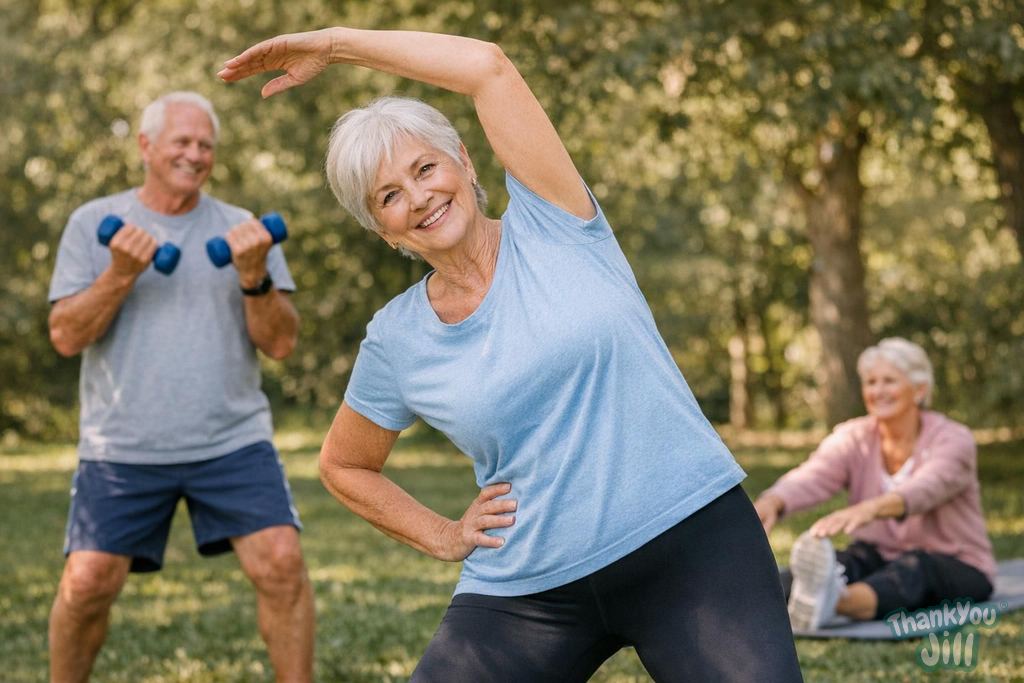
Aging is associated with progressive loss of muscle mass (sarcopenia: approximately 1–2% per year after age 50), reduced bone density (osteopenia and osteoporosis), diminished balance and proprioception (the leading cause of falls), decreased flexibility and joint mobility, and decline in cardiovascular and cognitive function. The good news: nearly all of these processes can be significantly slowed by appropriate exercise, even when starting later in life. A landmark study published in JAMA (Fiatarone et al., 1994) demonstrated that institutionalized older adults aged 72 to 98 were able to increase muscle strength by 113% and walking capacity by 28% with a 10-week resistance training program. It's never too late to start.
The Four Components of Exercise for Healthy Older Adults
The 2020 WHO guidelines for older adults (65+) recommend physical activity comprising four specific components. Aerobic activity: 150–300 minutes of moderate-intensity activity or 75–150 minutes of vigorous-intensity activity per week. Examples include brisk walking, swimming, cycling, dancing, and water aerobics. Walking remains the most accessible activity with the best safety profile. Muscle strength: strengthening exercises at least 2–3 times per week, targeting major muscle groups. Essential for preventing sarcopenia and falls. Balance and proprioception: specific balance exercises at least 3 times per week for those at risk of falling. This component is particularly important for older adults compared to younger populations. Flexibility and mobility: stretching of major muscle groups at least 2 times per week to maintain joint mobility and daily functional capacity (bending to pick something up, turning while driving).
Strength Exercises for Older Adults: Safe and Effective
Fear of injury prevents many older adults from starting resistance training. In reality, with proper progression, strength exercises are safe and produce remarkable benefits. Recommended exercises for beginners: chair stands: starting from a seated position, stand up and sit back down. Begin with 5–8 repetitions and progress gradually. Works the quadriceps, glutes, and core. It's the functional test most commonly used by geriatricians to assess lower limb strength. Calf raises: standing with support from a chair for safety, rise up onto your toes. 10–15 repetitions. Strengthens the calves and improves circulation. Essential for fall prevention. Standing hip abductions: holding onto a chair, lift one leg out to the side while keeping it straight. 10 repetitions per side. Strengthens the glutes and improves lateral stability (essential for preventing lateral falls, which are the most dangerous). Resistance band arm extensions: using a light-resistance fitness band, perform a rowing motion. Strengthens the back, biceps, and shoulders. Important for maintaining upright posture. Seated leg lifts: while seated in a chair, extend one leg and hold it elevated for 2–3 seconds. Strengthens the quadriceps without loading the back.
Balance Exercises: The Priority for Fall Prevention
Falls are the leading cause of physical trauma in older adults: 30% of those over 65 fall at least once per year, often with serious consequences (hip fracture in particular). Regular balance exercise reduces fall risk by 23% (Sherrington et al., 2019, Cochrane review, based on 159 RCTs). Progressive balance exercises for older adults: single-leg stance: stand on one foot, starting with support from a wall or chair, progressing toward unsupported balance. Goal: 10–15 seconds per side. Tandem walking (heel-to-toe walk): walk by placing one foot directly in front of the other, heel to toe. 5–10 steps. Tai chi: the most robust meta-analysis on falls in older adults shows that tai chi reduces fall risk by 20–30%. It combines balance, gentle strength, and coordination in a culturally rich and socially enjoyable form. The Otago Program (developed by Campbell et al. in New Zealand): 17 strength and balance exercises specifically designed for older adults at risk of falling, validated in RCTs with a 35% reduction in falls. Available in Italian through local health authorities and residential care facilities.
How to Start Exercising Later in Life: Practical Tips
Preventive medical visit: before starting an exercise program after years of sedentary living, a visit to your primary care physician is recommended to rule out contraindications (severe arrhythmias, uncontrolled hypertension, decompensated heart failure). A stress test is not necessary to begin moderate-paced walking; however, it is advisable for moderate to high-intensity programs. Gradual start: the 10% rule (never increase training volume or intensity by more than 10% per week) is particularly important for older adults whose recovery is slower than younger individuals. Exercise groups for older adults: the social aspect is fundamental for adherence. Senior centers, gyms with specialized classes, and sports associations for older adults (UISP Terza Età, CSI, AiCS) offer structured programs in stimulating social environments that dramatically increase program continuity.

No medication produces all the benefits of physical exercise in older adults: strength, balance, cognition, mood, sleep, and independence. Physical exercise is the true pill for healthy aging, and geriatricians increasingly prescribe it as a primary intervention. Rising from a chair ten times a day, walking for 30 minutes, balancing on one foot: small gestures that keep frailty at bay for years.
The Older Adult Gym: Safe Exercises in Three Levels
Beginner level (completely sedentary): all exercises are performed seated or with secure support. Chair stands (5–8 reps), seated leg lifts (10 reps per side), seated torso rotations (10 reps), arm raises with light resistance band (10 reps), single-leg stance with wall support (5 seconds per side). Duration: 15–20 minutes, 3 times per week. Intermediate level (some activity already present): chair stands without support (10 reps), calf raises (15 reps), standing hip abductions (10 reps per side), tandem walking (10 steps), unsupported single-leg stance (goal 10 seconds). Duration: 25–30 minutes, 3–4 times per week. Advanced level (active but seeking progression): partial squats (bending to 90°, 10–15 reps), assisted lunges (5 per side), exercises with medium-resistance bands (10–15 reps per muscle group), single-leg stance with eyes closed (advanced progression), tai chi or yoga for older adults as complementary activity.
Swimming and Water Aerobics for Older Adults: Specific Benefits
Swimming and water aerobics are the physical activities with the best joint safety profile for older adults with arthritis, knee problems, back issues, or hip concerns. Water reduces perceived body weight by 90% (when submerged to shoulder level), eliminating joint loading while performing cardiovascular activity. The benefits include: cardiovascular capacity improvement comparable to brisk walking, maintenance of muscle strength (water provides resistance in both directions of movement), improved flexibility thanks to warm pool water (28–30°C in pools for older adults), and reduction of chronic joint pain during and after activity. Municipal pools and sports centers often offer water aerobics classes specifically for older adults at reduced rates. Organizations like UISP have swimming sections for older adults throughout Italy.
Measuring Fitness in Older Adults: Functional Tests
Geriatricians use standardized test batteries to assess functional fitness in older adults. The most commonly used in Italy include: Short Physical Performance Battery (SPPB): assesses walking speed, lower limb strength (chair stand test), and static balance. Score ranges from 0 to 12: below 9 indicates high risk of disability. Timed Up and Go (TUG): measures the time to rise from a chair, walk 3 meters, turn around, and return to sitting. Normal: less than 12 seconds. Above 20 seconds: high fall risk. 30-Second Chair Stand Test: the number of times one can rise from a chair in 30 seconds without using their arms. Normal for ages 70–74: 12–17 (men), 11–16 (women). These tests can be performed at home with a watch and a chair to monitor progress over time.
Frequently Asked Questions
What are the safest and most effective strength exercises for older adults who are just starting to exercise?
Recommended exercises for beginners include chair stands, calf raises, standing hip abductions, resistance band arm extensions, and seated leg lifts. They are simple, safe, and targeted at strengthening the key muscles needed to prevent falls.
How can balance exercises reduce fall risk in older adults?
Balance exercises, such as single-leg stance and tandem walking, improve stability and proprioception, reducing fall risk by 23%. Activities like tai chi offer additional benefits by combining balance, strength, and coordination.
When is it a good time to start a physical activity program later in life, and what precautions should be taken?
It's always beneficial to start physical activity even later in life, as it slows muscle decline and improves overall health. Before beginning, a medical visit is recommended to rule out contraindications, and gradual progression of intensity is advised to prevent injury.
What specific benefits do swimming and water aerobics offer older adults with joint problems?
Swimming and water aerobics reduce joint loading through water buoyancy, improve cardiovascular capacity, maintain muscle strength, and increase flexibility. They also help reduce chronic joint pain during and after activity.

Latest News




Comments
No comments yet. Be the first!
Leave a comment